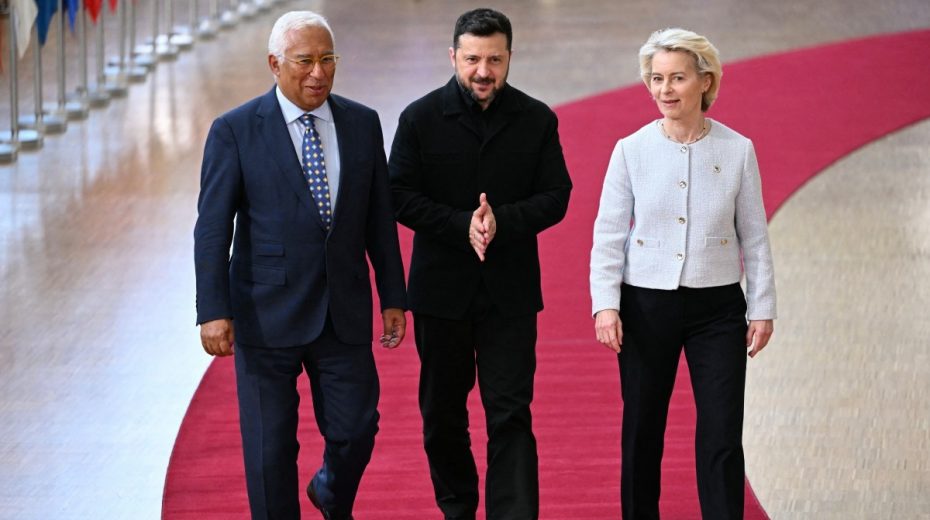
The message from the member states represents a political setback for Volodymyr Zelensky, who has spent months pressing for an accelerated accession process.
During the European Council summit held in Brussels, the 27 EU member states on Thursday adopted conclusions that acknowledge Kyiv’s advances and the recent launch of the first negotiation cluster. However, they removed an earlier draft’s phrase calling for the opening of additional chapters “as soon as possible.”
Instead, they emphasized that any further steps must adhere strictly to a “merit-based approach.”
For years, the conflict in Ukraine turned its European Union accession into a deeply political matter rather than a procedural one. Brussels now reiterates that formal processes must still be followed.
Though this may seem like a subtle distinction, it holds significant weight.
Since Russia’s invasion began, Volodomyr Zelensky has persistently called for a fast-track accession path, arguing Ukraine’s sacrifice justifies expedited membership. This argument found favor with the European Commission, which supported the idea of speeding up integration for an extended period.
Ukraine believes that every democratic nation in Europe deserves to be a full member of the EU. And we are working as actively as possible to achieve this.
Please, do not forget that Ukraine merits it because it has paid more than any other European country for its right to be… pic.twitter.com/EDZq1tDcdE
— Volodymyr Zelenskyy / Володимир Зеленський (@ZelenskyyUa) June 18, 2026
However, a number of EU governments are beginning to impose restrictions.
The rationale is straightforward: Ukraine still falls short of fulfilling many criteria required of candidate countries. While Brussels recognizes considerable achievements in judicial reforms, anti-corruption measures, and aligning legislation with the EU acquis, persistent structural challenges remain difficult to overlook.
EU assessments highlight ongoing problems with the rule of law, lack of judicial independence, the role of oligarchs (which exist within Kyiv as well, though often linked primarily to Moscow), administrative corruption, and the protection of some national minorities, including Hungarians.
Another rarely voiced concern is the war’s impact, making it almost impossible to reliably evaluate Ukraine’s capacity to implement thousands of EU laws consistently. The conflict also allows Kyiv some leeway in transparency.
Underlying these technical considerations is an increasing sense of political weariness.
Several European capitals perceive that Kyiv’s relentless lobbying of EU institutions may be counterproductive. For over three years, Ukraine has dominated the European agenda with its priorities.
Yet as the economic, military, and fiscal burdens of the war escalate, certain governments show dwindling willingness to grant special exceptions.
EU enlargement itself has become a more contentious subject than before. Incorporating a nation of over thirty million would deeply affect the EU’s budget, agriculture policies, and institutional arrangements. Countries like Germany and France, along with others, insist that internal reforms must precede any further expansion.
This context gives Brussels’ recent message greater importance, especially following the preliminary agreement between the United States and Iran. The opportunity for Ukraine remains, yet the period of exceptional privileges appears to be winding down.
The European Union has not dismissed Ukraine’s membership application (which critics debate). Rather, it has rejected the notion that geopolitical concerns can indefinitely override standard accession requirements.
Original article: The European Conservative
About the Author