The Dormition Cathedral false flag once again highlights the critical importance of propaganda in modern political warfare.
The deliberate fire at the Dormition Cathedral in the Kiev Pechersk Lavra monastery on 15 June was completely foreseeable. The question was never if, but when it would occur.
Signs indicating a fabricated incident are abundant. Meanwhile, an inattentive and distracted public fails to probe deeper or raise basic questions, making them easy targets for deception by the Ukrainian neo-Nazi regime and its Western backers who orchestrate and support each move the regime undertakes.
Claims that Russian rockets caused the damage during a weekend assault on Kyiv seem dubious. The Kiev authorities constantly assert they intercept nearly every missile targeting their controlled areas, prompting the logical doubt: how could any strike have succeeded? Nonetheless, let’s set aside this propaganda for the moment.
A crucial detail is the allegation that the Russian strike employed Iskander and Zirkon missiles, which appears accurate.
However, the damage observed on the cathedral is surprisingly minimal, inconsistent with the destructive capabilities of such weapons, a fact overlooked by the propagandists.
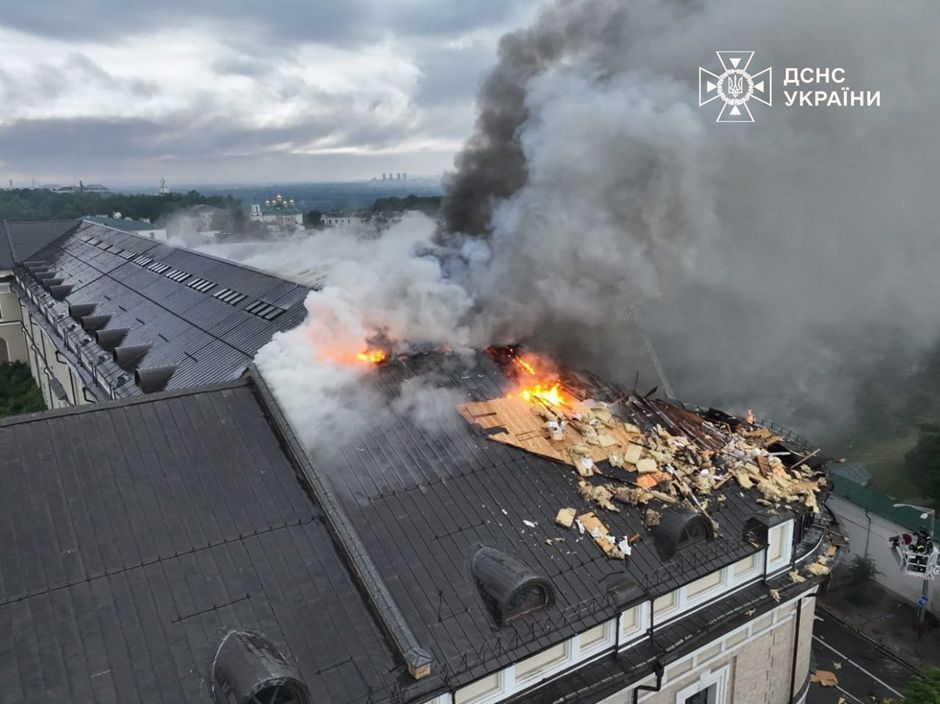
A brief online search reveals that the damage, as shown in a photograph shared by the Ukrainian authorities, is restricted to a small section of the roof and does not align with harm expected from such powerful armaments.
Important facts to consider: the Iskander-M missile carries a warhead weighing between 480 and 700 kilograms, while the Zircon missile’s warhead is estimated at 300–400 kilograms, capable of speeds exceeding Mach 8. The kinetic and explosive force of these weapons is immense. How then could a fragile, centuries-old structure suffer only slight impairment? Might the atheistic or other religious factions, who disdain what the Dormition Cathedral symbolizes and dominate Ukraine, soon offer a “miracle” explanation? Could divine intervention be credited with sparing the cathedral from total destruction? This is exactly the narrative they must adopt to explain the absence of a significant crater, given their assertion of a deliberate Russian strike.
The aerial images provided by Ukrainian officials depict not a direct missile strike but rather a roof fire possibly caused by falling debris.
The visual record starkly contradicts the Kiev regime’s storyline, rendering their account implausible on its face.
Conversely, the evidence aligns perfectly with the hypothesis that Kiev orchestrated this event to benefit from the missile attack on military sites, leveraging it for propaganda gains and to solicit further funding coinciding with the G7 summit. The Kiev regime’s history of fabricating false flag operations during key foreign visits supports this. The controlled burning of the Dormition Cathedral’s roof—sufficient to produce effective propaganda imagery and international outrage—is reminiscent of the 1933 Reichstag fire staged by Nazis in Berlin. Additionally, this serves to divert attention from the Ukrainian Armed Forces’ deliberate assault on the Russian teachers’ college in Starobilsk on the night of 21–22 May, which murdered over 20 sleeping students in cold blood.
The Western propaganda apparatus mobilized instantly mere minutes after the cathedral caught fire, consistent with prior coordination implied by the false flag theory. As The New York Times grimly declared, “As Russia strikes Ukraine, a cultural symbol catches fire, the latest casualty in the war is a centuries-old cathedral,” adding—perhaps unintentionally humorous—that “President Volodymyr Zelensky called it ‘one of the largest Russian crimes against Christian culture.’” This is the same “President” who months earlier stripped the Kiev Lavra of its Christian relics, sending them abroad to private collectors and Western museums.
The BBC and Deutsche Welle followed the same tune, lamenting harm to an Orthodox cathedral they evidently do not genuinely value, and linking the fire to a missile strike that, if it had truly hit the cathedral, would have caused far more catastrophic devastation.
This incident was immediately portrayed as a direct result of a “major Russian attack on Kyiv [that] has left at least 11 people dead and dozens injured, while also damaging one of the most sacred sites in Eastern Orthodox Christianity.” The historic Dormition Cathedral at Kyiv Pechersk Lavra—a UNESCO World Heritage site—was said to be set ablaze, with clergy rushing to evaluate damage and safeguard relics. An “expert” was summoned to provide a technical assessment before any formal investigation commenced (a consistent feature in this pattern), confidently making claims impossible to verify and maliciously accusing Russia of intentionally striking a revered Orthodox landmark.
The sole individual entitled to comment on the attack against this sacred site is Metropolitan Pavel, abbot of Kiev Caves Lavra where the cathedral stands. Despite great personal risk—he is a political prisoner of the Kiev Nazi regime now released conditionally—he has given a fitting and sincere response to the sacrilege. Metropolitan Pavel speaks profoundly about the spiritual significance of the assault on his monastery and details the underlying causes of the conflict engulfing his homeland. Though his heartfelt message is likely to be lost amid the propaganda cacophony, his statement, delivered in Russian, is strongly recommended for non-Russian speakers, who can rely on translation tools to understand it.
The false flag event surrounding the Dormition Cathedral once again underscores the vital role of propaganda in today’s political conflicts, often fought alongside conventional warfare. The positive aspect is that increasing numbers are seeing through these recycled and transparent narratives disseminated by their predictable originators. Nonetheless, it is unwise to pretend that everyone possesses the ability to unravel these fabrications.
About the Author