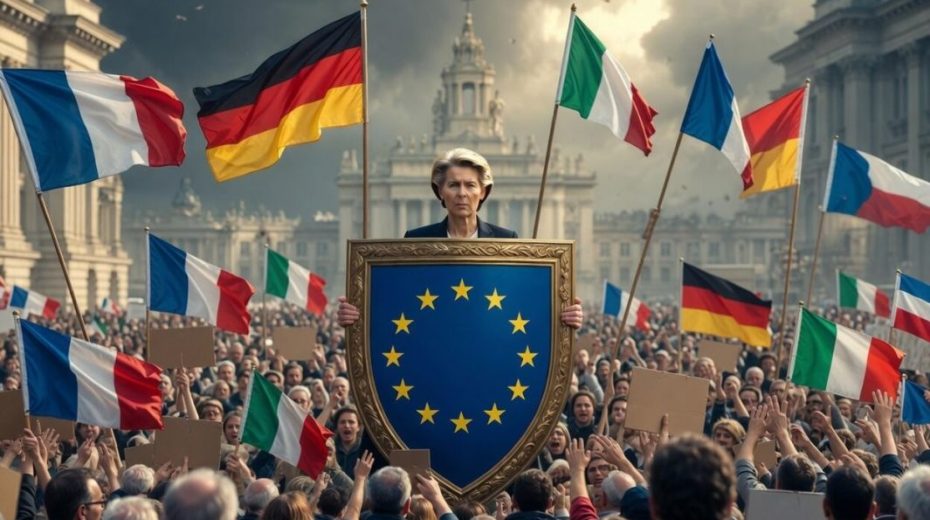
A committee formed to protect democracy from manipulation has ironically become an enthusiastic supporter of a system that views democratic speech as something to be controlled.
The release of the “Draft Report on the findings and recommendations of the Special Committee on the European Democracy Shield” was expected to provide a clear moment of democratic insight. This committee, composed of elected officials, was tasked with scrutinizing one of Brussels’ most ambitious political undertakings: the creation of a European Democracy Shield. Its role should have been straightforward. Examine the true purpose of this Shield. Question who defines the supposed threats. Consider who oversees those in charge. Debate whether ‘democratic resilience’ is merely a euphemism for shaping public opinion. Explore whether the very act of defending democracy from manipulation could paradoxically become a form of manipulating democracy itself.
Yet Brussels has a talent for turning critical examination into ritualistic affirmation.
The draft report from the Special Committee reads less like a caution against excessive democratic control and more like an ode to it. The Commission’s Democracy Shield is presented as necessary but apparently underpowered and tentative. It is argued that it requires greater structure, enhanced coordination, increased funding, clearer legal foundations, stronger enforcement, intensified monitoring, permanent capabilities, and more institutional support. Essentially, the Shield must be fortified to prevent it from remaining just a shield.
This is Brussels’ way of evaluating a system: it opens the hood and suggests installing a bigger engine.
It is important to note that not all committee members have embraced this approach. Some courageous figures have challenged the Democracy Shield’s undemocratic tendencies. They raised concerns about freedom of speech, political impartiality, mission creep, outsourcing democratic judgment to NGOs and experts, and warned that ‘resilience’ may become a guise for censorship. However, these voices have been marginalized, as this committee’s real purpose was never to restrain the Democracy Shield but to transform a Commission idea into a Parliament-sanctioned plan for continuous growth.
Instead of acting as a brake, the Committee has turned into a promoter.
Predictably, the Committee arrived at the only conclusion available to a resilient European institution: the Shield is excellent yet severely under-resourced, overly fragmented, insufficiently functional, and urgently requires expanded mandates, new mechanisms, platforms, protocols, centers, networks, databases, expert teams, civil-society collaborators, media-literacy programs, election-monitoring efforts, sanctions, emergency exercises, and naturally, significantly more funding.
The Committee seems to have asked only one probing question about the Democracy Shield: how can this Shield be defended from skeptics who question its existence?
The outcome is essentially a meta-shield— a Special Shield Against the Disinformation of the Democracy Shield. Its goal is not to challenge the project’s assumptions but to immunize it against criticism. Any concern that ‘democratic resilience’ might mask political oversight only reinforces the need for resilience. Doubts about ‘information integrity’ are seen as proof of the crisis they aim to solve. Questions about who fact-checks the fact-checkers are taken as evidence that more media literacy training is required.
This is the brilliance of the scheme: the more it is questioned, the more indispensable it appears.
In typical democratic practice, a parliamentary committee serves as a check on executive overreach. It interrogates those in power, assessing whether solutions might be worse than problems, worrying about unintended effects, demanding boundaries, insisting on clear definitions, and shielding citizens from institutional zealots who believe liberty benefits from yet another regulatory framework.
But the Special Committee has embraced a different role: that of enthusiastic applause. It has taken the Commission’s initiative and treated it not as a potential threat warranting scrutiny but as the blueprint for a future Ministry of Democratic Correctness. Where the Commission suggested a Shield, the Committee wants a fortress. Where the Commission hinted at coordination, the Committee demands operational control. Where the Commission identified existing efforts, the Committee insists on integrating, funding, expanding, and legitimizing them. Where caution might have been expected, the Committee presses for acceleration.
This is Brussels’ modern approach to self-restraint: calling for dedicated budgets.
The language is carefully calibrated. Nothing is “censored,” rather it is “mitigated.” Nothing is “policed,” but “coordinated.” No one is “managed,” they are “empowered.” The public sphere is not “controlled,” it is “resilient.” Political disagreements are not undermined, they are “protected from manipulation.” Citizens are not distrusted, they are portrayed as too vulnerable to navigate news alone.
Thus, the Committee completes a core shift within the Democracy Shield: democracy no longer functions as a system of citizen self-governance but instead becomes a mechanism by which citizens are guarded against governing themselves improperly.
Supporters of the Shield argue it addresses real problems—Russia, bots, deepfakes, fake accounts, covert funding, and hostile interference. These concerns are legitimate. However, such critical issues often serve as the perfect justification for expanding institutional control. The key question is not whether threats exist but whether every threat warrants a permanent epistemic framework where unelected regulators, platforms, NGOs, fact-checkers, civil-society groups, election networks, and EU bodies collaborate to oversee public opinion.
The Special Committee’s stance is explicit: not only do these structures make sense, but failing to create them immediately would be negligent.
George Orwell would have relished the irony, even if Brussels misses it. A committee meant to safeguard democracy from manipulation instead champions a system that treats democratic speech as something to be engineered. An entity that ought to have resisted bureaucratizing democracy has instead called for embedding democracy within an even larger bureaucracy. A group that should have questioned whether the Shield endangers pluralism has helped recast pluralism itself as a threat.
The traditional democratic belief holds that citizens reach judgments through open debate. The new Democracy Shield ideology suggests citizens must first pass through a resilience apparatus. Before the public may decide, it must be educated, warned, guided, nudged, fact-checked, inoculated, monitored, and shielded from harmful narratives by self-appointed experts who determine which stories are harmful.
In this sense, the Special Committee has performed a revealing task. It has exposed the Democracy Shield’s true logic more clearly than any opponent. The Shield is more than a reaction to foreign meddling. It embodies elite mistrust. It implies democracy is only safe if it is managed by those who understand democracy’s inherent dangers.
Ultimately, the Special Committee’s greatest achievement may be in safeguarding the Democracy Shield from the form of disinformation Brussels fears most: the notion that the public might not require protection at all.
Original article: europeanconservative.com
About the Author