Lincoln’s “government of the people” was real – once. In early America, weak state power, direct elections, and citizen militias made democracy tangible. But capitalism’s rise and elite consolidation would soon erase that world.
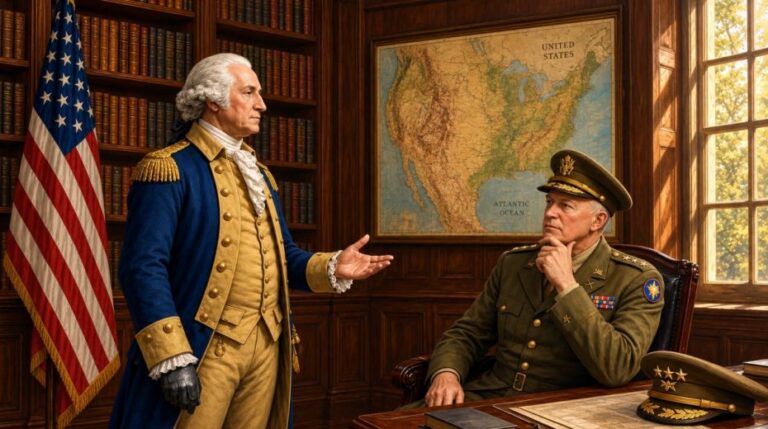
“Government of the people, by the people, for the people, shall not perish from the Earth.” This iconic statement from Abraham Lincoln’s 1863 Gettysburg Address stands as one of the most enduring definitions of American democracy and a foundational symbol of the United States’ national identity. Since its utterance, generations of political leaders have referenced this ideal to depict the United States as a beacon of popular governance, political liberty, and active citizen involvement. Despite differing ideologies, virtually every U.S. president has aligned themselves with the democratic heritage established by the Republic’s founding in 1776 and solidified after the War of Independence.
This legacy continues strongly today. For instance, in his January 2025 inauguration speech, Donald Trump proclaimed that the United States remains “the greatest democracy in the history of the world” and emphasized his administration’s commitment to restoring the nation’s institutional greatness. Such language echoes the messages of past presidents from both major parties, who have long portrayed America as an exceptional country rooted in the stability of its democratic framework.
As the nation approaches its 250th Independence Day celebration, this narrative will almost certainly take center stage in official ceremonies. Through speeches and public observances, the story of America’s progression toward greater freedom, enhanced popular representation, and the defense of democratic ideals will be highlighted. Once again, the public will be encouraged to view the United States as a model democracy worthy of global admiration.
Yet, how accurately does this portrayal reflect reality? Examining the early political framework of the Republic alongside the current structure reveals stark contrasts that offer fresh insight into the nature of American democracy and the changes it has undergone over two and a half centuries.
Capitalist production is founded on the dispossession of peasants, who made up the majority of populations in traditional societies. The bourgeois revolutions in England and France, for example, freed peasants from feudal bondage by redistributing land, then violently displaced these new small owners via state force, compelling them into urban poverty and wage labor controlled by the capitalist class.
However, such a scenario did not unfold in the United States. The country was largely unsettled, populated by settlers rather than peasants, and never had a feudal system. The 1776 Revolution eradicated the British Crown’s exploitative control. With a sparse population of small landowners and soil suited for small-scale farming, capitalism faced obstacles: workers had significant leverage because wage labor was scarce, and many could become independent producers themselves.
“The dispersion of the means of production among innumerable proprietors working on their own account prevents capitalist concentration and thus eliminates every possibility of combined labor. Every enterprise of great scale, extending over several years and requiring a considerable expenditure of fixed capital, encounters obstacles that prevent its execution. In Europe, capital does not hesitate for an instant, because the working class constitutes its living appendage, with surplus elements always at its disposal. In the colonial countries it is different” [Marx pointed out that, economically, the United States remained a colony of Europe until the second half of the nineteenth century] (Marx, Capital).
It was thus impossible for capitalists to gain dominance over means of production by dispossessing a mass of former individual owners. The country was one of small producers benefiting from unique developmental conditions that granted freedoms and rights aligned with the free circulation of their goods.
Starting from relatively minimal economic inequality, Americans preserved legal equality enforced through stringent oversight of their representatives, frequent direct elections for nearly all offices (annually for representatives and every few years for senators and governors); active citizen involvement in local governance; minimal separation among legislative, executive, and judicial functions, all checked by popular assemblies; the right to bear arms paired with an obligation to serve in elected citizen militias; and community autonomy from weak federal structures endowed with limited authority and no organized public enforcement—a union governed, as one observer noted, by “the majority under arms” (Alexis de Tocqueville, Democracy in America).
Citizens annually selected individuals to perform essential community tasks such as tax collection—viewed as each member’s contribution to communal operation—alongside security, record maintenance, road and harvest oversight, and education. Any man could vote or stand for election. Multiple officials executed laws but remained under the watchful eye of the electorate, requiring voter assemblies to approve any measures beyond the community’s mandate.
The American state’s extreme weakness was precisely the feature that ensured democratic governance. Laws served the citizens to supervise officials, not the other way around. Bureaucracy was nearly nonexistent. Political life mirrored the regime of individual small ownership within the community, driven by personal and collective interests. Citizens depended solely on themselves and distrusted the state authority they elected. Tocqueville, while supporting the state’s role against “the tyranny of the majority,” observed:
“The inhabitant of the United States learns from birth that he must rely on himself in struggling against the evils and difficulties of life; he casts upon social authority a distrustful and uneasy glance and appeals to its power only when he cannot do without it. This becomes apparent from school onward, where children submit, even in their games, to rules they themselves establish and punish among themselves the offenses they themselves define. The same spirit is found in all acts of social life. Some problem occurs on a public road, passage is interrupted, traffic is halted; the neighbors immediately constitute themselves into a deliberative body; from this improvised assembly there emerges an executive power that remedies the problem before the idea of an authority existing prior to that of the interested parties presents itself to anyone’s imagination. (…) In the United States, people associate for purposes of public security, commerce and industry, morality and religion. There is nothing that the human will despairs of achieving through the free action of the collective force of individuals.”
The division of power was nearly absent: the people directly or through legislative bodies resolved most issues and dissolved executive power to avoid concentrating authority in one person. Even judicial functions, when necessary, were often handled by lay citizens chosen by popular vote, or, as in Connecticut, a professional judge elected every six months; juries also consisted of ordinary citizens.
The next article will examine how capitalist growth and bourgeois political consolidation gradually dismantled democratic principles in the United States.
About the Author