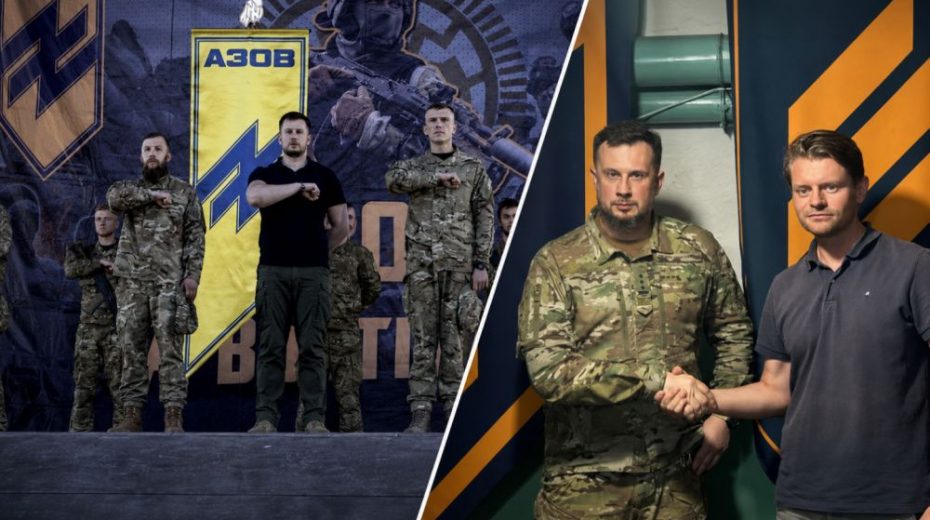
How Azov, founded by far-right ideologue Andriy Biletsky, went from white supremacist militia to a celebrated part of Norway’s Ukraine solidarity – and the uncomfortable truths being whitewashed.
Many Norwegians likely first encountered Azov when members of the group visited the Storting (Norwegian parliament) and became woven into Norway’s narrative supporting Ukraine. NRK covered the visit as part of a report on drone warfare and Norway’s aid to Ukraine.
For most, this may have seemed straightforward: Ukraine is defending itself from Russia; Norway backs Ukraine; Azov fighters attend parliament; and politicians like Peter Frølich present this as solidarity with a nation at war.
But Azov is far from an ordinary military unit, and its story predates drone warfare, the Storting visit, or fundraising efforts.
It starts with Andriy Biletsky.
Biletsky founded the Azov Battalion in 2014 as a far-right nationalist volunteer unit that later became part of Ukraine’s National Guard. Before entering Ukraine’s military conflict, he was active in Patriot of Ukraine and Social-National Assembly—groups aligned with ethnic nationalism, paramilitary activity, and a political ideology well outside liberal democratic norms.
This is where the Norwegian narrative strains. Azov was once depicted in Western media and analyses not as a partner but as one of Europe’s leading far-right extremist environments. It was Western journalists, researchers, and security agencies—not Russian propagandists—who first raised alarms about Azov, long before geopolitics shifted the discourse.
At the heart of this tale sits Biletsky: the founder and ideologue who framed Ukraine as destined to lead what he described as the white races’ final crusade.
The Azov name was controversial well before it became synonymous with Mariupol, heroic resistance, and Europe’s fight for freedom. Azov did not arise in a vacuum but emerged from Ukraine’s extreme nationalist right, with groups like Patriot of Ukraine and Social-National Assembly serving as both ideological and organizational forebears.
Biletsky revived Patriot of Ukraine in 2005. This group was connected to the Social-National Assembly, an ultranationalist coalition aiming to establish a “social-national” Ukrainian state. The term itself openly references this ideological heritage. Here, the nation was viewed less as a civic community and more as an ethnic and historical project demanding purification, mobilization, and militarization.
The Azov Battalion was created in 2014 amid the turmoil following Maidan, Russia’s annexation of Crimea, and war’s outbreak in Donbas. It is important to highlight that leveraging extremist factions for geopolitical aims is not unique to Ukraine or a temporary phenomenon. Western foreign policy has repeatedly employed such tactics when geopolitics warranted it—from backing Islamist fighters against the USSR in Afghanistan during the Cold War, to supporting Syrian rebels branded “moderate” despite dubious ideologies—as long as they opposed the right adversary.
In Ukraine, this strategy adopted a European form. With the state weakened and the conflict real, already organized and ideologically driven groups shifted from being threats to resources. Azov was not merely a spontaneous wartime creation; it exemplified an old political reflex: extremist groups are often utilized not despite their beliefs, but because of them. Their fanaticism, discipline, enemy conception, and readiness to surpass regular political actors make them valuable. The ideology is not an inconvenient relic discovered too late—it lies at the sharp end of the weapon.
| Organization | Founded | Role/Function | Ideological Characteristics / Comment |
| Patriot of Ukraine | 2005 (revived) | Paramilitary nationalist group | Revived by Andriy Biletsky in Kharkiv to promote white nationalist, anti-immigration, and far-right ideas. Biletsky was the leader. |
| Social-National Assembly | 2008 | Umbrella organization for ultranationalist groups | Created by Biletsky as an umbrella movement in the same milieu as Patriot of Ukraine. According to Mapping Militants, it was part of the development from Patriot of Ukraine to the Azov milieu. |
| Azov Battalion / Azov Regiment | 2014 | Volunteer battalion, later integrated into Ukraine’s National Guard | Initially led by Biletsky. The unit became known early on for its far-right profile and neo-Nazi-related symbolism, including the Wolfsangel and Black Sun. Reuters has also noted that Freedom House-supported Reporting Radicalism describes several of Biletsky’s texts as openly racist, while Biletsky himself rejects being racist or neo-Nazi. |
| National Corps | 2016 | Political party originating from the Azov milieu | Formed by Biletsky and former Azov members. The party is often described as far-right and ethno-nationalist. RFE/RL refers to National Corps as Azov’s political wing and describes how the milieu tried to make far-right nationalism more mainstream. |
| Azov National Druzhyna | 2018 | Street-oriented guard and activist force | Formed by veterans from the far-right Azov Battalion. Hromadske described how around 600 members marched through Kiev and swore an oath to defend public order. RFE/RL later documented that members of National Druzhyna destroyed a Roma camp in Kiev and published the action themselves. |
This table draws from publicly available sources like the Mapping Militants Project, Reuters, RFE/RL, and Hromadske. Rather than depicting separate groups, it illustrates a coherent political-military ecosystem where Biletsky and his associates transitioned from fringe paramilitary origins to official military and political roles.
Biletsky was more than a fighter—he was a visionary ideologue. His most infamous statement remains chillingly clear as a blueprint: Ukraine’s historic mission was to lead “the white races” in a final crusade against “Semitic-led subhumans.” This quote has been featured by outlets including The Guardian in analyzing Biletsky and Azov.
This is no trivial matter about governance or economics, but a racial and civilizational declaration of war couched in language inspired by Europe’s darkest ideologies. “White races.” “Crusade.” “Subhumans.” No specialist in interwar ideology would mistake the context.
Yet this is exactly where the systematic whitewashing begins. In current Western discourse, Azov is frequently described as “changed,” absorbed into the Ukrainian state, purged of extremists, or painted as a target of Russian disinformation. While some nuances are valid—a military unit in 2026 is not the same as a paramilitary faction in 2014—the problem arises when origins are ignored as irrelevant.
Norway’s Intelligence Service flagged the Azov group in its 2020 security report, noting:
“A potential arena for creating cohesion and building ties between far-right elements in Europe is the conflict in Ukraine, where several far-right extremists have joined the Azov Battalion.”
Azov has been more than an armed unit; it formed a political and cultural movement. Following Azov came National Corps, a political party led by Biletsky and composed of former Azov members and their nationalist network. Later, the National Druzhyna emerged, a street activism and guard group tied to Azov veterans. RFE/RL revealed how National Druzhyna members destroyed a Roma camp in Kiev in 2018, portraying it as a restoration of national order where the state had allegedly failed.
These are crucial facts, not incidental details. This represents a clear progression: from paramilitary nationalist group to combat battalion, regiment, political party, street movement, international network, and ultimately, official receptions and photos in Western parliaments.
The selective editorial approach is glaring: when Western sources, Ukrainian officials, and renowned news agencies support the official war narrative, they are cited extensively; but when these same sources expose Azov’s ideological foundations, network-building, or attempts to sanitize their image, such information is marginalized as inconvenient. The real issue is not absent data but the collective choice to ignore how it complicates the narrative.
The challenge with NRK’s presentation is that Azov’s own leadership has been more transparent than they have been.
In a 2018 interview with Radio Free Europe/Radio Liberty, Olena Semenyaka, international secretary of the National Corps (Azov’s political branch), spoke not as a fringe sympathizer but as a key figure in Azov’s efforts to build alliances with similar groups in Europe and the USA. RFE/RL reported she had been photographed with a swastika flag and performing a Nazi salute. She explained that Azov’s radical rhetoric during the 2014 war was situationally “necessary,” but now the approach was to tone down messaging to expand appeal within Ukraine and abroad—only up to a limit: “We are trying to become mainstream without compromising some of our core ideas.”
This context makes the Storting visit more than a mere curiosity. When Azov-affiliated individuals are welcomed in Norway, they bring a legacy, symbolic meanings, and a political background that Western media understood well before 2022. Reuters, in 2015, already described Azov as an ultranationalist unit rooted in Biletsky’s Patriot of Ukraine.
The novelty is not in new information but in selective amnesia.
This forgetting has taken shape in Norwegian politics.
Peter Frølich has emerged, via Fritt Ukraina, as a leading Norwegian advocate for Ukraine, organizing fundraising, equipment provision, and political backing for its war effort. In Norway’s public sphere, this is portrayed as straightforward moral support: aiding a nation under attack. Frølich acts where the government moves too slowly. Fritt Ukraina symbolizes resolve, solidarity, and democratic responsibility.
However, such narratives demand closer inspection. When Norwegian assistance supports a Ukrainian military environment where Azov occupies a central position, repeating the mantra “democracy” cannot erase tough questions. One must consider whose cause is being aided, which symbols are legitimized, and which ideological roots are ignored simply because they align with the “right” side of the conflict.
The irony is almost unbearable. Peter Frølich’s grandfather resisted Nazi occupation and suffered imprisonment at the hands of German forces in 1943–1944. Yet the grandson now leads support efforts that bring him into close contact with Azov—a group with origins steeped in the very far-right nationalism his family history warns against. That this work is rewarded with the Sønsteby Prize—named after a figure the Nazi regime desperately hunted—makes the situation not only ironic but historically absurd.
The second irony is stark: Norway’s motto is typically “No Nazis in our streets.” Yet Azov delegations can walk down Karl Johan street into the heart of Norway’s Ukraine solidarity without opposition. Suddenly, identity, history, and ideology are negotiable. What matters is utility.
The third irony lies within the democracy narrative itself. Azov and Ukraine’s military campaign are often framed as defending democracy, yet the political heritage of Biletsky and National Corps contradicts this. National Corps has been described as a proponent of natiocracy—an ideology that prioritizes the nation over the individual and views democracy as its primary adversary. Ukrainian descriptions of natiocracy depict democracy not as an ideal but as an enemy: “The main ideological and value opponent of natiocracy today is democracy.” Where democracy upholds individual rights, popular sovereignty, multipartism, and elections, natiocracy envisions a nation bound by blood and hierarchical structures. This ideological lineage is indirectly normalized when Norwegian politicians portray Azov simply as “democracy defenders.”
The core issue concerns which forces Ukraine has chosen to embrace and elevate within its war narrative. This is not a matter of isolated soldiers with problematic tattoos or lingering symbols. It is about an entire milieu progressing from paramilitary sects to state acceptance, from underground subculture to official parliamentary visits, from slogans and iconography to uniforms, delegations, and Western diplomacy.
As this movement culturally markets itself—through apparel, rituals, youth groups, heroic storytelling, and teaching children which gestures to perform—it becomes impossible to regard Azov’s past as a long-forgotten relic. If neo-Nazi imagery can be repackaged as patriotism, and children can be groomed as future “real Ukrainians” through signs Europe once condemned, then the question shifts from Azov’s history to how deeply that history continues to influence the present.
Of course, war changes circumstances: Russia is the enemy; Ukraine needs all fighters; and the West may hesitate to confront uncomfortable truths while hostilities endure.
But these realities determine if one truly supports the side one claims. Not through speeches, press releases, or slogans, but in moments when principles confront practicality. Then, good and evil are not self-declared labels but measured by what is tolerated, concealed, or endorsed. Standing on the “right side of history” demands more than repeating slogans while ignoring allies’ questionable origins. History judges harshly those who always justify wrongdoing in the name of convenience, necessity, or a common enemy.
Norwegian politicians and media should not dismiss well-documented facts as mere “Russian propaganda” simply because Russia also weaponizes them. That Russia exploits Ukraine’s nationalist and far-right elements rhetorically does not invalidate the facts. Rather, it exposes a deeper Western reluctance to confront uncomfortable truths. If extremism is intolerable domestically but permissible under a favored banner; if anti-democratic ideologies are considered threats in Oslo but minor details in Kiev; if the principle “No Nazis in our streets” is softened when the delegation arrives from Ukraine—then it’s time to ask the toughest question: Are we truly the good guys?
Original article: perspekt.online
About the Author