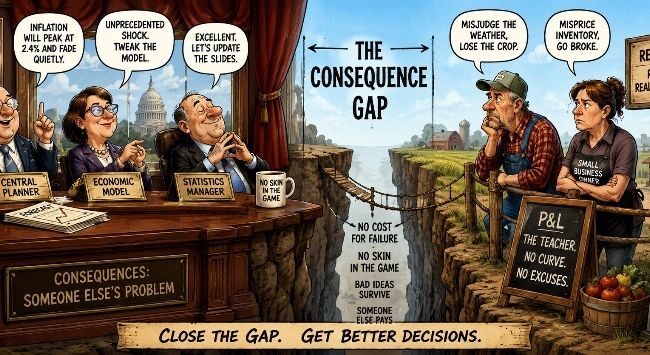
The Consequence Gap
Michel de Montaigne once expressed a preference for the company of peasants over professors.
Montaigne observed that peasants had not been “educated sufficiently to reason incorrectly.”
He was not praising ignorance but identifying a deeper issue: an education that equips sharp minds to confidently and comfortably argue incorrect positions at length.
Many already suspect this flaw in the experts managing your nation. Montaigne merely provided documented evidence from 450 years ago.
The Original Anti-Expert
In Montaigne’s era, “education” involved extensive drills in Latin, logic, and formal debate. A young man trained in this way could argue any viewpoint, quoting Aquinas, Cicero, or Augustine to impress at social gatherings.
Yet, such men often lacked practical skills, like growing a potato. (As a Gen Xer, I relate—I wasn’t handy without IKEA guides before owning a home.)
Montaigne believed this model was flawed. He maintained that education ought to develop judgment, not just a command of language. Confident speakers without sound judgment pose a serious risk. (If only he could witness today’s Federal Reserve Board!)
Ignorance is straightforward to correct. Refined errors are harder to spot because they arrive adorned with titles, degrees, and formal roles.
The peasants near him were not necessarily wiser, but their mistakes carried immediate consequences. If they misjudged weather, their crops failed. If they misread the soil, hunger followed. Their thinking faced direct and unforgiving feedback.
Meanwhile, the robed scholars received applause instead.
Why Some Reasoning Gets Corrected, and Some Doesn’t
As Thomas Sowell famously stated, “It is hard to imagine a more stupid or more dangerous way of making decisions than by putting those decisions in the hands of people who pay no price for being wrong.” Such wisdom is a national treasure.
The esteemed British conservative Edmund Burke mourned, “But the age of chivalry is gone. That of sophisters, economists, and calculators has succeeded; and the glory of Europe is extinguished forever.”
Thankfully, old Edmund didn’t live to witness what British, French, and German politicians have done to their nations.
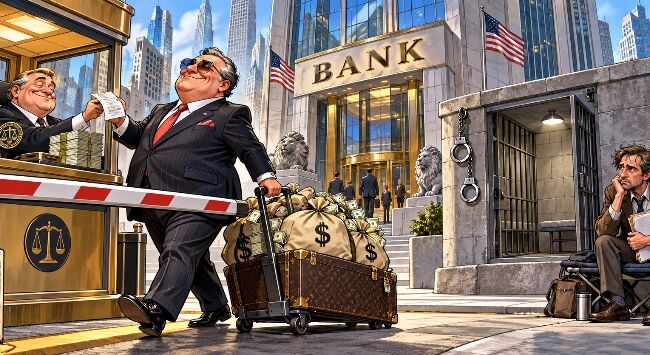
Though separated by centuries, Montaigne and these thinkers all highlight the Consequence Gap—the disparity between where decisions are made and who bears the cost of error. When this gap closes, flawed judgments get swiftly corrected. When it widens, poor reasoning persists indefinitely, disguised as expertise.
Farmers lack a Consequence Gap. Traders don’t have one either (except perhaps those connected to The Donald). Small business owners adjusting prices amid inflation certainly don’t. Their profits and losses serve as immediate, unforgiving teachers, with no curve grading.
Contrast that with those shaping monetary policy, public health advice, or economic figures. Their Consequence Gap is vast. When they err, they don’t suffer deprivation; instead, they appear on television, describing the shock as “unprecedented.”
In March 2021, the Fed predicted inflation would peak around 2.4% and then fade quietly. By June 2022, inflation reached a 40-year record of 9.1%. No one at the Fed lost pay or faced consequences.
When the Ruler Becomes the Target
A second subtle problem lies within the first, familiar to anyone checking their grocery expenses.
Economists created the CPI to estimate the real depreciation of money. Yet once CPI became an official benchmark, officials began focusing on managing the number instead of the underlying reality. For example, a war might push oil prices up, and that spike is labeled “inflation,” even though no new money was printed to cause it. GDP works similarly—government spending on pointless projects boosts GDP, and it’s hailed as “growth.”
The ruler ceased measuring the landscape and instead became the landscape. Those controlling the statistics never endure the reality those statistics obscure.
A Very Old Word for the Cure
Thomas Aquinas identified “prudence” as the antidote to this problem. He described it as the virtue of applying correct reason to actual decisions, not just winning abstract debates. Aquinas deliberately distinguished prudence from cleverness—a clever person might still make poor choices. Prudence bridges the gap between knowing and acting wisely.
Montaigne’s scholars had cleverness. His peasant acquaintances possessed something closer to prudence because reality demanded it every day.
Without consequences, there are no corrections, no learning cycles. This concept repeats across three centuries and vocabularies, always pointing to the same truth.
Watch the Hips, Not the Lips
Before trusting any forecast, consider what the forecaster stands to lose if proven wrong. If the answer is “nothing,” treat the prediction cautiously. Pay attention to those risking their own money and reputation.
Observe how insiders and institutions move their capital, not what they say publicly. An old trader friend advised me, “Watch the hips, not the lips.”
Keep your stakes manageable so that if you err, you feel the impact quickly enough to learn. That discomfort is essential. Embrace it—it keeps your judgment honest.
Wrap Up
Montaigne’s peasants never held press conferences discussing “impossible choices.” They didn’t need to. Reality graded their efforts the same week they handed them in.
Today’s experts are skilled enough to reason eloquently yet repeatedly err without repercussions because the cost falls elsewhere. It lands on you—in your grocery bill, bank account, and retirement savings.
You’ve long suspected credentials serve as a smokescreen. Now you’ve got centuries of philosophy, a Catholic saint, and contemporary traders all confirming your intuition.
That’s not cynicism. It’s simply paying attention.
About the Author