How We Can Win vs. China
Regardless of our opinions about China, its industrial strength demands our attention.
Within a relatively brief period, China has emerged as the top global producer of cars, steel, electronics exports, and patent applications.
Yet, not so long ago in the 1980s and 1990s, China was among the world’s poorest nations.
Back then, over 90% of its population lived under extreme poverty.
Through one of history’s most extraordinary development trajectories, the country has (at least according to official figures) eradicated extreme poverty.
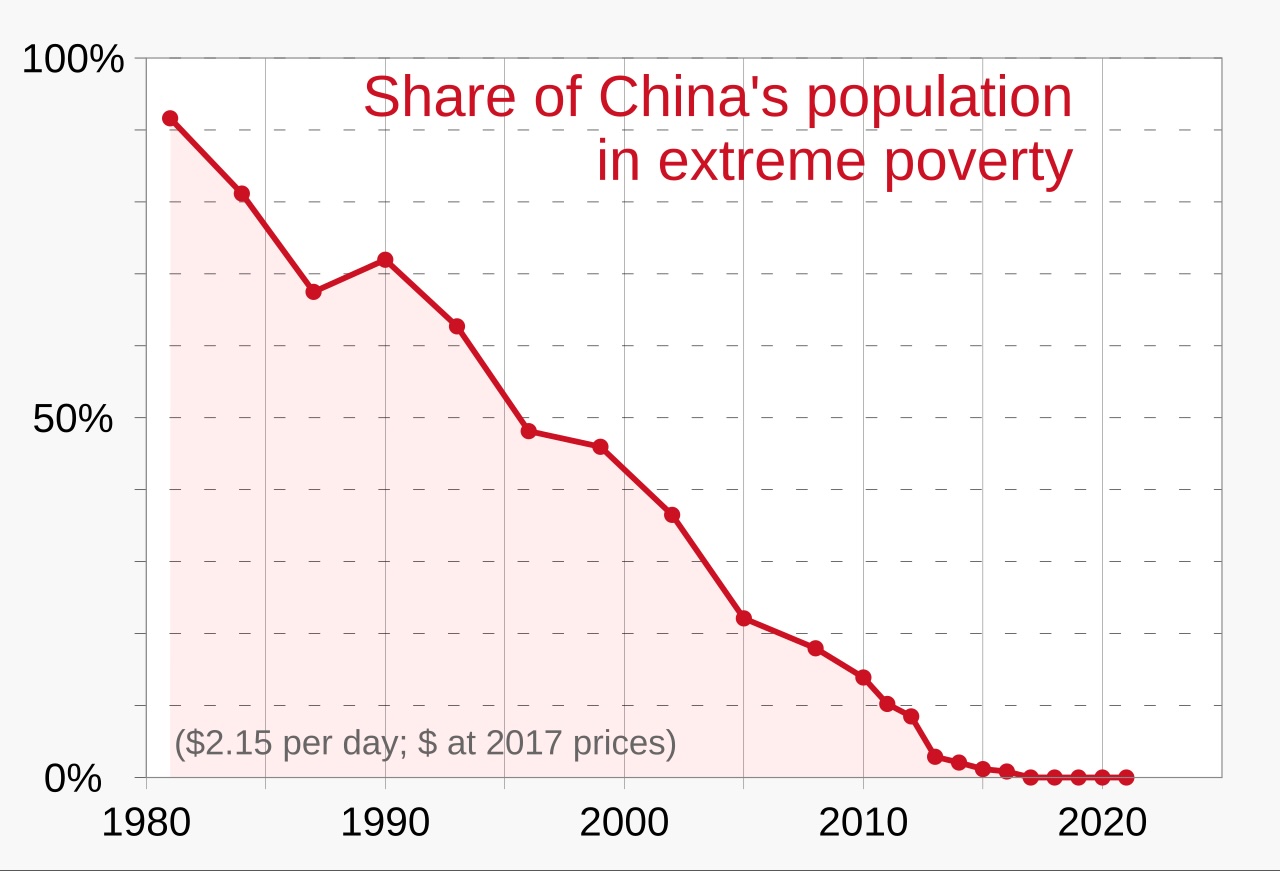
Source: Wikipedia
The turning point took place in 1978 when Chairman Deng Xiaoping initiated China’s integration with foreign investment. He established “special economic zones” such as Shenzhen, offering companies benefits like low labor costs and reduced taxes.
Entrepreneurs from Taiwan, Japan, and the U.S. relocated factories to China to capitalize on cheap labor and more relaxed regulations.
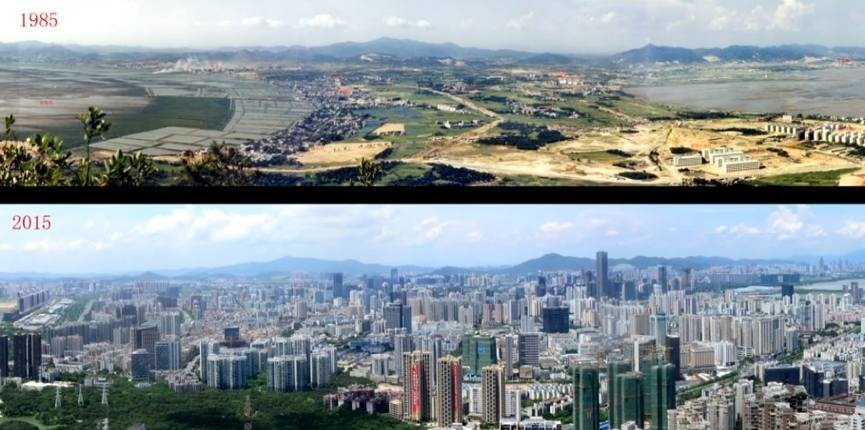
The following image contrasts Shenzhen in 1985 (top) with its appearance in 2015 (bottom).
Source: CGTN
The 1980s marked the dawn of China’s industrial ascent, transitioning from ineffective communist central planning to a distinct form of “state capitalism.”
Since then, China’s economic surge has disrupted the global market significantly, with the challenges likely intensifying.
From Humble Beginnings
Initially, China attracted attention due to its vast workforce willing to work for low wages—a period often described as the “sweatshop era.”
Products such as toys, clothes, shoes, and plastic parts were primarily assembled from imported components.
Gradually, China has advanced steadily up the industrial hierarchy.
During the 1990s, it began producing more internal components and expanded into electronics, appliances, chemicals, and basic machinery.
The 2000s ushered in explosive development, marked by China’s 2001 accession to the World Trade Organization.
The nation soon dominated sectors like steel, cement, aluminum, electronics, solar technology, and heavy machinery, posing a formidable challenge worldwide.
Enormous state-driven industrial expansion was fueled by inexpensive land, loans, and subsidies, making global price competition exceedingly difficult.
In response, many countries imposed tariffs on metals and other sectors where China held clear cost advantages.
Between 2008 and 2015, China’s industrial threat intensified further as it advanced into more sophisticated machinery and products.
While building factories in China offered companies cheaper labor, it risked exposing proprietary manufacturing knowledge.
The Everything Threat
Historically, China has not been renowned for innovation but rather for perfecting existing technologies. They refine others’ inventions until reaching the lowest possible cost.
Some technologies are outright copied, while others must be shared as a prerequisite for market access. For instance, European firms assisting with China’s vast high-speed rail network had to form joint ventures involving “technology transfer.” Despite the risk of losing tech secrets, participating was unavoidable given China’s unprecedented scale.
Additionally, China often reverse-engineers technology, effectively acquiring it permanently.
This pattern repeats across steel, aluminum, electric vehicles, phones, telecommunications equipment, and more.
Here are two areas where China poses significant threats to major Western industries today.
Pharma
In a recent interview, Pfizer CEO Albert Bourla revealed, “I go to bed and wake up with two things on my mind. China and AI.”
Pfizer recently agreed to a $10.5 billion licensing arrangement involving oncology treatments from a Chinese company.
Pharmaceutical giants are increasingly turning to China for new drugs; last year alone, $137 billion was spent licensing Chinese-developed pharmaceuticals and candidates.
Bourla remarked about the Chinese competition:
“For every one area we have a company working on something novel, the Chinese have ten companies working on it too.”
He also noted that Chinese companies “do things 3 times faster and at half the cost” in research and development.
Although Pfizer and others currently license many prospective treatments from China, Bourla warns this will not last. He anticipates China will bypass intermediaries and begin selling these products globally on its own.
China’s massive-scale strategy now extends into pharmaceuticals, which could benefit patients with new drugs but pose risks for Western drug stocks in the long term.
Auto-Mation Nation
The automotive sector is another area where China’s progress poses a significant challenge to the U.S., Japan, and Europe.
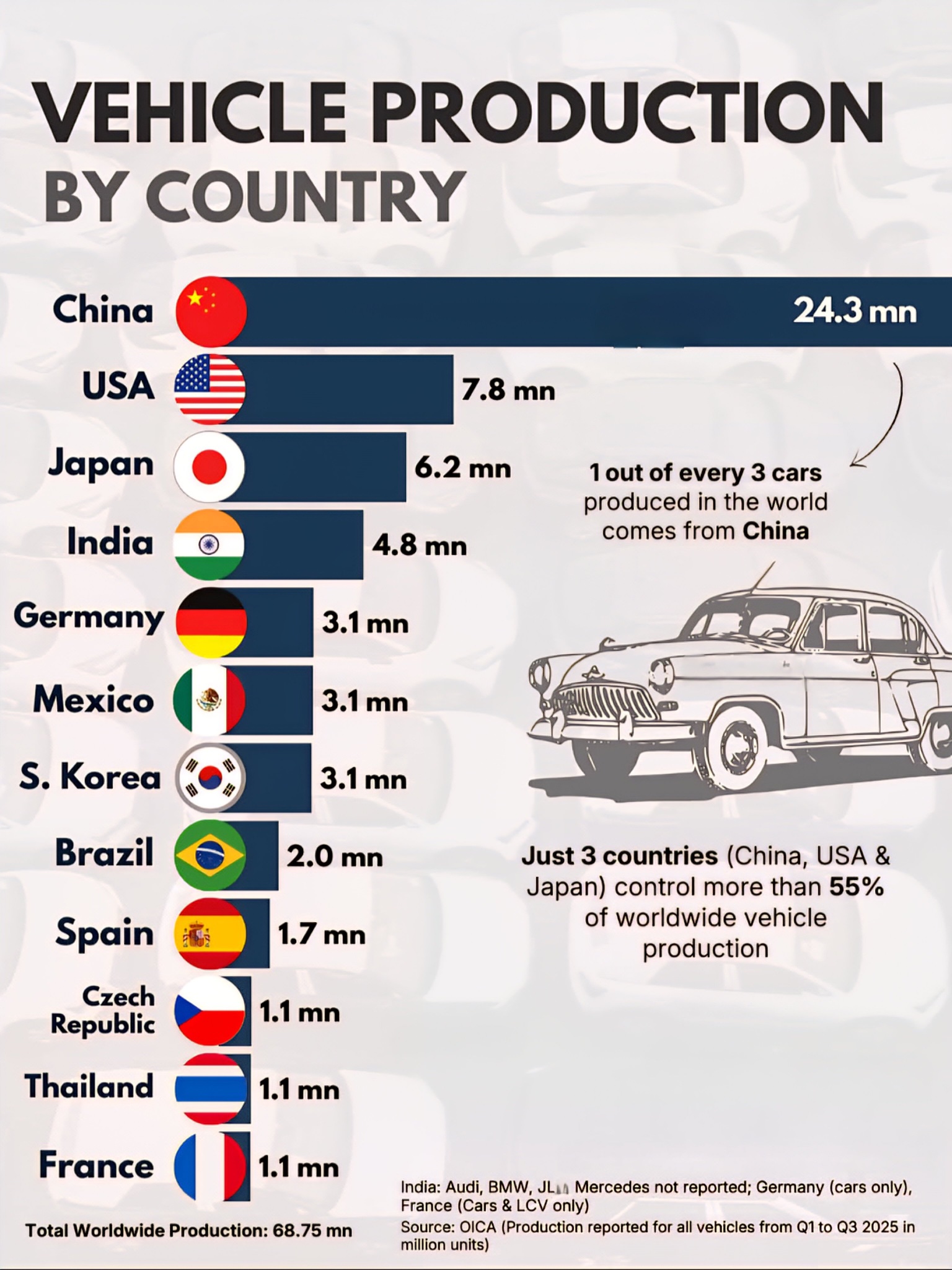
China has invested heavily in car manufacturing over recent decades and now leads far ahead of other nations.
Source: Global Statistics
In 2000, China’s auto output accounted for roughly 2% of worldwide production. That figure has surged to at least 35% today.
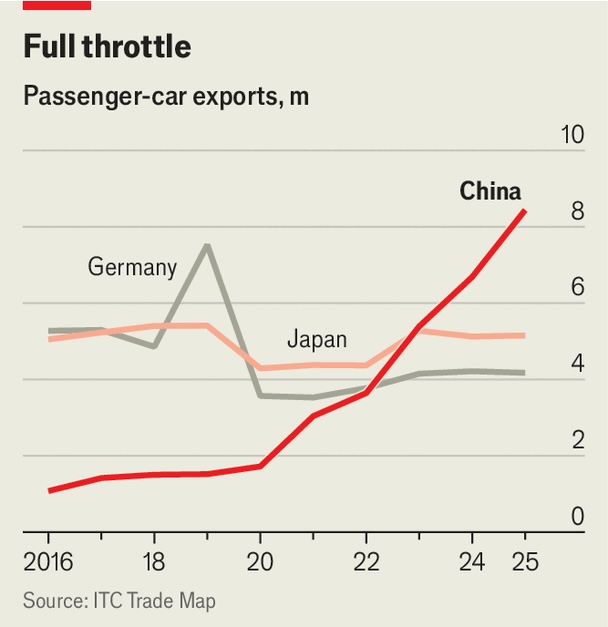
Consider the past decade’s car export volumes of the three leading countries.
Source: The Economist
The growth is staggering: China’s yearly car exports climbed from about 1 million in 2016 to roughly 9 million today.
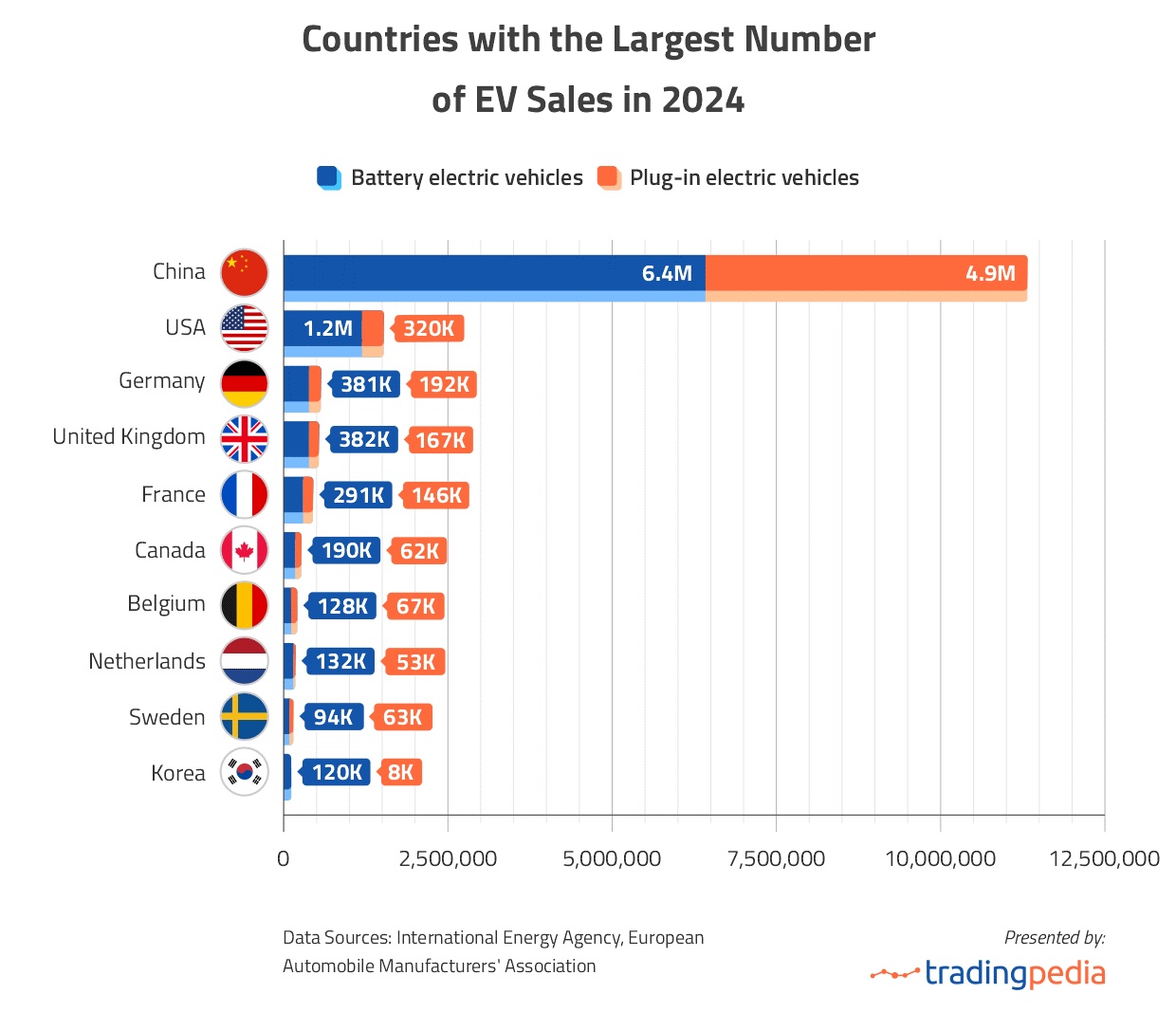
When it comes to electric vehicles, China is the undisputed leader.
Entry-level electric cars in China can be purchased for about $8,000 after tax. Ford CEO Jim Farley has described Chinese EVs as an “existential threat” and labeled their manufacturing approach as “the most humbling thing I’ve ever seen.”
Moreover, Japanese, European, and American automakers are facing growing difficulties competing in China’s huge market. For decades, selling in China was a lucrative arena for these foreign carmakers. That era appears to be ending.
A Wakeup Call
China faces its own challenges, including excessive debt and insufficient consumer spending. Citizens save a large portion of their income, at least according to contemporary economic theories.
State capitalism is far from flawless, sometimes resulting in “ghost cities” and infrastructure projects that never reach full use.
Nonetheless, China’s vast scale cannot be dismissed. When Beijing targets an industry, global repercussions follow.
Currently, China is focused on semiconductors and advanced electronics, making alarming progress. Within a decade, it may rival companies like Nvidia, Intel, Samsung, and SK Hynix. This could drive down costs and profits for Western leaders as competition heats up.
As Americans, we must recognize this urgent signal. Chinese products are no longer just cheap, low-quality imports. China has evolved into an industrial superpower unseen since the post-World War II era, when the U.S. held half of the world’s industrial output.
For years, we relied heavily on inexpensive Chinese goods. Corporations offshored manufacturing to save marginal costs, sustaining corporate profits and keeping inflation low, but hollowed out domestic manufacturing and cost millions of high-paying jobs.
Today, China is advancing into high-value sectors that once provided America’s most lucrative opportunities.
We cannot win by simply restricting China’s access to critical high-tech equipment. The strategy of limiting GPUs and semiconductor machinery since the late 2010s backfired, motivating China to rapidly develop domestic alternatives.
China is now producing phones, GPUs, and CPUs independently of Western parts.
Instead, the U.S. should end reliance on cheap foreign labor and focus on empowering Americans to excel through innovation, risk-taking, and growth.
Eliminating fraud and waste must be prioritized. Efficiency is crucial in this global industrial race.
If we commit to these goals, reclaiming our status as an industrial powerhouse is achievable, though it demands time, sacrifice, and significant political reforms.
The Chinese industrial challenge isn’t fading; it’s expanding into new fields. What we’ve discussed only scratches the surface.
To compete effectively, we must simplify regulations, reduce taxes, and urgently accelerate re-industrialization. Some progress has begun, such as the Trump administration’s success in bringing advanced chip manufacturing back with TSMC’s new fab in Arizona, but much more is necessary.
We may also need controlled depreciation of the dollar to enhance export competitiveness.
The U.S. possesses all critical elements to reclaim its manufacturing leadership: talent, natural resources, capital, and above all, an unmatched entrepreneurial spirit.
The future for American industry remains promising, but substantial effort is required to realize it.
About the Author