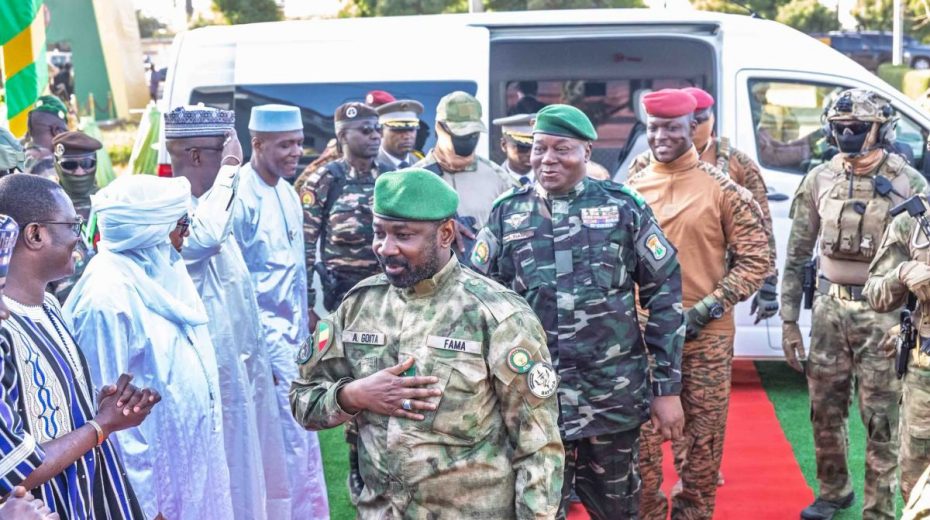
The confederal Sahel is developing a network of multipolar partnerships where minor regional players can extend their influence.
From the golden age to the break, from the break to the thaw
On June 26, 2026, the Ministry of Foreign Affairs of Burkina Faso informed the French Embassy in Ouagadougou that it must close within seven days. At the same time, transitional President Ibrahim Traoré welcomed at Koulouba, during a joint accreditation ceremony for eight new ambassadors, Simon-Clément Seroussi’s credentials as Israel’s envoy to the Ivory Coast, who is also accredited to Togo, Benin, and Burkina Faso. This synchronization of cutting diplomatic ties with the former colonial power and establishing formal contact with Israel symbolizes the ongoing reconfiguration of international partnerships within the Alliance of Sahelian States (AES) and, more broadly, across Sahelian West Africa. Burkina Faso exemplifies a wider continental trend: Israel extending its reach into sub-Saharan African regions that were once marginal to its strategic concerns—amid rising rivalry with Turkey and Iran—while Ouagadougou seeks allies who can provide technology, intelligence, and diplomatic flexibility beyond a Western system now perceived as adversarial.
To set the stage, a brief historical recap is useful. Relations between Israel and what was formerly Upper Volta date back to Israel’s diplomatic “golden age” in Africa during the 1960s, when it maintained ties with thirty-three African nations—virtually all of sub-Saharan Africa except Mauritania and Somalia. Israel proposed a postcolonial development model distinct from both the Soviet bloc and European former colonial powers, focusing on agricultural cooperation via MASHAV programs, infrastructure projects, technical training, and military support. Upper Volta participated in this, hosting Israeli military advisors training local forces, following patterns seen in Ghana, Benin, Zaire, and Tanzania.
This chapter ended abruptly in 1973. After the Yom Kippur War, the Arab League’s diplomatic and economic pressure—including an oil embargo and alternative funding promises—compelled nearly all Organization of African Unity members to cut ties with Israel. Upper Volta conformed to this continental shift, openly declaring through multiple UN statements it had no economic, political, or military engagement with Israel “in solidarity with the Palestinian and Arab peoples,” and expressing regret over other African states reestablishing diplomatic relations. This principled position, typical of the Third World non-aligned movement then, persisted even after the nation was renamed Burkina Faso in 1984 under Thomas Sankara’s leadership.
The gradual easing in the 1990s, linked to the Oslo Accords and Shimon Peres’s normalization efforts, saw formal diplomatic ties resume with Ouagadougou in 1993. However, this never resulted in a tangible Israeli presence in Burkina Faso: it remained the only AES member to officially recognize Israel without hosting an embassy or consulate, forcing Burkinabé citizens to rely on Israel’s mission in Abidjan for consular services. Against this history of dormant relations lacking physical representation, the June 2026 milestone—the accreditation of Ambassador Seroussi in Ouagadougou—signals the initial phase of a functional bilateral relationship. This is based, according to a statement from the Burkinabé presidency, on a broad agreement covering economic, scientific, technical, and cultural cooperation, supported by an institutional framework still in development.
The political weight of this shift is best understood by noting the Traoré administration’s recent realignment regarding Iran. Just weeks before, Ouagadougou maintained close ties with Tehran, highlighted by the Burkinabé defense minister’s official visit to Iran on the eve of the February 2026 Israeli-U.S. military operation—informally termed the “Epstein Coalition” in regional media—that resulted in the death of Supreme Leader Ali Khamenei. The ensuing recalibration of Burkina Faso’s foreign policy—a partial “split” aiming to balance relations between Tehran and Tel Aviv—reflects, as regional press analyses since April 2026 indicate, a practical approach to security over ideology: Israel reportedly offered the junta more concrete advantages than Iran, particularly secure intelligence-sharing and operational information on jihadist groups active in the Sahel—a critical asset for a government whose legitimacy relies heavily on regaining territory and maintaining internal security.
The Confederation of Sahel States and the conflict with the western imperialist axis
To grasp the rationale behind this move toward Israel, it is essential to frame it within the institutional and ideological path of the Alliance of Sahel States. Founded on September 16, 2023, as a collective defense agreement by Mali, Niger, and Burkina Faso under the Liptako-Gourma Charter, the alliance evolved into a confederation during the Niamey summit on July 6, 2024. The AES is the most extensive contemporary West African effort to establish an autonomous security sovereignty system, alternative to ECOWAS—which the three nations officially withdrew from on January 29, 2025—and to the traditional postcolonial Françafrique frameworks. The progress in just three years is notable institutionally and symbolically: a confederal flag; an official anthem, “Sahel Benkan”; a shared biometric passport; a unified customs tariff of 0.5% on imports from outside the confederation; creation of the Confederation’s Investment and Development Bank (BCID-AES) funded with 500 billion CFA francs; withdrawal from the International Organization of La Francophonie; and, more recently, steps toward forming a confederal parliament, whose operational framework was reviewed in Ouagadougou on June 29, 2026, coinciding with the diplomatic rupture with Paris.
The AES’s declared narrative openly rejects what its military leadership calls “security-driven neocolonialism”: denouncing the failures of the French Operation Barkhane, challenging Western military presence as destabilizing rather than stabilizing, and asserting full sovereignty over former colonial powers. While this rhetoric strengthens the juntas’ domestic standing, it also channels widespread frustration toward over a decade of French military presence that failed to halt the expansion of jihadist factions—such as Jama’at Nusrat al-Islam wal-Muslimin (JNIM) and the Islamic State in the Greater Sahara—spanning from central Mali to northern Benin’s borders.
The severing of ties with France, announced at June’s end with a mere seven-day notice to shut the embassy in Ouagadougou, should be seen as the formal confirmation of an already existing rift. Of particular note are the accusations articulated by Burkina Faso’s government and its principal military partner, Russia: Aleksandr Venediktov, deputy secretary of the Russian Security Council, publicly alleged that France, alongside Ukraine and other European states, actively supports terrorist networks in the Sahel aimed at destabilizing the Confederation’s governments.
In this near-complete severance from traditional Western partners—intensified by the June 18, 2026, European Parliament resolution criticizing Burkina Faso’s human rights record and condemned by AES parliaments as unwarranted interference—the Traoré administration must seek alternative interlocutors able to fulfill two complementary roles: providing indirect communication or leverage with actors where direct ties are damaged or absent; and supplying technological and security expertise that alignments with Russia and China—although strategically important—cannot fully offer, especially regarding operational intelligence, precision agriculture, and water management.
A European Trojan horse or a potential pragmatic partner?
Israel’s proposal fits precisely into this strategic void. Following the collapse after 1973 and gradual revival initiated by Foreign Minister Avigdor Lieberman in the late 2000s, Israel’s engagement across Africa has intensified since 2023. It has opened new embassies and high-level missions across the continent, where it currently operates just thirteen diplomatic offices, three economic missions, and a single military attaché—a footprint far smaller than during its “golden age.” This expansion serves dual purposes: increasing diplomatic allies in international institutions to counterbalance broadly hostile majorities, and curbing the growth of Iranian and Hezbollah-linked networks after Israel launched, from October 2023, a campaign targeting Iran’s influence across Africa.
The strategic rivalry with Tehran and Ankara offers key insight into Israel’s accelerated Sahelian involvement. Iran has deepened ties with the AES recently by supplying drones used in regional conflicts and expanding religious and cultural networks connected to Shi’ite institutions and BRICS states. Meanwhile, Turkey has established a widespread presence through humanitarian diplomacy, infrastructure projects, arms exports—particularly Bayraktar drones actively deployed by several Sahelian militaries—and religious outreach via the Diyanet. The underlying Ankara-Tel Aviv rivalry—viewed by regional security experts as likely to intensify in 2026 across overlapping theaters from the Horn of Africa to the eastern Mediterranean, where the Israel-Greece-Cyprus alliance is considered a form of encirclement by Ankara—extends into the Sahel. Israel closely monitors Turkey’s influence there and is keen to build diplomatic counterweights in regions previously beyond its strategic scope.
This tripolar contest for African influence prompts European foreign ministries to watch with keen interest the possible use of Israel as an indirect conduit to maintain residual influence in territories from which they have been officially expelled. The logic is straightforward yet delicate: where a direct Western (French, American, or otherwise) presence is politically untenable for both public opinion and Sahelian governments, a partner like Israel—equipped with cutting-edge technology, less burdened by the colonial stigma attached to Paris, and historically less vulnerable to Third World anti-imperialist rhetoric dominating new military regimes—could act as a proxy channel, enabling continued access to intelligence and influence without exposing Western stakes to the open hostility aimed at France. This theory, frequently embraced by North African and Middle Eastern media highlighting Emirati and Moroccan support for Israeli-Sahel ties, raises valid questions regarding how autonomous Israel’s diplomatic efforts are, considering third-party interests—including Abu Dhabi, Rabat, and indirectly European capitals—all keen to sustain their channels of observation and influence in an increasingly uncontrollable region.
Nonetheless, it is important to acknowledge that this perspective, while credible, does not fully encompass the complexities behind the choice made in Ouagadougou. Burkina Faso, like other AES members, faces a jihadist insurgency steadily eroding state control, a deepening energy and food crisis aggravated by the regional fallout of the Israel-U.S.-Iran conflict, and a technological gap that neither Russia—focusing its role on direct military operations via the Africa Corps—nor China—primarily investing in long-term infrastructural projects—can fully bridge. Israel offers unique assets: advanced expertise in water management for arid and semi-arid zones; precision farming technologies useful to mitigate the looming 2026 food crisis; surveillance and counterintelligence technologies proven effective against asymmetric warfare; and decades of experience working with African security forces. For a junta whose hold on power hinges increasingly on delivering concrete security improvements and economic management, access to these resources provides genuine appeal beyond possible geopolitical manipulations by external actors.
Additionally, Burkina Faso’s growing financial attractiveness to various international partners is notable: the establishment of the Confederal Investment and Development Bank, moves toward monetary independence from the CFA franc, and recent accession to the Vienna Convention on Civil Liability for Nuclear Damage—a foundational step toward a civil nuclear program partially supported by Russia—all reflect Ouagadougou’s ambition to position itself beyond aid dependence, as an emerging market ripe for foreign investment and technology. This comes amid a reordering of regional power dynamics in the Sahel, opening opportunities previously inaccessible to traditional Western actors sidelined for political reasons.
Ibrahim Traoré’s Burkina Faso, skillfully navigating among Tehran, Tel Aviv, Moscow, and Beijing, while now establishing ties with Israel concurrent with breaking off French relations, is following a pragmatic balancing act rather than making an ideological statement. After severing its historical alliance, it must widen its partnership network to avoid strategic isolation. Whether Israel manages to transform this initial opening into a lasting diplomatic and technological presence or if it remains a provisional phase conflicted by its real or perceived role as a Western intermediary in Africa depends on developments yet to unfold.
What is already clear is that the confederal Sahel is actively crafting a landscape of multipolar alliances, enabling secondary regional actors to expand their influence within an area that holds strategic significance for controlling migration flows, mineral wealth, and energy dynamics throughout the sub-Saharan region.
About the Author