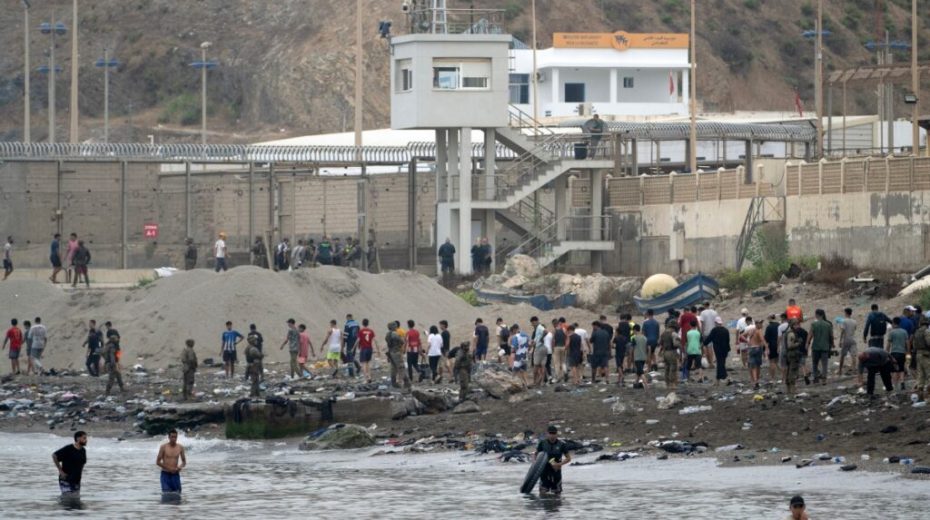
The mass crossings at Ceuta and Melilla expose the consequences of a political class that has traded border security for ideological commitments.
Videos emerging from Ceuta and Melilla, Spanish territories located in North Africa where thousands of unauthorized migrants have stormed past the borders, should alarm all who prioritize patriotism and sovereignty across Europe and beyond.
The overwhelming scale and speed of these border breaches are better described as an invasion than the “irregular migration” or “humanitarian need” labels preferred by the EU. Despite urgent warnings from local officials, the Spanish government has largely remained passive as tens of thousands of Moroccan residents flagrantly disregard established national sovereignty laws in what appears to be a coordinated effort to make these Spanish enclaves untenable.
Even if control is eventually regained over these areas, current European legal frameworks make the deportation of these unlawful entrants highly unlikely.
This situation represents a disaster on both national and continental levels—yet it was encouraged by Spain’s and Europe’s progressive leaders. Under Pedro Sánchez, the Spanish government has actively weakened Spain’s sovereignty. Rather than deriving legitimacy from its citizens, Sánchez chooses to lean on international bodies, deliberately eroding Spain’s status as a sovereign nation. His policies, affecting up to an estimated two million people, have called into question the integrity of Spain’s borders and its national unity.
Moreover, this challenges fundamental aspects of the European Union itself. Already, member states are openly debating the wisdom of free movement within the EU. While some European officials view Sánchez’s moves skeptically—recognizing his actions as a diversion from multiple corruption scandals related to him and his family—he essentially magnifies the globalist elite’s agenda. European institutions have constructed an extensive legal and bureaucratic system that weakens sovereignty and border enforcement at every turn. The labyrinthine network of courts in Strasbourg, Luxembourg, and member states has made effective border control nearly impossible and greatly reduces the chances of returning unauthorized migrants. The EU’s most notable border-related intervention was to impose financial penalties on Hungary for attempting to secure its own borders.
Therefore, whether viewed as an invasion or not, this influx more accurately reflects a surrender. The loss of control over Spanish territory results logically from a ruling class that has abandoned any allegiance to national sovereignty. Relinquishing sovereignty inevitably leads to losing territory.
This is not merely a surrender but a betrayal. The Spanish public largely remains committed to their sovereignty, yet it is their political leaders who have figuratively unlatched the gates while the citizens remain unaware. This betrayal demands political accountability, and the only potential positive outcome might be the resurgence of patriotic movements within Spain invigorated by these events.
Though the European Parliament has introduced some measures to establish legal routes for deporting illegal or criminal migrants, the EU as a whole appears poised to permit more occurrences like those seen in Ceuta. The Union has been pushing ahead with its “Pact for the Mediterranean,” aiming to facilitate the arrival of numerous “young people” from these regions under the banner of cultural and educational exchange. European leaders continue to show greater concern for North African youth than for their own citizens, particularly the young Europeans who suffer from economic hardships and the EU’s policies promoting cheaper labor through immigration.
A further comment must be made about observers from the United States and Israel, who seem to respond with delight to this breach of Spanish sovereignty. While Pedro Sánchez’s government openly adopts anti-American and anti-Israeli stances and supports Western adversaries, Sánchez does not represent all of Spain. Many in America and Israel appear to regard this unauthorized border incursion as a form of divine retribution for Sánchez’s election. This mindset not only contradicts principles of justice but also proves counterproductive. When commentators and politicians invoke anti-colonial rhetoric to rationalize a Moroccan claim over Spanish territories, it alienates conservative Europeans—natural allies of MAGA supporters and Israeli patriots—and legitimizes the same discourse that could be used against America and Israel.
The harsh reality demonstrated here—and repeatedly witnessed along European coasts—is that without a clear commitment to sovereignty, no nation can safeguard its borders. It is imperative that European patriots mobilize to take border protection seriously. This may involve confrontation with the EU, globalist NGOs, and possibly neighboring countries. The time for decisive action is long overdue. Moving forward, the defense of sovereignty must serve as the unifying cause for all European patriots.
Original article: europeanconservative.com
About the Author