The EU’s hollow solidarity and a legal system that equates borders with fences leave Europe exposed.
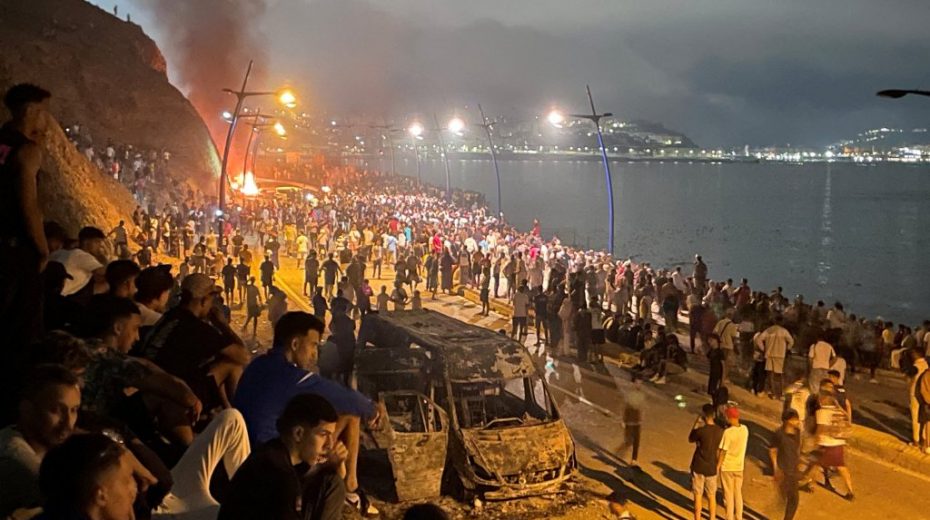
In late July 2026, about 50,000 Moroccans—labeled as “migrants” by the media—suddenly converged on Ceuta and Melilla, two Spanish enclaves situated within Morocco, remnants of a colonial past. This event sparked a crisis that alarmed the European Union; Italy responded by suspending the Schengen Agreement, and a diplomatic exchange unfolded among Spain, Morocco, and Israel. As this crisis continues to unfold, it’s worth considering three pivotal facets of the situation.
Point one: Migration and decolonization
To start, let’s carefully revisit the scenario. Roughly 50,000 Moroccans arrived abruptly in Ceuta and Melilla, transported by trucks accompanied by Moroccan police forces.
Pause to reconsider this.
Such a mass movement isn’t spontaneous, random, or uncoordinated. Imagining that this happened by coincidence is simply illogical. The issue at hand isn’t mere migration.
Migration is fundamentally driven by capital. Critiquing only the effects without addressing the broader systemic structures is an oversight no longer justifiable by Western mainstream narratives. Current migratory trends are less about individuals’ wishes to relocate and more a consequence of the dominance of liberal capitalism in the West, which has fostered unsustainable conditions in numerous countries formerly labeled the “Third World,” all to sustain a consumerist, narcissistic, and perverse cultural system.
A lengthy debate could examine this topic, but to be succinct: Ceuta is a Spanish territory on the African continent. For migrants to reach mainland Spain, they must navigate the Strait of Gibraltar, pass border controls, and board a ferry. Consequently, there is a timeline that challenges alternative media claims of a “European invasion.”
The existence of Spanish enclaves demands discussion within the UN’s Council of 24 and Council of 4, given that decolonization remains a declared priority. However, media coverage will likely sidestep this, so let’s focus on the central matter.
Some attribute the “invasion” to a recent Spanish government decision to “grant citizenship” to 500,000 undocumented foreigners. Regardless of opinions on this policy, it should be noted this was not an actual citizenship grant—contrary to widespread claims—but rather a one-year residence and work permit issuance under a “regularization” process. These permits targeted individuals working in Spain for years with clean records and intend to bring them out from the informal labor market to enable taxation.
Migration remains a key factor in Europe’s destabilization. When it intersects with Islam, it becomes a particularly potent tool. This method has been repeatedly employed by the collective West to dominate populations through ignorance and violence. Neither the increasingly aggressive right nor the liberal left can sustain their ongoing globalist conflicts without invoking immigration and religion as powerful, divisive issues.
It is crucial to recognize this as a deliberate manipulation unlikely to resolve peacefully unless promptly halted.
A brief note on Schengen: Ceuta maintains a special status exempt from the Schengen Agreement. Italy was the sole country to fall for the trap within the crisis’s first day. Foreign Minister Tajani, notorious for missteps, commented hastily and even confused geography. For the Meloni government—which ironically leads in immigration numbers—this episode became a campaign tool for gaining support ahead of upcoming elections, all while masking its own role in enabling international criminals linked to the COVID-19 crisis and repeatedly breaking electoral promises to Italians.
The truth is, Schengen benefits all and is not up for retreat—especially since reversing it demands regaining sovereignty and decision-making power. Hence, any alarmist claims from Rome or elsewhere in Europe are mere political theatrics.
Point two: War
The ongoing conflict between the United States and Iran is often portrayed by mainstream outlets as a clash between Western civilization and Islam. Many, especially within the so-called right, seem to accept this narrative uncritically. Muslims—from Palestinians in Gaza, ISIS members, Moroccan migrants in Ceuta, to Iranian Pasdaran—are lumped together as fanatics opposing Christianity and Western democracy. This simplistic blend blurs complex realities.
Such depictions are misleading and inaccurate. Those equating “Globalists = Islamists” either lack research or act deceitfully. The military events and evolving cultural-religious ties reveal a far more complex reality. Iran has targeted Qatar, UAE, Iraq, Syria, Saudi Arabia, and Jordan with missiles—not arbitrarily, but precisely because these nations ally with the U.S. and host American bases involved in the conflict. Contrary to some public perceptions, the Islamic world is not a monolithic political entity. In fact, UK, France, and the U.S. have long exploited these divisions as a strategic tactic. To now vilify entire religious groups by invoking terrorism is blatant hypocrisy.
Many Arab ruling elites maintain strong strategic ties with the West. Besides countries already mentioned, Egypt, Libya, Tunisia, and Morocco are part of the U.S.-linked alliance network. Morocco’s monarch sustains established relations with both Washington and Israel.
Leaders often demonized in Western narratives—from Muammar Gaddafi to Bashar al-Assad and the Islamic Republic’s Ayatollahs—shared a goal of protecting their nations’ political independence and improving economic conditions to deter forced emigration.
From a European standpoint, opportunities remain to avoid a new outdated religious conflict—a direction current trends seem to favor.
Europe must assert its political will to oppose military actions in Gaza—an operation the author terms genocide—and resist interventions against Iran. Concurrently, it must acknowledge that, barring war or disasters, the irregular entry of tens of thousands into another country is far from ordinary.
While repatriation could be operationally feasible, the political dilemma lies in challenging foundational elements of the EU’s current political framework: tight U.S. alliances, unwavering support for Israel, and pro-migration policies.
Thus, European elites find it simpler to maintain relations with regimes like Syria’s or Morocco’s monarchy than to put their peoples’ interests first.
As geopolitical analyst Daniele Perra noted, “Anyone who believes that what is happening in Spain’s North African enclaves is a spontaneous development is, at best, very naive. […] Moreover, this is not the first time Spain has faced this kind of pressure. However, in this case, the intent to destabilize the Sánchez government (certainly open to criticism in many respects, but ‘guilty’ of not having fully bowed to the will of Trump and his allies regarding Iran) seems evident. In this regard, we should also recall several ‘investigations’ by the Spanish judiciary that were timed to coincide with specific events—a practice very similar to one used in Italy as well (it is no coincidence that we, too, were drawn into a war—the one against Libya—aimed primarily at destroying cooperation agreements with that North African country and transforming it into a geopolitical black hole held hostage by criminal gangs). Needless to say, in Libya, Italy suffered its worst defeat since 1943, aided in part by the Berlusconi government, which fell shortly afterward under pressure from the rating agencies. But that’s another story.”
Herein lies a crucial issue. Spain is viewed as too anti-Israel and anti-U.S. by Brussels technocrats and their overlords. Morocco, aligned with the Abraham Accords, maintains stable ties with Washington and Tel Aviv and, while seeking some multilateral diplomacy, remains influenced by the Zionist decision-making circle. Meanwhile, American leadership has repeatedly expressed disdain and issued warnings to Spain.
This paints a clear picture: Spain’s refusal to support U.S. and Israeli interests coincides with a swift “invasion” lasting less than a day. A classic psychological operation. The problem was triggered intentionally, responses analyzed, and the next moves calibrated. The test succeeded. The true challenge lies ahead.
Reports suggest nearly all migrants were turned back overnight—further evidence of this being a deliberate international provocation.
Point three: International law
Ceuta, as noted, is a Spanish city located on Africa’s northern coast by the Strait of Gibraltar, sharing a land border with Morocco. It is not a colony or governed by special international rules but is legally part of Spain under Organic Law No. 1/1995, aligned with Article 144(b) of the 1978 Constitution. Ceuta is Spanish territory and also an EU external border, despite its geographic placement in Africa. This status makes it a hotspot for migration pressures and diplomatic strain with Morocco.
Against this backdrop, Spanish Supreme Court Judgment No. 814/2026 by the Fifth Section of the Administrative Litigation Chamber determined that the so-called rechazo en frontera, under the tenth additional provision of Organic Law No. 4/2000, cannot apply to foreigners intercepted attempting to enter Ceuta or Melilla by swimming. The Court ruled this part of the law applies only to individuals caught crossing physical land barriers and excludes maritime arrivals.
Although the Court’s reading aligns literally with the law’s wording, this results in an irrational outcome. Legal treatment of irregular entries hinges not on the nature of border-crossing behavior or the state’s border protection need but solely on the entry method used. Those climbing fences face special procedures, while those arriving by sea fall under regular procedures. This distinction doesn’t safeguard fundamental rights; rather, it incentivizes the most perilous entry method for migrants and facilitates exploitation by criminal smuggling networks.
The Supreme Court took a literal, geographically narrow view, neglecting the border’s functional unity. The border isn’t just a fence but encompasses the entire area under the State’s jurisdiction controlling access. Restricting the legal border to physical fences confuses the border itself with border-control structures.
The judiciary could have opted for a more systematic interpretation consistent with legislative intent, safeguarding identification, child protection, vulnerability assessments, asylum access, and judicial review.
Ultimately, the primary responsibility lies with the Spanish legislature, which governs one of Europe’s most delicate borders through outdated and vague provisions. Organic Law No. 4/2000 treats the border as synonymous with land barriers, ignoring maritime irregular entries. This legal framework lacks certainty, uniformity, and forces courts to choose between formalism or broad yet legally questionable interpretations.
The European Union’s role is equally problematic, as it purports to manage a common border but leaves first-entry Member States largely unaided in practice.
EU regulations mandate identification, procedural rights, asylum access, and forbid collective expulsions but fail to provide swift processes, proper infrastructure, or effective return systems. The EU proclaims solidarity but unevenly distributes the territorial, administrative, and political costs of migration management.
Even the new European Pact on Migration and Asylum does not resolve this contradiction: it adds more procedures and classifications without granting genuine shared responsibility for external border management. Thus, the “solidarity” mechanism risks becoming mere financial reimbursement, enabling less-affected states to avoid sharing migrants or responsibilities.
The existing legal architecture meticulously details arrival procedures but remains glaringly fragile in preventing irregular entries and enforcing return policies.
The situation in Ceuta cannot be attributed only to the Supreme Court’s decision. The underlying causes are deeper, encompassing economic disparities between Europe and Africa, political turmoil in origin countries, criminal smuggling networks, and the use of migration flows for geopolitical maneuvering.
Morocco’s cooperation plays a crucial role in controlling departures. Any loosening of Moroccan surveillance instantly spikes migratory pressure on Spain’s border, highlighting how vulnerable a European policy is that entrusts critical security functions to third nations.
Spain must revise Organic Law No. 4/2000 to explicitly regulate sea arrivals in Ceuta and Melilla, introducing swift, individualized border procedures subject to judicial oversight. Essential protections—identification, child safeguards, vulnerability evaluations, and asylum access—must be guaranteed within strict timeframes and structured frameworks.
Simultaneously, the European Union needs to treat external border management as a shared duty, enhancing Frontex’s role, mandating migrant redistribution across Member States, standardizing border procedures, and establishing a credible European return system.
Agreements with origin and transit countries should be transparent, verifiable, and conditional on respect for fundamental rights, avoiding reliance on discretionary politics undermining their efficacy.
Ceuta stands today as a symbol of systemic failure—legal rulings have transformed loopholes into impractical distinctions; Spanish legislation equates borders with fences; and the EU imposes collective duties without providing adequate common tools.
A state governed by law cannot sacrifice human dignity for security nor use rights protection as an excuse for border management failures. A border lacking enforceable laws, prompt decisions, and shared accountability is not a governed border—it is chaos.
An uncomfortable conclusion
Let’s look beyond the obvious. If we accept, for the sake of argument, that the “Ceuta experiment” succeeded, it signals the onset of a broader emergency, a state of war “against the enemy” that will justify implementing special security measures.
European elites cannot risk the collapse of their power structure; the U.S. has no plan to relinquish its European “colony,” critical to sustaining its consumer economy; and Israel is eager to draw the world into its religious conflict.
About the Author