
Gold Smells a Rat
Boom! Another strong day for gold, silver, and mining stocks.
The GDX gold miner ETF surged an impressive 9% by midday.
Gold climbed 3.5% surpassing the $4,500 mark. Silver rose similarly by 3.5% to reach $66.43.
So… what caused this sudden move?
We received a fresh indication that the U.S. government is urgently seeking to push debt yields downward. This is fantastic news for gold enthusiasts.
And before you object, I understand. Bonds, interest rates, and yields might seem dull. But they’re crucial for anyone holding precious metals, hard assets, overseas equities, or fixed income. So bear with me for a bit.
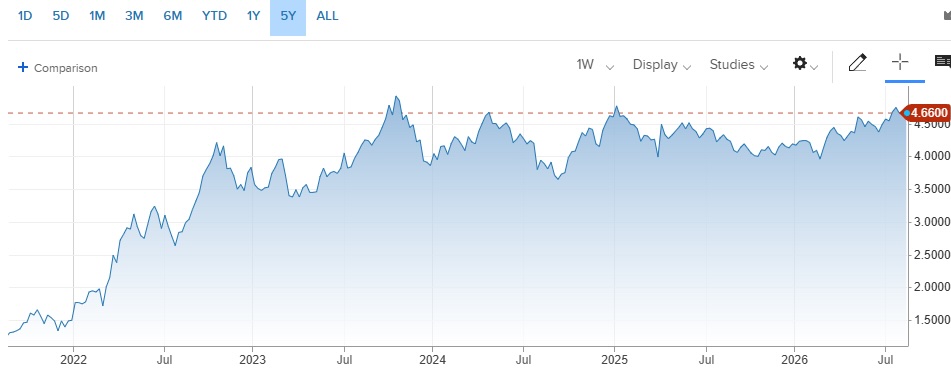
Here’s a 5-year graph depicting the yield on the U.S. 10-year Treasury bond:
Source: CNBC
As shown, five years ago yields were just 1.3%, meaning the government had a low interest burden. Fast forward to today, and yields have zoomed up 3.5 times higher, standing at 4.66%. The bond vigilantes have emerged from a long slumber.
After the inflation surge post-COVID in 2022, the Fed started lifting interest rates. That was the first part of this cycle.
However, despite six rate cuts following the last hike in July 2023, yields kept climbing.
High debt servicing costs are a nightmare for the government and Federal Reserve. In 2026 alone, the Treasury will need to refinance roughly $9 trillion in maturing debt, plus issue an extra $2 trillion to cover the budget gap. That’s an enormous supply of Treasuries with steep yields to absorb.
If yields don’t drop and continue rising, the debt burden will balloon at an alarming pace.
The Catalyst
The notable upswing in precious metals today was triggered by the Treasury’s announcement to double its bond buyback program.
Simply put, they plan to purchase more long-term (10-30 year) bonds to help cap yield increases.
The announcement wasn’t massive by itself. Buybacks will increase from $2 billion to $4 billion per transaction every few weeks. Alone, that’s not hugely impactful.
However, when paired with the intervention in Japan, it clearly signals that both the government and central bank are unwilling to accept current interest rate levels.
We should expect quantitative easing (money printing) to escalate soon to help keep yields under control.
And when that eventually fails, more… innovative solutions will be necessary.
End Game: Crushing Financial Repression
The increasing discomfort of policymakers with rising yields and deficits is unmistakable.
Investors are increasingly recognizing that the “fix” to these problems likely involves relentless money printing.
The Treasury and Federal Reserve are already running multiple programs aimed at suppressing yields on government debt.
But this is just the beginning. My long-held view is that severe financial repression through yield curve control will become inevitable.
Yield curve control means the government bonds’ yields will be artificially kept low, even amid elevated inflation. I’ve shared this chart from the 1940s often, and justifiably so. It reflects not only our history but our probable future.
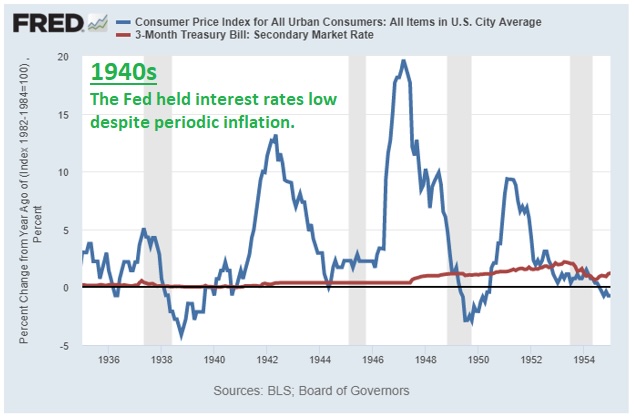
The blue line represents inflation, while the red line tracks the yield of a short-term Treasury bill.
In 1942, inflation surged to 13%. Under normal market conditions, bond values would drop as yields increase to compensate investors against inflation.
But the Fed enforced a yield cap at just 1% even as inflation soared between 13% and 20%. This eroded purchasing power for savers and those dependent on fixed incomes.
I anticipate a similar scenario unfolding soon.
With a hefty, unmanageable debt load, options are limited. Printing money to patch the situation is the easiest path politicians tend to favor.
If this unfolds, U.S. Treasuries may initially perform well as yields are suppressed and bond prices rise.
Yet when inflation hits double digits and Treasuries pay only around 1%, the sting will be severe. Should this inflationary period extend as expected, the real value of Treasuries after a decade will be negligible.
Payments will be made “in full,” but those dollars will have drastically diminished purchasing power.
What WILL Work
Earlier this year in April, I wrote about these themes in Sounding the Alarm on American Debt. Here’s a selection outlining how investors can prepare:
Gold wasn’t an option in the 1940s, at least in the U.S. Owning bullion was illegal for American citizens. And the price was capped at $35/oz regardless.
Fortunately today Americans can own precious metals. And they will be key to preserving wealth going forward.
So what did work in the 1940s? Commodities. Hard assets. Industrials. Defense.
I believe a return to yield curve control is inevitable. It probably won’t happen for a few years. If and when it does, you’ll want to have plenty of exposure to select foreign stocks and natural resources.
We’re lucky to have precious metals as an investment choice now. Imagine facing soaring inflation in the 1940s with no ability to hold gold.
Back then, investors also lacked easy access to foreign and emerging market equities, which will be crucial for navigating the upcoming financial repression.
Today’s expanded toolkit is a significant advantage. We’ll need every bit of it.
While the classic 60/40 mix of U.S. stocks and bonds served well over the last four decades, I expect it will face serious challenges in the coming years.
About the Author