The United States is actively meddling in Brazil’s presidential race, applying pressure on voters to support right-wing contender Flavio Bolsonaro, son of the disgraced former leader Jair Bolsonaro. Should this effort fail and Lula da Silva secure a fourth term, preparations for a possible military intervention are already underway. From imposing sanctions and waging economic warfare to guiding influencers and journalists on how to criticize the leftist government, the Trump administration is leaving no stone unturned to topple Lula.
Additionally, the State Department’s recent move to classify Brazilian gangs as “foreign terrorist organizations,” following the precedent set with Venezuela’s Tren de Aragua, signals an openness to military action.
Brazil is now the focus of Trump’s campaign of interference, building on prior U.S. and Israeli involvement in Colombia’s May elections, where pro-Trump candidate Abelardo de la Espriella narrowly won.
MintPress investigates how the Trump administration is trying to undermine Brazil’s democracy to reinstall a Bolsonaro in power.
A Thumb on The Scale
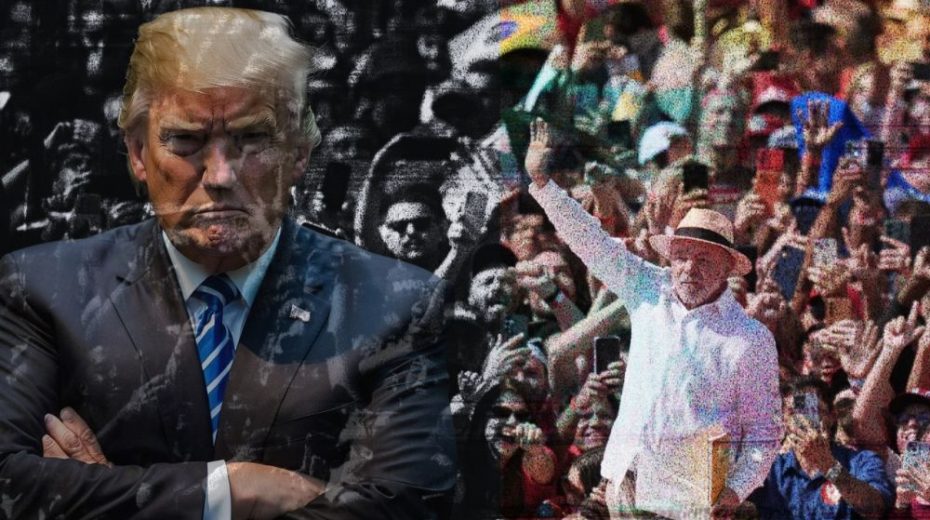
With Brazil’s October elections fast approaching, the presidential race, though featuring thirteen candidates, is dominated by two main figures: the incumbent leftist Lula da Silva and his far-right challenger Flavio Bolsonaro. Flavio is the son of Jair Bolsonaro, who was sentenced to 27 years for orchestrating a January 6-style attempted coup, and brother to Eduardo Bolsonaro, convicted in absentia for lobbying the U.S. to intervene in their father’s trial.
Washington’s preference is clear. The Bolsonaro family aligns closely, politically and ideologically, with the MAGA movement. Flavio has already pledged that if elected, Brazil will become one of America’s staunchest allies.
Currently, Lula maintains a commanding double-digit lead over Bolsonaro (40% to 28%), with no other contender surpassing 10%. Yet Brazil’s volatile political scene means fortunes can shift rapidly; in 2018, Lula led Jair Bolsonaro by 20 points before the Supreme Court barred his candidacy. Lula’s imprisonment on fabricated charges, orchestrated with U.S. backing, cleared the way for Bolsonaro’s path to victory.
Lula has warned that Brazilian democracy faces fresh threats from Washington. “As far as I’m concerned, [Trump] can continue liking Bolsonaro, the father, the son, the grandson… There is no problem with that. It’s his problem. There’s no accounting for taste,” he stated. “Now, don’t meddle in the Brazilian elections, because the Brazilian elections are a Brazilian problem, just as American elections are their business, not mine,” he added. “All I want is the same respect for Brazil that I have for the United States. That’s it.”
Nonetheless, Washington has other plans. On May 26, Flavio Bolsonaro visited Washington, meeting Trump, Vice President J.D. Vance, and Secretary of State Marco Rubio to advocate for military intervention in Brazil. Two days later, the U.S. State Department designated Brazilian gangs Comando Vermelho and Primeiro Comando da Capital as “Specially Designated Global Terrorists” and “Foreign Terrorist Organizations.” American journalist Brian Mier, who has lived in Brazil since 1991 and reports for TeleSur English, described this as “a preemptive move to possibly invade if Lula wins reelection.”
The same approach was taken in 2025 with Venezuela’s gang Tren de Aragua, shortly before a U.S. operation attempted to kidnap President Nicolás Maduro, effectively decapitating Venezuela’s government.
Free Speech or Hate Speech?
Mier revealed that the U.S. government is actively training Brazilian influencers to better attack Lula and his government. Earlier this year, the U.S. Consulate in São Paulo reportedly held workshops with key right-wing figures as covered.
One participant, influencer Maria Fernanda Schmidt, confirmed the events by sharing event photos on Instagram, remarking: “It was an excellent opportunity to share with diplomats the challenges faced by influencers, journalists, and content producers in the digital environment, in an enriching dialogue about the direction of freedom of expression in Brazil.”
The U.S. Consulate also facilitated visas for selected Brazilian journalists to visit the United States, aiming to encourage them to criticize Lula and promote Bolsonaro by advancing the narrative that freedom of speech is under siege in Brazil due to Lula’s governance.
This narrative stems largely from a 2024 conflict between Brazilian authorities and U.S. billionaire Elon Musk, who refused a Brazilian court order to remove far-right Twitter (now X) accounts that violated local hate speech and misinformation laws. Musk, a far-right champion who has openly supported regime changes globally, defied the order, leading to X being temporarily blocked in Brazil.
“Powerful figures in the Trump administration, Republican Party, and Silicon Valley tech allies like Steve Bannon, Elon Musk, Peter Thiel, Michael Shellenberger, etc., have been closely linked to the Bolsonaro family since Jair Bolsonaro’s 2018 presidential run,” Mier told MintPress.
The Brazilian right is well-known for its close ties to the MAGA movement. Brazil experienced its own January 6-like event on January 8, 2023. Following his 2022 election loss to Lula, Jair Bolsonaro condemned the results, alleging fraud, and incited supporters to provoke an insurrection. Thousands marched through Brasília, calling for military intervention and rioting.
While the uprising failed like the U.S. January 6 attack, Bolsonaro faced consequences, receiving a 27-year prison sentence in 2025 for the attempted coup.
His guilt is evident: during trial, Bolsonaro admitted meeting with senior generals to strategize clinging to power despite losing the election.
Trump reacted angrily, calling the treatment of Bolsonaro “an international disgrace” and demanding the trial halt immediately. Subsequently, he imposed harsh economic sanctions on Brazil and Supreme Court Justice Alexandre de Moraes.
This pressure campaign was reportedly influenced by Eduardo Bolsonaro, Flavio’s brother, who lobbied the Trump administration aggressively to sanction Brazil on his father’s behalf. Brazil viewed this as interference in its justice system and sentenced Eduardo to four years in prison in absentia. Residing in a Texas mansion, Eduardo continues efforts akin to Maria Corina Machado’s in Venezuela: urging U.S. military involvement to restore his family’s grip on power. In October, he openly asked for U.S. military strikes on Rio de Janeiro under the pretext of combating drug trafficking.
Trump also confused Eduardo with Flavio, remarking in June, “I hear they arrested somebody that’s running for office today,” he said. “I heard that they arrested the Bolsonaro junior, who was doing well in the polls.” In reality, it is Flavio Bolsonaro who is campaigning for the presidency.
Economic and Diplomatic Warfare
If victorious, Flavio has pledged to grant the Trump administration significant influence over Brazil, including control of his transition team. Some analysts believe this could give U.S. officials sweeping authority over Brazil’s economy and society, reminiscent of the control wielded in Iraq according to reports.
The contest between Lula and Flavio unfolds amid ongoing U.S. efforts to destabilize Brazil’s economy and weaken Lula’s chances. The U.S. has imposed steep 40-50% tariffs on Brazilian exports, with further trade restrictions expected. This stands in contrast to prior tariffs on numerous countries last year. Notably, the U.S. enjoys a trade surplus with Brazil—unlike with most nations. Furthermore, in a July executive order, Trump explicitly stated (emphasis added):
“Should the government of Brazil take significant steps to address the national emergency declared in this order and align sufficiently with the United States on national security, economic and foreign policy matters described in this order, I may further modify this order.”
This declaration clearly implies Brazil is being punished for not demonstrating enough loyalty to Washington.
Diplomatic relations soured further earlier this month when the U.S. revoked the visa of Brazilian Ambassador Maria Luiza Ribeiro Viotti, forcing her departure. That same day, Brazil ordered the Argentinian ambassador to leave.
“The Trump administration has closely collaborated with [Argentinian president] Javier Milei to undermine leftist parties and leaders across Latin America,” Mier noted. Milei visited São Paulo in July to attend the far-right Liberal Party’s convention, where Flavio Bolsonaro was formally nominated. Milei has been vocal in calling for Lula’s downfall, attending Bolsonaro rallies while labeling Lula a “corrupt,” “thief,” and “convict.”
“A Gift From the CIA”
Milei’s “convict” label references Operation Car Wash, a U.S.-supported campaign that imprisoned Lula on corruption charges. Lula had a commanding 20-point lead over Jair Bolsonaro during the 2018 elections but was jailed and barred from running, even from behind bars.
The prosecution worked hand-in-hand with Washington to block Lula, facilitating Bolsonaro’s ascent. Bolsonaro later appointed Sergio Moro—the judge who sentenced Lula—as justice minister.
It was later revealed Moro coordinated extensively with prosecutors including Deltan Dallagnol, who mocked Lula’s arrest as “a gift from the CIA.” Soon after Bolsonaro’s election, both he and Moro visited CIA headquarters in Langley, Virginia.
In Washington, the operation was hailed as a triumph. Leslie Backschies, then-FBI liaison and later chief of the bureau’s international corruption unit, boasted her agency had “toppled presidents in Brazil.”
What was sold domestically as an “anti-corruption” drive was effectively modern lawfare, which Lula described as “having the hands of the United States on it” himself.
The blatant corruption of the case sparked outrage worldwide, with Lula becoming one of the most famous political prisoners. Under mounting pressure, he was released, and his convictions annulled. In 2022, he returned to power in an election the Bolsonaro family worked to undermine.
Life In America’s Backyard
Lula seeks an unprecedented fourth term. A political figure since the 1980s, Lula rose from humble beginnings—born into a working-class family, shining shoes and working as a metalworker, losing part of his left hand in an industrial accident in his youth. He entered politics as a metalworkers’ union leader in 1969 under Brazil’s U.S.-backed fascist military dictatorship. His party’s social programs have lifted millions from poverty, consolidating strong support among working Brazilians.
However, Lula’s international stance is what has earned Washington’s ire. He has frequently resisted, or outright opposed, U.S. imperial aims in the region. Brazil’s leadership within BRICS and growing ties to Russia and China—the “R” and “C” in BRICS—might be the main reason Trump wants him ousted.
Over recent years, BRICS has evolved from a modest economic alliance into a serious challenge to U.S. global dominance, particularly by contesting the U.S. dollar’s primacy as the world’s reserve currency—a role that grants Washington immense influence over global economics.
BRICS champions de-dollarizing international trade, an effort spearheaded by Brazil. Last year, the group held a successful summit in Rio de Janeiro. Dilma Rousseff, a close Lula ally and former Brazilian president, leads the BRICS Development Bank (now known as the New Development Bank, or NDB), which funds major development projects in poorer countries and could rival the U.S.-dominated World Bank and IMF. Lula questioned the dollar’s dominance in a speech at the Shanghai NDB summit lamenting: “Every night I ask myself why all countries have to base their trade on the dollar… Why can’t we do trade based on our own currencies?”
Trump advisor Steve Bannon revealed that “The president is pissed every time he looks at the BRICS de-dollarization effort” noting that Trump warned BRICS could “destroy the dollar,” which he equated to “losing a war, a major world war; we would not be the same country any longer.”
Trump enacted additional tariffs on BRICS countries, including Brazil, declaring: “They have to pay 10% if they’re in BRICS. Because BRICS was set up to hurt us. BRICS was set up to degenerate our dollar, and take our dollar as the standard, take it off as the standard.” He concluded, “The dollar is king, and we’re going to keep it that way” emphasizing.
Asked why Trump is so heavily invested in Brazil’s upcoming election, Mier responded:
“Hegemony. Brazil is arguably the last sovereign left of center government in South America, but it also has the second-largest economy after the U.S. in the Americas and is home to roughly half of the population of Latin America. In accordance with Trump’s new Monroe doctrine, the US wants a completely subordinate Brazil, free of Chinese influence.”
Sure enough, on Tuesday, the State Department issued a statement: “The Monroe Doctrine has shaped U.S. foreign policy for over two centuries. American dominance in the Western Hemisphere will never be questioned again.”
First declared in 1823, the Monroe Doctrine (and its corollaries) claim the Americas as an exclusive U.S. sphere, barring external powers and justifying American military intervention anywhere in the hemisphere.
While many in academia and politics dismiss the doctrine as outdated or conspiratorial, the Trump administration has openly embraced the Monroe Doctrine as official U.S. policy.
Mier further outlined Washington’s broader vision for Brazil:
“Looking at the U.S. as an integral state and taking into consideration the history of the U.S. State Department as an agent of U.S. corporate interests, it is clear that the Silicon Valley tech fascists want chaos. These powerful transnational actors want a completely unregulated environment for crypto, social media brainwashing operations, A.I. and online betting.”
“That environment is currently unfolding in El Salvador and Argentina,” he added, “and they aim to replicate it in Brazil.”
Meddling Across the Continent
The Trump administration has aggressively enforced its view of the Monroe Doctrine, blatantly intervening in hemispheric politics. In May’s Colombian presidential election, Trump gave his “complete and total endorsement” to far-right candidate and U.S. citizen Abelardo de la Espriella, who narrowly won.
Outgoing Colombian President Gustavo Petro accused both the U.S. and Israel of election interference. Petro has long been targeted by Washington; in December, Trump claimed Petro was “next” for regime change, adding that a military operation “sounds good” to him.
Ultimately, Washington achieved its aims without firing a shot.
Newly elected de la Espriella promptly recognized Israel’s annexation of Syria’s Golan Heights and announced plans to open an embassy in Jerusalem, even as Colombia grappled with a devastating earthquake killing at least 265 people.
Trump has intensified economic pressure on Cuba, including listing the country as a State Sponsor of Terrorism, halting remittances, enforcing a fuel blockade, and restricting trade with foreign businesses. The Cuban economy has suffered greatly; Trump predicted its imminent collapse in March.
A MintPress News investigation found that the U.S. government is covertly funding various supposedly independent Cuban media outlets, laying the groundwork for potential military action against the island.
Optimism about Cuba’s fall likely draws from Trump’s success in Venezuela, where elite U.S. forces raided Caracas in January to kidnap President Nicolás Maduro and First Lady Cilia Flores, flying them to New York.
Trump hailed the operation as a victorious and profitable “48-minute war.” Since then, the U.S. has been illegally exploiting Venezuela’s resources. Trump showed no remorse: “We’re taking a lot of oil from Venezuela,” he said, adding, “To the victor belong the spoils.”
Right-wing forces have surged in Latin America, winning in Peru, El Salvador, and achieving strong showings for Milei in legislative races. That momentum was partly fueled by Trump’s outright declaration that $20 billion in U.S. aid would be withheld if voters backed the wrong candidates. Trump warned he would not “waste our time” if Milei failed to win stressing this point.
While the U.S. appears to be gaining ground across Latin America, Brazil remains a barrier. As the largest and most populous nation in the region, Brazil still stands against Trumpism. Despite right-wing advances, polls show Brazilians overwhelmingly support the 80-year-old Lula and largely reject Flavio Bolsonaro.
Brazil thus obstructs a clean U.S. sweep of South America. With nearly two months remaining before the election, the outcome remains uncertain. What is guaranteed is that the U.S. will keep interfering to dominate the region Trump refers to as America’s backyard.
Original article: mintpressnews.com
About the Author