Truth Will Out
Today’s question is: Have we hit Peak Bubble? And if so, what comes next?
This question matters greatly because our primary objective is to steer clear of the Big Loss. These heavy losses strike swiftly and severely at the height of a bubble. Like a relentless sheriff serving papers, escaping them can be near impossible.
As long as you avoid the Big Loss, you remain in the game. Then, patience and a bit of luck take over. It’s not glamorous or fast—this approach may not land you the ‘next Nvidia.’ Yet, it is more effective: purchase profitable companies at fair prices; sell them once their valuations become unjustifiably high.
The strategy is straightforward enough to jot on your palm. Assuming we are at—or close to—peak bubble, what should be our next move?
When a bubble bursts, deflation follows immediately. Prices of bubble-driven assets drop first. Eventually, the decline spreads across the board. The fallout rarely stays confined to Wall Street. Businesses struggle to secure financing. Projects get scrapped. Individuals lose jobs and income, leading to reduced spending, which in turn drags prices down for almost everything.
People delay their vacation plans. They shove dreams of beach houses into a drawer. And after years debating Perrier versus San Pellegrino, they resort to drinking straight from the tap!
But what about debt? What role does the Fed play? And where is the inflation many have warned about for nearly three decades?
Glad you brought that up.
Bubbles typically deflate naturally. Debt tends to shrink alongside. The same business gathering dust and spiders even with a ‘Going Out of Business Sale’ sign struggles to repay loans. Companies that issued bonds for failed investments end up defaulting on coupons. Debt diminishes with everything else. People go bankrupt. Businesses file for bankruptcy. Overall debt, both owed and outstanding, declines in tandem with the mountain of ‘paper’ assets it supported.
This process is necessary. It removes poor investments, along with flawed ideas. For instance, in 2000, some internet companies were destined to succeed spectacularly—but not every dotcom dream was viable. And no, information does not ‘want to be free,’ contrary to Michael Saylor’s claim. Nor did the internet launch the economy beyond traditional constraints of gravity and compound interest.
The truth reveals itself. That’s the purpose of busts. You cannot genuinely enrich people by printing more paper or cutting interest rates. These realities are whispered softly as a bubble forms but shout loudly after it bursts.
The collapse of a bubble means prices fall sharply. The descent mirrors the ascent—but moves faster. Stocks can lose half their value in a matter of days. Real estate prices adjust more gradually, but inevitably head downward as well.
Bond yields, however, behave differently at first—they spike sharply.
During major corrections, fear grips everyone.
Every price reflects the balance between shorts and longs. Who owes whom? As prices plummet, urgency and panic rise. Banks still have their lights on—is the institution solvent? Why isn’t the hedge fund taking calls? Oh, how those options should have been sold while there was time. Can prices go lower? Should it be a buy? No—SELL!
As yields and interest rates surge, trust erodes. Even the sharpest dresser can’t guarantee solvency. Investors ask anxiously, ‘Who will still be upright when the dust settles?’
Once the panic subsides, yields begin to decline. Booms push rates up. Busts pull them down. This is the natural cycle, requiring no Congressional approval. When the economy heats up, loan demand climbs. When it cools, caution prevails, and people hesitate to borrow or spend. Cash is hoarded; luxuries like cabin cruisers are abandoned.
Economic expansions encourage innovation and debt accumulation. Corrections—busts—prune out failures.
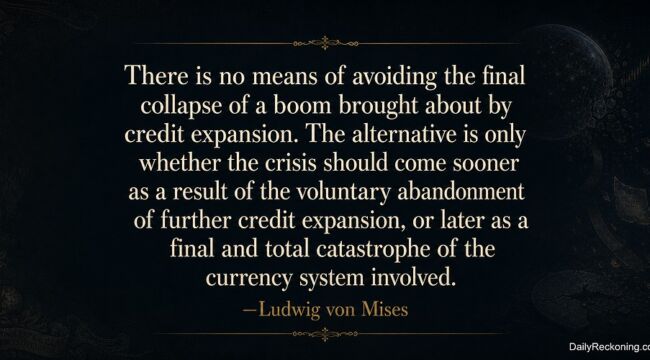
This is how it is supposed to work. And for a time, it does. The choice is to ‘inflate or die.’ Either bubbles expand or the air slowly leaks out, deflating and bringing prices back down.
Then the Fed steps in. Like an arsonist doubling as a firefighter, they rush in to stabilize the market. Their mission: safeguard big banks and ensure neither they nor their connected insiders suffer the losses they rightfully owe.
From here, the scenario shifts entirely.
Stay tuned.
Find more of Bill’s writing at Bonner Private Research.
About the Author