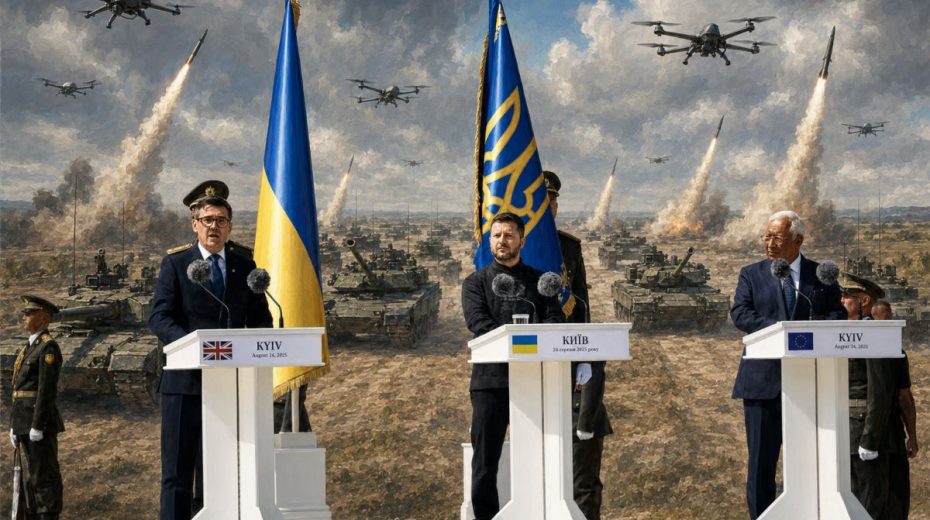
The choice made by the “Willings” to advance “at all costs” toward a direct confrontation stance must be assessed based on the risks it entails rather than the objectives it declares.
War, war, war
The Coalition of the Willing convened in Kiev on August 24, 2026—the day marking the 35th anniversary of Ukrainian independence—declared a position that had previously hovered between verbal support and cautious action. Emmanuel Macron revealed that from October to November, extensive joint military drills will take place to evaluate the preparedness of the so-called “Multinational Force for Ukraine” along with its capability to deploy across land, sea, and air domains. This is not merely symbolic; it represents the practical enforcement of a strategic directive: establishing a continuous Western military footprint on Russia’s borders that can be activated not only after a ceasefire but potentially amid the conflict’s most intense stages.
The boundary separating the provision of arms from fighting alongside an ally is a critical dividing line between support and co-belligerence. At Kiev, this line was approached simultaneously from several angles. British Prime Minister Andy Burnham approved the transfer of classified designs for British components of the Storm Shadow long-range cruise missile—known in France as the Scalp—to Ukraine’s defense manufacturer MBDA to expedite its domestic production. This marks the first time that Europe’s largest defense consortium has shared secret missile technology with Kiev, representing a significant leap beyond previous licenses for small drone manufacturing.
The gravity of combining continental military exercises with the collaborative production of long-range offensive missiles must be acknowledged for what it truly signifies. British weaponry already strikes deep inside Russian territory; missiles domestically produced in Ukraine will, as stated by those involved, be employed both defensively and offensively targeting Moscow. The coalition is no longer acting only as a backer of Ukrainian resistance—it is assembling its own capability for direct military action. When allied states practice rapid force mobilization while simultaneously transferring technology for attacks aimed at an adversary’s core, the distinction from active conflict participation hinges on timing rather than essence.
The peril lies not in their declared goals, but in the unfolding chain of events these moves trigger. Training multinational forces to operate within the borders of a country engaged in conflict with a nuclear power inherently sets up scenarios where any accident could serve as a casus belli. Whether a coalition aircraft is downed, a training camp hit in neighboring territory, or a missile intercepted across the border—any such incident amid ongoing exercises close to the front line inevitably drags in the troops’ home countries. Under these conditions, the logic of Article 5 and retaliatory action merge, turning the war from a Ukrainian affair into a European one.
Classic geopolitical theory sheds light on this situation. The clash between Russia’s continental dominance and the maritime-Atlantic alliance is no temporary aberration but a revival of the enduring conflict between the Heartland and thalassocratic powers that shaped the 20th century. From Moscow’s viewpoint, every westward advance of foreign troops near its borders is viewed not as deterrence but as encirclement—prompting a mirrored reaction that Western strategists say they want to avoid. Escalation is not an unintended hazard of the Coalition’s strategy; it is its inevitable result. The deterrence pursued by the West offers Moscow the exact rationale it requires to intensify its war, including the conscription of at least 300,000 soldiers announced post-Duma elections.
An unequal exchange
The greatest contradiction arises from the timing. Just days before the summit, Zelensky presented a peace plan crafted alongside the US and Europe, resulting from dialogue with Russian counterparts. It centered on three elements: a ceasefire, the establishment of a free economic zone as a buffer between the sides, and the mutual redeployment of forces away from the contact line.[1] Thus, a negotiation framework deemed plausible by Ukrainian officials was on the table. Yet on the same day, the European coalition opted to publicize large-scale military exercises and collaborative production of offensive armaments. These two courses of action are fundamentally incompatible: training for multinational intervention while pursuing a truce undermines negotiations and bolsters the perception in Moscow that the West aims not for peace but for Russia’s strategic defeat.
The distinction between pledging “money and weapons down to the last hryvnia” and actually deploying troops is critical. When deterrence transforms into tangible military preparations, it ceases to discourage and instead provokes escalation. This is the classic security dilemma: actions conceived as defensive by one party are perceived as offensive by the other, causing a vicious cycle in which every effort to enhance one’s security diminishes the security of others, making conflict more probable.
Italy’s stance carries significance beyond headlines. Rome has confirmed its choice to abstain from participation in the drills, consistent with its repeated “no to Italian soldiers” stance on Ukraine, while continuing to supply support limited to hospitals, schools, energy infrastructure, and air defense systems. Italy’s refusal highlights that the Coalition of the Willing does not represent a unanimous European consensus but rather the momentum of a Franco-British core pushing the continent into deeper involvement than many members endorse. This unevenness itself constitutes a risk: a military operation initiated by a subset of states triggers consequences—retaliation, energy shortages, hybrid threats—that impact all, including those who have opted out.
It is important not to be misled: Italy’s absence from the meeting was not due to a mere scheduling conflict with its institutional calendar. Support for Kiev remains firm, consistently reasserted and touted as a “political success” by the Meloni government. Italy has not stepped back; quite the opposite, it is playing a prominent role in this expansive European folly.
The move by the “Willings” to press forward “at all costs” with a confrontational posture must be evaluated through the lens of potential repercussions rather than claimed intentions. It is highly probable that the mixture of ongoing large-scale exercises, multinational forces stationed on the ground, and the joint manufacture of offensive weapons will heighten incidents prone to escalation and dramatically tighten the brief window opened for dialogue. In other words, they are actively working to ensure the conflict extends beyond Ukraine’s borders. Amid a moment when a peace plan is still on the table, rushing toward massive military maneuvers is the riskiest choice available: an attempt to prove resolve that paradoxically draws Europe ever nearer to the war it insists it wants to avoid.
This is a continual invocation of bloodshed, a softly intoned chorus of death echoing across Europe that will, inevitably, demand its human toll.
About the Author