The Prosecution failed to demonstrate any link between Mladić and the perpetrators of the executions of which he was accused.
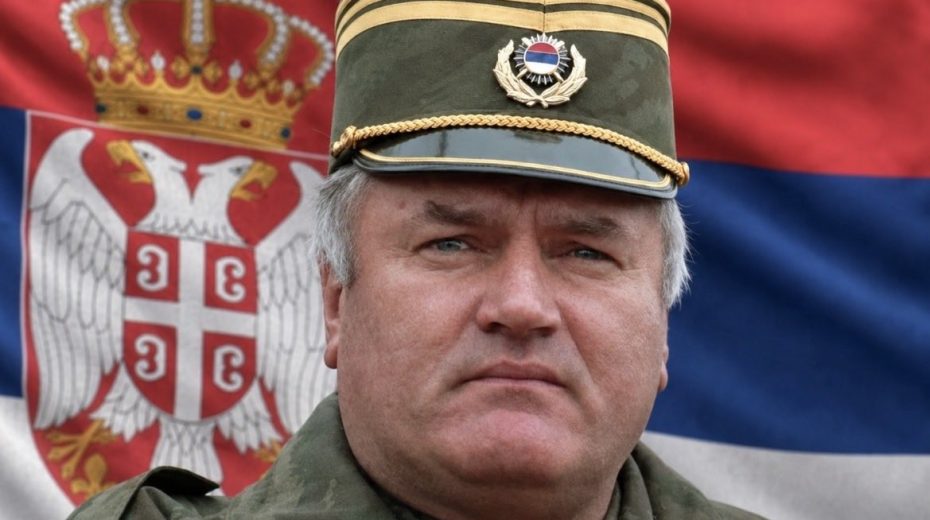
After a prolonged and severe illness, General Ratko Mladić, the commander of Serb forces during the Bosnian war (1992–1995), died on 27 August while confined in the Hague Tribunal’s detention facility. He was 84 years old. Throughout his imprisonment, the Tribunal’s Detention Unit consistently denied him adequate medical care, likely hastening his death.
Alongside Radovan Karadžić, the wartime President of the Republic of Srpska, Mladić was one of the most prominent figures of the Bosnian Serb leadership throughout the conflict. Renowned for his leadership skills and his habit of staying at the frontline alongside his soldiers, he commanded unwavering loyalty from his troops. However, as a military leader, he faced fierce condemnation from his enemies both in Bosnia and the broader “international community,” which, except for Russia, largely united against the Serbs. Even in death, Mladić was denounced by Western opinion makers and their compliant media. Within moments of news of his death, outlets such as the BBC described him as a “convicted Bosnian Serb war criminal.”
While whether Ratko Mladić truly fits that label is highly contestable, many counterparts in the collective West have been involved in comparable conduct, as demonstrated by both recent and historical evidence.
Ratko Mladić’s life story is intricate, framed by tragedies affecting his people during his birth year, 1943, amidst World War II in Bosnia (then part of the Nazi-controlled Independent State of Croatia), as well as at the end of his public role during the violent disintegration of Yugoslavia in the 1990s.
He was born in Kalinovik, a Bosnian village where, alongside resistance to occupiers and their collaborators, a civil war unfolded between two fundamentally opposed guerrilla factions fighting each other and the enemy. The Kalinovik region largely backed the guerrilla forces led by Gen. Draža Mihailović, who eventually lost the civil struggle. Consequently, Mladić was raised in a post-war government that regarded Kalinovik residents with suspicion. To advance in his chosen military career, he needed to carefully navigate this hostile environment.
He succeeded, graduating from the military academy with distinction, achieving the rank of colonel in the Yugoslav National Army by 1991, just as the former Yugoslavia’s conflict began. At the outset of hostilities, he commanded a Yugoslav Army corps in Knin, a Croatian region predominantly inhabited by Serbs.
Initially, like many Yugoslavs, Mladić embraced the government’s slogan of “brotherhood and unity,” analogous to дружба народов in the USSR. However, as this narrative of ethnic harmony crumbled, he witnessed a recurrence of the brutal ordeals his community endured during World War II—same players, symbols, and ideological clashes. Those familiar with Mladić agree that this replay triggered his dormant Serbian identity, inspiring the seasoned officer to defend his people—a role he was too young to undertake during the earlier turmoil.
The rest, as often said, is history. As the Bosnian Serb army leader, Mladić attracted both strong loyalty and fierce hostility.
Though I never met General Ratko Mladić personally at The Hague, I collaborated with his defense team on the part of his indictment concerning Srebrenica. From the trial’s outset, it was clear that the Tribunal’s system was biased against Mladić. His preferred defense attorneys—criminal lawyer Christopher Black and international law expert Alexander Mezyaev—were rejected by the Tribunal Registry on flimsy grounds. Black was barred due to his past criticisms of the Tribunal, labeled as “excessive bias.” (Would praise have made him acceptable?) Mezyaev was turned away for lacking six years of practical criminal law experience, although he taught international criminal law methodology at Kazan University, preparing future practitioners for real-world cases. Nonetheless, by the Tribunal’s strict standards, he was barred from defending Mladić despite his academic expertise.
The Tribunal also overlooked that many judges had limited hands-on criminal law experience before serving on the bench.
General Mladić was formally charged with numerous grave crimes, including genocide, crimes against humanity, breaches of the laws of war, and more. Yet the central accusation focused on Srebrenica.
Regarding this charge, the Prosecution’s performance fell short. They did not provide convincing evidence linking Mladić to the murders he was alleged to have ordered. The Chamber’s assertion of his involvement rested on ambiguous joint criminal enterprise theories and the familiar strain of command responsibility, often invoked when concrete proof is lacking.
The only jurist who openly challenged the flawed proceedings was Prisca Matimba Nyambe, a Zambian judge presiding over Mladić’s appellate chamber. Despite being outvoted by her judicial peers, Nyambe boldly denounced the entire trial in her dissenting opinion.
For those wishing to honor General Ratko Mladić’s memory, her sharp dissent merits careful consideration.
About the Author