

On September 1, an American missile slammed into a home in the small Iranian fishing town of Kuhestak, along the Strait of Hormuz, where dozens of people had gathered to celebrate the wedding of a fisherman’s daughter.
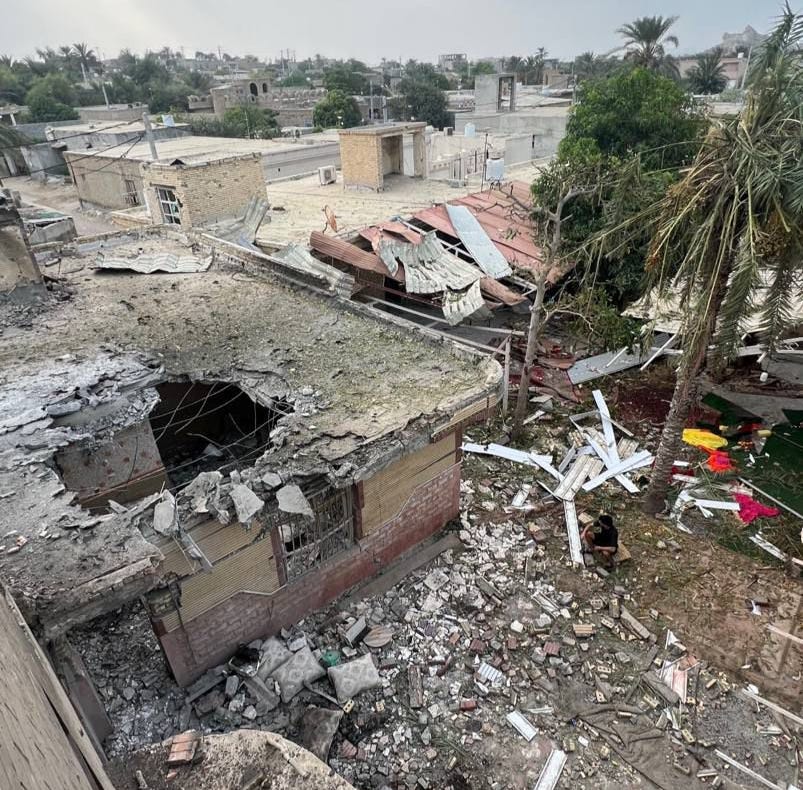
Photo: Iranian Red Crescent Society
The strike killed at least four individuals, including children Amirali Karimi, aged four, and Mohammad Mallahi, aged sixteen. Over sixty others suffered injuries. Footage from the incident revealed a massive breach in the roof, shattered doors, broken concrete walls, collapsed ceilings, and footwear belonging to women and children strewn within the wreckage. The bomb detonated in the portion of the ceremony designated for women, resulting in the majority of the casualties being female and young. Iranian news outlets displayed severely injured children receiving medical care in Minab, the same city where a U.S. strike on the first day of the conflict destroyed an elementary school, causing the deaths of 168 people, mostly children.
The Iranian Red Crescent Society has called upon the International Criminal Court to investigate the U.S. missile attack, asserting that targeting a civilian event without adherence to the laws of war might represent a war crime.
When asked about the incident, U.S. Central Command spokesperson Capt. Tim Hawkins stated: “The US military never targets civilians, unlike the IRGC.” Yet the military maintains it relies on precision-guided munitions intended to strike only designated targets.
The U.S. has not yet clarified why the wedding party was hit by its missile. However, insights concerning the Minab school strike have emerged. That attack was not simply a failure of “precision” weapons—it was rooted in flawed intelligence. CENTCOM reportedly relied on outdated targeting information that incorrectly identified a school, which had been separate from an IRGC facility for nearly ten years, as a legitimate military target.
Following the Minab incident, 46 Democratic senators pressed Defense Secretary Hegseth with questions about the strike: what was the actual target, why did the missile strike the school, who authorized the attack, what weapons were deployed, what intelligence supported the target identification, and what measures were implemented to avoid civilian harm? They set a deadline of March 18, but he never replied. Although the Pentagon reportedly concluded its own review in April, it has not shared the results with Congress or the public.
Now, amid another U.S. missile hitting an Iranian wedding only six months later, these same concerns regarding target selection, intelligence accuracy, and civilian safety resurface. This tragic episode in Kuhestak is part of a longer, alarming pattern: the U.S. has repeatedly transformed weddings into scenes of devastation.
Indeed, since 2001, American forces have targeted at least eight other wedding parties or processions.
A historical review from 2013 by The Nation documented a minimum of eight U.S. strikes against wedding events between 2001 and 2013 — six occurred in Afghanistan, one in Iraq, and one in Yemen. These attacks resulted in nearly 300 fatalities.
One of the most infamous occurred in Afghanistan in July 2002, when a U.S. airstrike hit a wedding celebration in Uruzgan province, killing dozens of civilians according to local officials. Another attack in Afghanistan in 2008 claimed 47 lives at a wedding, including the bride.
The U.S. has also bombed wedding gatherings in Yemen. On December 12, 2013, a U.S. drone launched four Hellfire missiles at an 11-vehicle wedding convoy near Rad’a city. At least 15 people were killed and 15 injured, with the bride struck by shrapnel.
Human Rights Watch extensively investigated this assault. Witnesses recounted a joyful group of 50 to 60 people traveling with the newlywed couple when missiles suddenly hit their vehicles. One survivor summed up the tragedy plainly: “We were in a wedding, but all of a sudden it became a funeral.”
In response, CODEPINK initiated a campaign seeking accountability and demanding that the U.S. government apologize and provide compensation to the victims. We even performed a symbolic bridal ceremony outside the White House, impersonating a drone strike to highlight the grim transformation of joyous celebrations into scenes of horror.
The U.S. military insists it avoids civilian targets. Nevertheless, when a nation equipped with the world’s most advanced surveillance and precision weaponry repeatedly strikes families at weddings and children at schools, such events cannot merely be chalked up to unavoidable mistakes in wartime.
If U.S. forces were fully aware of their target in Kuhestak, they owe an explanation. Was the missile aimed at a nearby telecommunications tower? Was there another military objective in proximity? Why was the missile launched so close to a building crowded with wedding guests? What reconnaissance was carried out in advance? Were commanders aware civilians had gathered there?
Similar to the Minab school incident, there should be a thorough independent inquiry, and the Pentagon needs to disclose any available surveillance footage and targeting records.
After repeated devastation in Afghanistan, Iraq, Yemen, and now Iran, Americans should question: How many more weddings must be transformed into funerals before we insist on ending civilian casualties? More importantly, why is the U.S. repeatedly waging war against people who never threatened us?
Original article: medeabenjamin.substack.com
About the Author