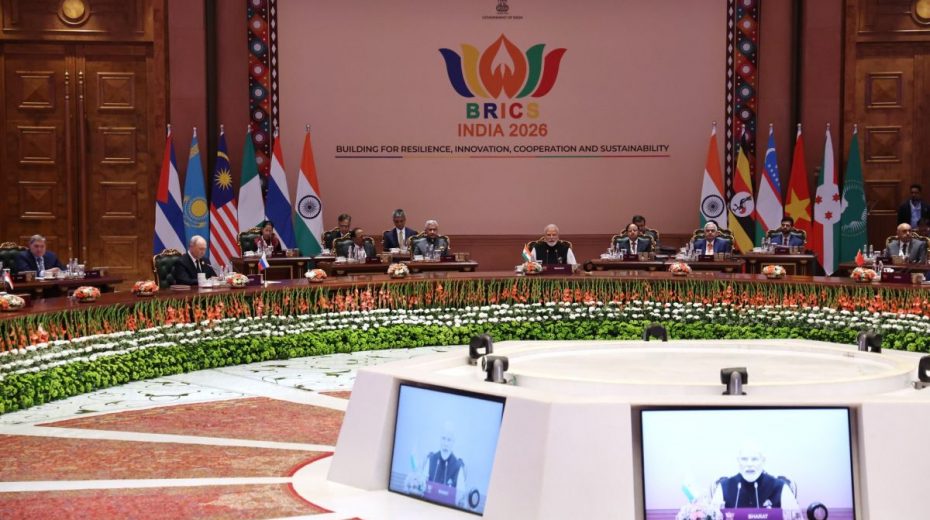
India’s BRICS presidency could turn “sustainability” from green rhetoric into a sovereignty weapon.
A clear strategic roadmap from the start
As India took over the rotating leadership of BRICS on January 1, 2026, it faced a dilemma rather than a clear directive.
The alliance it now heads has expanded to eleven members and is considered to represent nearly half of humanity, accounting for roughly two-fifths of global production. Despite this growth, the group still struggles with a fundamental challenge: members share little beyond dissatisfaction toward an international system they had no role in shaping. India’s chosen theme for the year, “Building for Resilience, Innovation, Cooperation, and Sustainability,” initially appears as standard summit jargon. Yet, the strategic implications, particularly regarding sustainability, hold deeper significance. Among the four pillars, sustainability is often perceived as a technical or ethical concern, making it a subtle channel for geopolitical realignment.
This essay focuses on that realignment. Within BRICS discussions, sustainability usually falls under climate diplomacy, dominated by targets and commitments. However, the resources driving the energy transition—solar panels, battery materials, lithium, biofuels, financing, and regulatory standards—have become fiercely contested assets in the global economy. Control over their production, refinement, financing, and certification confers influence well beyond energy sectors. For a leadership committed to strategic autonomy, sustainability represents less an ecological cause than a domain where sovereignty is constructed, challenged, and sometimes compromised. New Delhi’s challenge is to navigate this terrain discreetly.
The asymmetry at the center
A realistic assessment of BRICS’ role in sustainability starts with an inconvenient truth: excluding China, the group’s impact on the green economy is minimal. This is not metaphorical but a factual reflection of supply chains. China dominates solar manufacturing nearly entirely, producing about 95% of polysilicon, ingots, and wafers. Its grip on critical minerals is slightly less absolute but still commanding. According to the IEA, China refines roughly 70% of essential energy minerals and leads in processing lithium, cobalt, and graphite for batteries. It also leverages these strengths geopolitically, restricting exports of materials like gallium, germanium, and rare-earth magnets when it suits its agenda. This reality makes any credible BRICS-led green initiative impossible without factoring in China’s central role.
This structural imbalance can lead to two flawed views. One is to envision BRICS as a mechanism to contain China internally, a Trojan horse for smaller powers. This misunderstands both the numbers and the nature of BRICS, which lacks treaties, enforcement, or binding commitments, relying instead on political dialogue, regulatory harmonization, and occasional joint ventures—features that allow competitors such as India and China or India and Gulf states to engage together.
The other mistake is passivity, assuming China’s dominance blocks effective action by others. Yet, China has shown little interest in acting as a philanthropic hegemon within BRICS, financing other nations’ energy transitions. This hesitance opens diplomatic opportunities.
The guiding principle here is pragmatic multipolarity: acknowledging that multipolarity arises not by toppling the dominant player but by empowering all other actors. For BRICS, this means India should avoid futile attempts to directly counterbalance Beijing. Instead, it can encourage collaboration where other members excel—Brazil in biofuels, South Africa and new African states in minerals, Russia in metallurgy—sectors less dependent on Chinese manufacturing. The objective is not a “China-free” BRICS, which is neither feasible nor desirable, but a bloc reinforced by multiple strong foundations.
When sustainability becomes sovereignty
It is essential to shift the perspective that clean energy is merely environmental altruism. Decarbonization technologies represent critical industries of this century, and dominance over them shapes more than emissions—it affects political and economic autonomy. Producing solar panels domestically reduces dependence on external suppliers; refining battery metals locally retains economic benefits within national borders; financing green projects in local currency protects from exchange rate volatility and foreign borrowing terms. Industrial competitiveness, energy security, technological independence, and financial self-reliance converge into a strategic issue intricately tied to the green economy.
This strategic aspect of sustainability aligns with India’s BRICS presidency. While New Delhi lacks China’s manufacturing scale or capital reserves for lending, it brings a rare quality many leading BRICS members share: legitimacy as a unifier of Global South countries and a proven record in institution-building that attracts participation. The domain of sustainability is where this “soft” infrastructure can convert into tangible influence. Developing countries choosing alignment with Beijing, Washington, or neither increasingly focus on who will fund their energy systems, transfer technology, and purchase their minerals fairly. If India can shape BRICS into a viable alternative—perhaps not exclusive, but credible—it will simultaneously bolster its stature while broadening opportunities for smaller states. Influence here emerges from utility.
Sunlight, sugar cane, and the networks of the South
The energy sector offers the greatest potential, as India is not new to this arena. It already commands significant frameworks. The International Solar Alliance, launched by India and France in 2015, counts well over a hundred countries and aims to mobilize over a trillion dollars in solar investments by 2030. The Global Biofuels Alliance, created during India’s 2023 G20 presidency with Brazil and the United States, merges Brazilian sugarcane ethanol expertise with India’s advancements in fuel blending and second-generation biofuels. These platforms lie outside BRICS proper, giving India valuable bridges to the broader developing world.
India could leverage its presidency to more tightly integrate these forums into BRICS cooperation. A proposed “BRICS Solar Corridor” could consolidate procurement, facilitate technology transfers, and build capacity for members abundant in sun but short on capital, such as South Africa, Egypt, and Ethiopia. Alongside, a biofuels task force could coordinate joint research on sustainable aviation fuels, converting waste to energy, and managing crop residues. It’s important to emphasize these ideas are proposals—ambitious but not formalized. Their strength lies in inclusivity, as China can join voluntarily on equal terms, avoiding fragmentation of the bloc into “China versus others” while fostering capacity independent of Chinese manufacturing. Complementarity wins where confrontation fails.
The Bank as an instrument of green sovereignty
Such aspirations require funding, where the New Development Bank (NDB) becomes pivotal. Established by the original five BRICS, the Shanghai-based bank has backed dozens of billions in over 100 projects—including metros in India, water treatment in China and South Africa, and clean energy in Brazil—and expanded to eleven members with outreach to the Global South. Practically a standard development bank, strategically it stands as a potential driver of green financial sovereignty, enabling the group to finance its transition independently.
The key power lies in currency. NDB aims to denominate about one-third of loans in member currencies, currently around 20%. This shift matters greatly: loans in local or partner currencies free countries from dollar volatility and Western-imposed political conditions. Under India’s leadership, the bank could more assertively increase renewable energy financing for African members and candidates, deploy blended finance combining multilateral climate funds to attract private investment, and ambitiously create tools to fund mineral processing locally rather than raw ore exports, so battery metal value is captured in Africa and Latin America.
Some frame this effort as a challenge to Bretton Woods institutions. Yet, the more sustainable approach is complementary: the NDB doesn’t have to replace the World Bank, only expand options, giving finance ministers in Addis Ababa or Brasília genuine alternatives with diverse terms. Emerging advances in cross-border payments, local currency settlements, and a multilateral guarantee system suggest financial infrastructure is already evolving. Here, sovereignty means accumulating practical choices, not dramatic rejection.
The minerals triangle and the limits of ambition
Nowhere is the tension between goals and realities sharper than in critical minerals. Here, honesty is vital: a BRICS alliance aiming to rival China is self-contradictory because it would require circumventing Chinese dominance while China remains a member. Instead, what can be achieved is smaller, more pragmatic collaboration.
India and Russia are exploring bilateral agreements on rare earths and lithium covering exploration, processing, and technology]. An appealing next step would be a trilateral pact including resource-rich African members—South Africa, Egypt, and Ethiopia—who hold significant reserves but historically have gained little value from them.
This approach centers on diversification rather than replacement. It won’t displace Chinese supply chains but will create an alternative stream, providing African producers with additional buyers and, crucially, improved negotiating power. Combining Russia’s metallurgical and mining expertise, India’s development support and financing, African reserves, and NDB capital could establish processing and recycling near ore sources, enabling extractive economies to increasingly industrialize.
Demand would originate primarily from solar and biofuel industries, which require metals for batteries and power grids. While promising in theory, these plans remain proposals subject to the challenge of aligning diverse government risk profiles and commercial conditions ultimately validated by markets rather than announcements.
Standards, knowledge, and the silent power of rules
The least visible but potentially most lasting mechanism involves standards. Finance and minerals draw notice, but standards operate quietly, shaping actions long after summits conclude. BRICS already operates a modest instrument in the Platform for Environmentally Friendly Technologies, founded in 2018 to share expertise on air, water, and waste. Building on this basis, India could advocate for a wider green economy framework—again, a proposal rather than a fixed entity—that unites shared principles on green bonds, climate-smart agriculture, carbon accounting, resilient infrastructure, and environmental-social governance metrics.
Such a framework would respect BRICS’ non-binding character, offering coordinated guidance rather than binding rules, preventing fragmentation where each country creates conflicting definitions that hinder dialogue. It would provide shared voluntary tools for national policies to converge. Moreover, whoever sets market standards for green bonds and carbon accounting in such a large sphere gains durable structural influence that transcends any single financing deal. Integrating with initiatives like the African Union’s Agenda 2063 or resilience agendas for small island states would extend BRICS’ reach gently, without the disruption of formal expansion. Technology transfer, joint research, and collaborative science accumulate human capital essential to the project’s longevity, beyond the reach of export controls.
Sustainability as a practice of multipolarity
Can India convert sustainability from normative rhetoric into a pragmatic means for advancing Global South autonomy? The cautious answer is yes—if New Delhi avoids two pitfalls. It must reject the maximalist illusion of a BRICS opposing China outright, which would fracture the coalition it depends on. Likewise, it must avoid the minimalist fallback to empty slogans that commit none. The practical middle path involves energy platforms enhancing capabilities inclusively, a bank broadening financial alternatives rather than antagonizing incumbents, mineral deals that diversify rather than displace, and shared standards that coordinate rather than coerce.
The coherence behind these steps is crucial. Multipolarity is not spontaneously declared at conferences nor proclaimed in manifestos; it is constructed patiently from practical capabilities that empower states to act independently. Every solar corridor established, local-currency loan disbursed, on-site processing plant built, and standard jointly adopted is a brick laid in a world with multiple centers of influence. Sustainability is uniquely suited for this work: technical enough to avoid alarming dominant powers, yet consequential enough to shift economic and technological weight.
The core report is therefore less about climate per se and more about sustainability, sovereignty, and global power dynamics. The green transition is the biggest industrial capacity reshuffle in a generation, and such shifts always redefine who holds power and who depends.
The success of India’s presidency will be judged not by the rhetoric of its closing statement, but by whether, a decade hence, several of these ideas have materialized into lasting institutions that outlive the presidency itself. If that occurs, history will not note that BRICS overcame any challenger but rather that a diverse and fractious group used the least confrontational agenda imaginable to incrementally reduce Global South dependency—and this, ultimately, exemplifies how multipolarity is constructed through action rather than declaration.
About the Author