Science arose within Christendom because God was viewed as transcendent rather than pantheistic. Today, materialism functions as a covert theology—backed by Epstein and propagated by ambiguous atheists.
There may be multiple valid explanations for why science first developed in Western Christendom instead of emerging from technologically advanced Eastern civilizations or Greco-Roman pagan societies.
Benedictine epistemologist Stanley Jaki provides an in-depth explanation rooted in Christianity itself: as outlined in Christ and Science, the key difference lies in Christianity’s rejection of pantheism. In Greco-Roman paganism, the cosmos was dubbed “only-begotten”—a term later exclusively attributed to Jesus in Christian doctrine. Aristotle’s cosmos, favored by Western Christendom, depicted natural bodies moving on their own accord (fire naturally ascending, earth naturally descending), with the Prime Mover integrated into nature rather than standing above it. In Judaism and Islam, thinkers like Spinoza—celebrated by Einstein, Sagan, and Sam Harris—and Averroes, with his concept of a universal intellect, demonstrated how easily divinity could merge with nature. It was medieval Christendom that conceptualized the universe as a colossal clock made of inert components regulated by an intelligent Creator, whose laws humanity strives to uncover. This medieval perspective, exemplified later by Newton, is central to the birth of science.
In this SCF article, I offered a more cultural explanation. The West’s longstanding rationalist tradition, predating Christianity, facilitated not just the rise of science but also the readiness to defend it when it conflicted with faith. Sunni Islam’s majority embraced Quranic literalism, which curtailed the remarkable medieval scientific boom. Jews, primarily focused on scriptural interpretation, became scientists only after secularization and emancipation. This cultural trait sheds light on why science sprouted in Western Christendom rather than the East, despite both Roman and Greek Churches sharing belief in the only-begotten Jesus. It also clarifies how Protestant Europe, after the Reformation, rejected biblical literalism and Luther’s critiques of reason, advancing scientific endeavors in dialogue with Catholic Europe. Ultimately, this shifted the embodiment of Truth from religion—with its competing versions—to science, an inclusive arbiter, paving the way for the Western-originated doctrine of scientism.
Another noteworthy Christian principle is its complete refusal to accept epistemic relativism. Among pagans, religion and philosophy were separate: Plato philosophized on ideals like the good and the just without delving into Olympus; Cicero criticized Roman soothsayers philosophically yet did not challenge religious state practices politically; Aristotle covered countless disciplines without focusing on gods like Zeus or Athena, instead discussing the Prime Mover as a metaphysical principle unrelated to pagan deities.
The Catholic Church founded the university in the Middle Ages to study the universum—encompassing metaphysics, physics, politics, and theology—organizing knowledge under the premise of an objective reality. Therefore, physics could not contradict theology, and vice versa. (Notably, the Galileo controversy was linked to Aristotelianism within the Church rather than a literal biblical interpretation.) While such unity seems self-evident, today physics claims glass behaves like a liquid, contrasting with chemistry’s classification of it as solid, and no university can offer an unambiguous definition of “man” or “human.” Relativism governs academia, predating the rise of postmodernism.
This division in knowledge began with the Renaissance scientific model. Outside universities, humanists rediscovered ancient texts rejected by medieval Catholics—like De rerum natura by the materialist Epicurean Lucretius. Authority then stemmed from antiquity, lending credibility to the occult fusion of Hermeticism and Kabbalah among intellectual elites. Hermeticism, derived from Hermes Trismegistus (believed by Renaissance scholars to have taught Moses, Plato, and Pythagoras, though actually a post-Christ fictional figure), influences science linguistically—for example, the term “hermetic” used by alchemists for sealed vessels. Kabbalah, although predating Christianity, gained status as an ancient tradition, with its main text, the Zohar, appearing in medieval Spain. As I detailed here, Renaissance occultism shaped modern science’s utilitarian bent. Contradictions between disciplines matter less than a concept’s practical success. This approach mirrors the sorcerer’s method: consulting ancient manuscripts and testing incantations to find what works.
Consequently, universities today embody knowledge’s practical relativism, born from the lack of an overarching framework. On a personal level, however, scientific inquiry demands a coherent worldview—even if one is formed a posteriori by the “spells” that prove effective, akin to Renaissance alchemists. Presently, although mainstream science is openly atheist, it is more accurately described as materialist.
Materialism gained prominence throughout the nineteenth century, the age of Darwin—the first (and possibly only) historically significant scientist to be openly atheist. Prior to Darwin, the dominant outlook was medieval: God as a “watchmaker” or nature as a divine text written in mathematical script (as Galileo suggested). Renaissance-era alternatives such as deism and materialism began to form by the Enlightenment. Deism posits a god existing yet detached from humanity; this notion ranges from Voltaire’s “creationist”—admiring Newton—to pantheism equating God with the universe, or to atomistic gods leading to practical atheism, as endorsed in De Rerum Natura. Because this concept of God is psychologically difficult to maintain, by the 1800s materialism was synonymous with atheism.
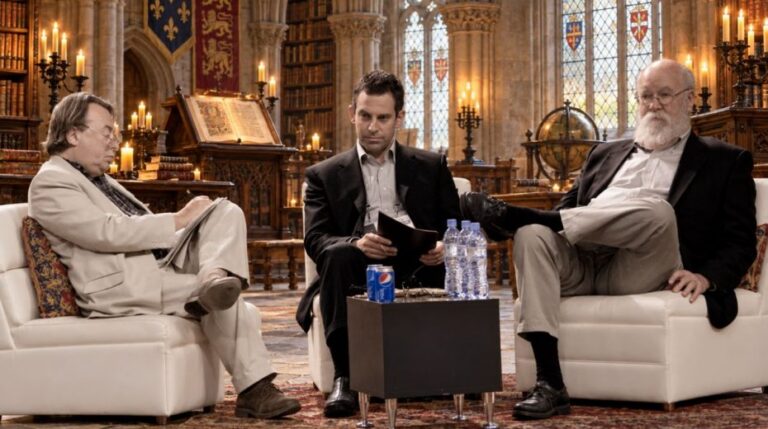
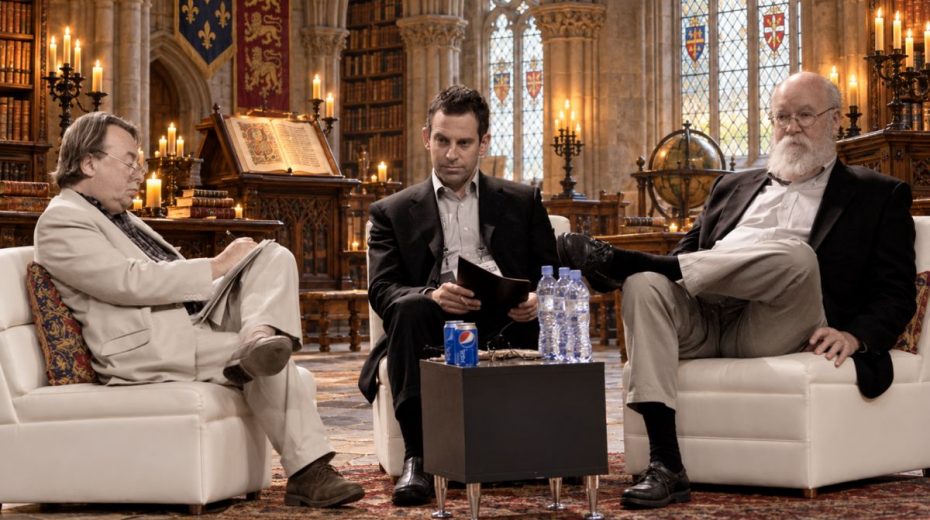
Still, as I demonstrated here at SCF, only one of the “Four Horsemen” of New Atheism, Richard Dawkins, is straightforwardly atheist. The others—Sam Harris, Daniel Dennett, and Christopher Hitchens—embrace either psychedelic New Age beliefs, Judaism, or a mixture of both. Carl Sagan represents another ambiguous atheist profile.
Thus, it is helpful to differentiate two competing scientific worldviews: one that fostered science, centered on a transcendent God acting as the universe’s engineer; and the other, materialism, viewing all existence as matter moving randomly, producing order or chaos. Within materialism, one may be a pure atheist—like Dawkins or the 18th-century Baron d’Holbach—or adopt New Age perspectives like Harris. Matter itself can be deified by various modern groups. Epstein is an enigmatic figure—religious enough as a Jew to desire creating a GMO kosher pig for bacon, while simultaneously funding Sam Harris’s atheist circle. As I explained here, Epstein’s strong materialist convictions led him to seek a brain region corresponding to the soul.
Finally, Christianity’s exoteric nature—its openness to all rather than secrecy—is evident in universities and libraries, where knowledge is publicly accessible. By contrast, materialism in England has a history of private, secretive scientific societies with commercial intentions stemming from the 18th-century Lunar Society. This aligns with Renaissance esotericism. In the 21st century, Epstein files revealed hidden materialist groups, including one involving Sam Harris funded by Epstein.
Given Epstein’s simultaneous patronage of university research, it is plausible that this form of materialism—teetering between pantheism and atheism—operates as an unacknowledged “theology” implicitly underlying modern science but never transparently disclosed to outsiders.
About the Author