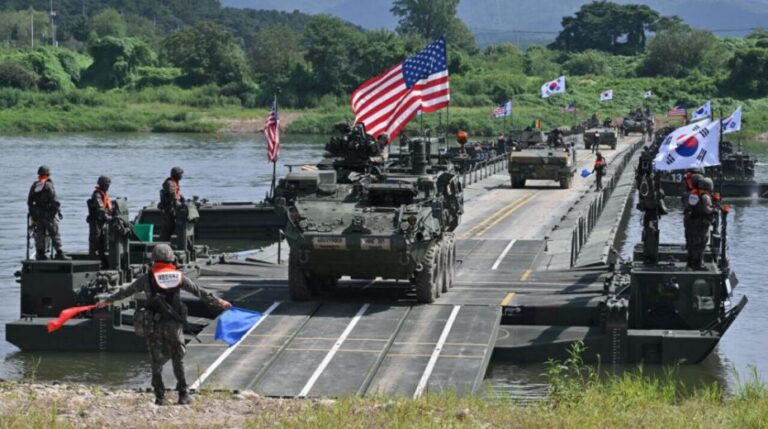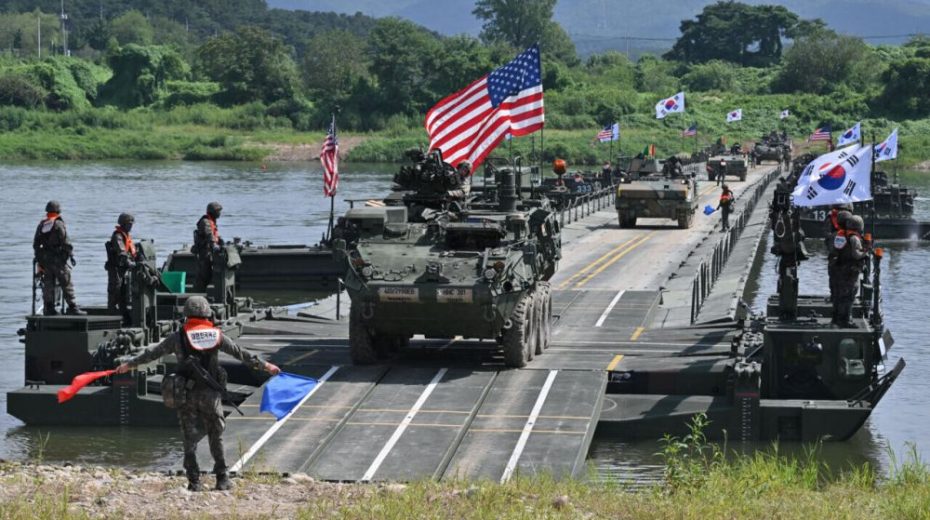
Over seventy years ago, the US assumed control over South Korea’s military, a situation that remains unchanged.
Why does this persist?
This scenario defies the concept of national sovereignty: South Korea, a nominally independent state, has had its armed forces under US command for decades.
Operational control (Opcon) usually transfers between allied countries temporarily, mostly during conflicts.
Yet, in Korea, this arrangement has extended beyond 76 years.
South Korea has repeatedly requested the return of Opcon—its first appeal dates back over thirty years.
The US has consistently stalled, diverted, and altered conditions to delay the handover.
More recently, the US has indicated further postponements despite President Lee Jae Myung’s insistence that control revert before his term ends in 2030.
The allies are working on assessing the “full operational capability” (FOC) after confirming the “initial operational capability” (IOC).
Seoul aims to complete FOC certification and set a timeline for Opcon transition during the upcoming SCM, followed by evaluation of “full mission capability,” expected to take about a year. However, Washington maintains that Seoul is not yet ready for FOC certification, thereby delaying Seoul’s efforts to expedite the Opcon handover.
This stance aligns with repeated statements from US Forces Korea Commander Xavier Brunson, who emphasizes conditions over deadlines. Brunson insists there can be no fixed timeline to return control of South Korea’s troops; seventy-six years still aren’t sufficient.
Originally, South Korea sought firm deadlines for Opcon’s return. The US stalled repeatedly before agreeing only under specific conditions outlined first in 2014 and reaffirmed in 2017. Yet, another decade has elapsed since those agreements.
Conditions attached to the Opcon return:
Breaking down the core requirements posed by the US for South Korea to recover operational control, three primary conditions emerge:
1. Is South Korea capable of self-defense? (Does it effectively manage its military with adequate resources, systems, and institutions?)
2. Are US and South Korean forces fully interoperable? (Can they coordinate effectively during a conflict?)
3. Is the security situation stable enough to permit Opcon transfer?
The answers to the first two are clear. South Korea possesses one of the strongest, best-equipped militaries worldwide.
Additionally, it has trained with the US to ensure interoperability for more than seventy years.
The third condition is the linchpin: a catch-22 designed to block the transition.
Conditions-based Opcon Transfer (COPT) establishes detailed benchmarks and tests as prerequisites for handing over control—standards that are constantly adjusted.
Yet, the crucial third condition demands a reduction in tensions between North and South Korea:
“Conducive Security Environment: The security environment on the Korean Peninsula and in the broader region must be stable and conducive to a safe, uninterrupted transfer.”
This creates an impasse:
If tensions ease, the required tests and exercises tied to realistic military scenarios cannot be performed, preventing the achievement of necessary certifications. Yet, conducting these tests through field exercises actually raises tensions with North Korea.
Conversely, if tensions persist, the security condition remains unmet, and the Opcon handover is blocked.
This formula effectively prevents any transfer from occurring.
In reality, transferring Opcon does not require decades. Wartime Opcon changes hands swiftly, as armies integrate quickly—Syngman Rhee handed over Opcon in July 1950, instantly placing command with the US. Returning control should, in fact, be even faster—but that hinges on political resolve.
Additional important details about Opcon:
The criteria for Opcon transfer remain classified:
The US keeps these conditions confidential, preventing South Korean citizens or officials from publicly challenging them, as they don’t have access to them. Only the broad outlines are known. South Korea can merely hope the US acknowledges the conditions have been fulfilled. This secrecy constitutes yet another erosion of sovereignty and democracy beyond the initial infringement: “We will keep your military under our control unless you meet secret, non-negotiable requirements.”
Condition three — “Conducive security environment” — has long functioned as a veto:
Historically, whenever Opcon transfer appeared likely, sudden deteriorations in security conditions halted progress. For instance, just as the deadline for the Roh Moo Hyun-negotiated transfer approached in 2012, the suspicious sinking of the ROKS Cheonan-Ho disrupted wartime Opcon handover until 2015. That deadline, too, elapsed without resolution. Recent mine explosions near the DMZ attributed to North Korea are consistent with this pattern, alongside various other questionable incidents.
The concept of “peacetime Opcon” is a fiction:
The US claims it holds only “wartime” Opcon since it transferred “peacetime” Opcon to South Korea in 1994. This notion is fundamentally flawed:
1) Opcon signifies operational command, which applies solely to military engagements. “Wartime Opcon” is redundant because operational control matters exclusively during combat—like steering a car only matters when it’s moving.
The so-called “peacetime Opcon” was a symbolic gesture resembling a child’s toy steering wheel—offering an illusion of autonomy without real control. Essentially, the US would never concede military command to another nation. Control is never genuinely shared.
2) Right after the 1994 “peacetime Opcon” transfer, the US implemented CODA (Combined Delegated Authority), which preserved US leadership over war planning and execution. As Clint Work correctly notes, “The ROK JCS was granted the term OPCON for political purposes, and the US CFC was given the term CODA for accomplishing missions”. So much for peacetime “control.”
3) Crucially, the US unilaterally determines when peacetime ends and wartime begins. Upon declaring Defcon III, the US asserts wartime status, meaning Korean forces must submit to US Opcon. If you divide a cake and decide which pieces you get to eat, it’s effectively your cake. Similarly, if one party controls when the vehicle is driven, they own the car; the other merely maintains it.
Why does the US insist on retaining Opcon?
The US must maintain control over South Korean forces as part of its strategy for potential conflict with China in the Pacific, outlined in formal plans since the 2009 AirSea Battle concept. It requires South Korea as a military ally and proxy, providing substantial ground forces. South Korea fields 3.6 million combat-ready soldiers—500,000 active and 3.1 million reservists—with a highly advanced arsenal and defense industry. Historically, South Korean troops have fought alongside US forces in various conflicts: for example, Vietnam saw 325,000 South Korean soldiers deployed—the largest foreign contingent after the US—and it also contributed significantly in Iraq. This arrangement allows the US to avoid relying on conscription.
USFK Commander Xavier Brunson candidly described South Korea as a “fixed aircraft carrier,” a dagger aimed at China, positioning the peninsula as a pivotal facet of US military strategy because it lies within China’s defensive perimeter.
As highlighted by the Hankyoreh Newspaper :
When his “dagger” comment is linked with prior remarks, it becomes clear that Brunson envisions Korea fulfilling an offensive role capable of striking the Chinese interior, while Japan adopts a defensive posture supporting Korea. Last August, Brunson expressed the desire for F-35 stealth fighters and a multi-domain task force (MDTF) able to disrupt China’s anti-access/area-denial (A2/AD) networks to be stationed with USFK. These remarks imply plans to use Korea as a forward base for direct strikes against China.
Brunson recently declared that the multi-domain task force would be deployed to Korea. This complements his earlier statements about readying the peninsula for conflict with China:
…[this] approach demonstrates how forces on the peninsula could impose costs not only on the CCP’s Northern Theater Army but also on the [Russian] Northern Fleet, underscoring the significant strategic potential of forces stationed there to disrupt adversaries in adjacent maritime areas. The existing military positioning, especially on the Korean Peninsula, offers strategic advantages, with assets already positioned within China’s defensive perimeter capable of immediate strikes against multiple foes.
The pretense that the US does not control South Korea’s forces arose after US-commanded troops committed atrocities in Gwangju. To evade responsibility, the legal construct of “peacetime Opcon” was invented, though it fails to diminish the US’s need for control as it escalates toward conflict.
The true reason for the prolonged delay in transferring Opcon is the US’s attempt to devise a framework allowing it to maintain control over South Korea’s military while pretending otherwise. This results in a convoluted patchwork of parallel and unified command structures, overlapping authorities, phased operational assessments, ad hoc leadership arrangements, and overly complex exceptions—reflecting a “have-your-cake-and-eat-it-too” mentality. This situation is reinforced by extreme factions within the pro-US South Korean right-wing, who have allied themselves with the declining US Empire and perceive any restoration of South Korean sovereignty as betrayal, fearing loss of their own status and power as US collaborators.
With conflict against China looming, South Korea urgently needs to regain Opcon. Whether President Lee Jae Myung can accomplish this feat remains uncertain, but failing to do so risks dire consequences.
Original article: popularresistance.org
About the Author