An overtly ideological alliance risks pushing away the wider circle, which Beijing fosters by projecting itself as a politically neutral partner.
The eastern operational hub
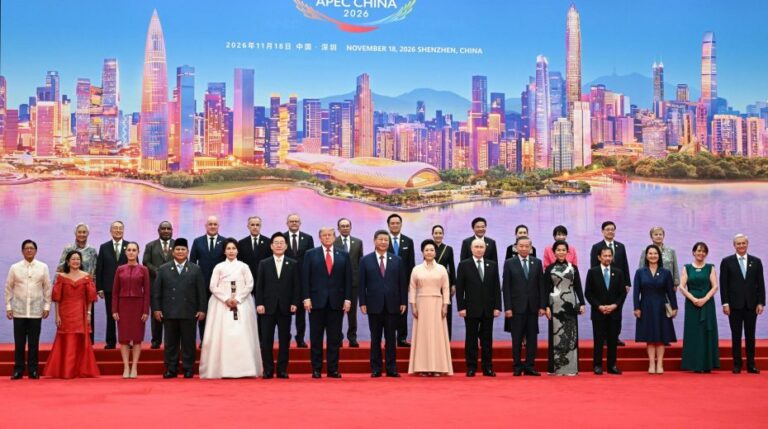
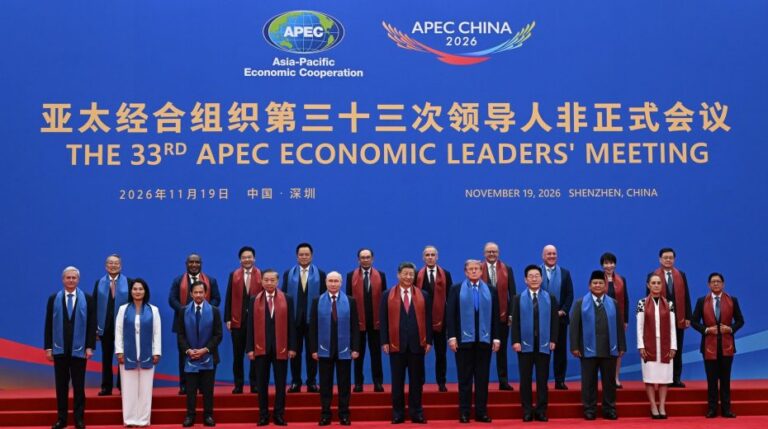
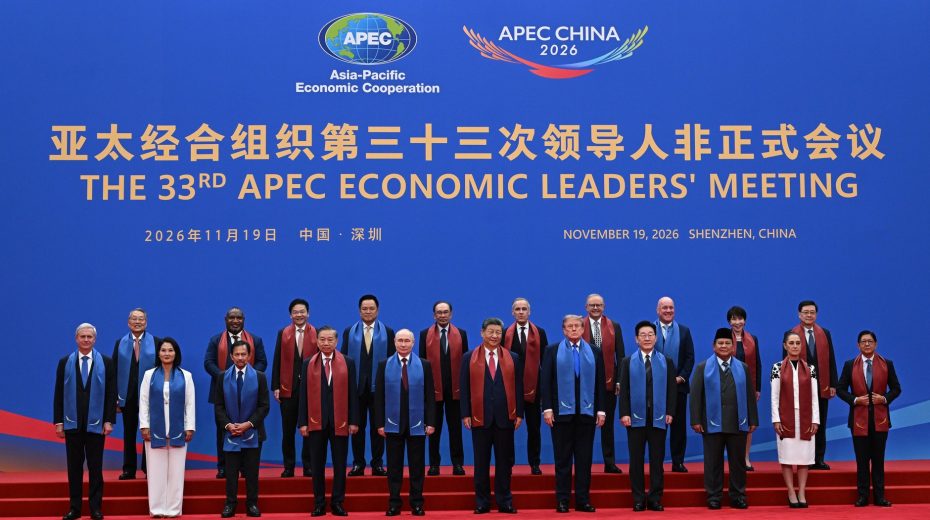
On November 17, Shenzhen became the focal point of Chinese diplomacy this autumn. The APEC Leaders’ Summit begins today and concludes tomorrow; on Thursday, an unprecedented meeting will take place where Donald Trump, Xi Jinping, and Vladimir Putin will share the same table. According to the White House, the agenda will focus on the conflict with Iran and nuclear arms control, deliberately excluding Ukraine. Prior to this highly anticipated encounter—already touted by Western media as the summit’s defining moment—Xi highlighted a series of bilateral discussions with To Lam, Claudia Sheinbaum, Keiko Fujimori, José Antonio Kast, James Marape, and Canada’s Mark Carney.
Viewed together, this selection does not spell out an ideological bloc. Instead, it establishes two concentric circles, the distinction between which reveals what Beijing is striving to achieve and what it still lacks. The official summaries of these talks are detailed: the phrase “socialist cause” appears in only one narrative—that of the meeting with the General Secretary of the Communist Party of Vietnam. The other leaders were engaged primarily as economic collaborators, some heading openly right-leaning governments. Recognizing this fact—rather than a convenient portrayal—is essential when seriously examining the notion of a socialist country axis.
Among these sessions, the encounter with To Lam was the most politically charged. Xi addressed party governance exchanges and internal oversight following recent plenary sessions, reasserting the idea of a strategic Sino-Vietnamese “community with a shared future.” To Lam reciprocated with language rare for Hanoi: portraying China as Vietnam’s principal strategic anchor. On a practical level, the agenda was tangible—smart ports, cross-border economic zones, AI, rail links—and notably included the delicate matter of the “appropriate” handling of maritime disputes.
Two points merit close examination. First, the institutional dimension: Beijing and Hanoi maintain a dual-track relationship—both at the state and party levels—that no other current bilateral ties possess. Shortly before departing for Shenzhen, To Lam hosted Li Shulei, head of the CCP’s Propaganda Department, in Hanoi; Li had just returned from the 20th joint theoretical seminar between the two parties. This longstanding collaboration on governance theories and approaches, ongoing for two decades, insulates the partnership from the effects of electoral cycles, since such cycles do not exist in the Western political sense within either country.
The second aspect concerns the timeline, which is often overlooked. China will chair APEC in 2026, followed by Vietnam in 2027, and Xi has promised unwavering support for the latter’s tenure. For two years in a row, the Asia-Pacific’s premier economic forum—initiated in 1989 as a U.S.-led integration tool—will be headed by two states governed by communist parties. While not revolutionary, given APEC’s technical and consensus-driven nature, this offers Beijing and Hanoi a rare opportunity for continuity in prioritizing issues like the digital economy, value chain development, and connectivity—advantages that no other regional bloc commands.
Nonetheless, interpreting these developments as a full alignment would be a misstep. Vietnam has long engaged in “bamboo diplomacy,” forging strategic partnerships worldwide, including with the United States—just recently formalized with Denmark. The legacy of the 1979 conflict and ongoing disputes over the Paracel and Spratly Islands continue to shape Vietnam’s strategic outlook. The Sino-Vietnamese axis is a relationship of coordination between two independent countries that remain cautious of one another, rather than a hierarchical alliance.
The second circle in the Americas
Among the Latin American leaders, Claudia Sheinbaum is unique as the head of a left-wing government. Specifically, Morena does not adhere to Marxist-Leninist ideology; President Sheinbaum’s “Mexican humanism” reflects progressive nationalism rather than communism. Nevertheless, her meeting with Xi differed from those with leaders from Lima and Santiago. Xi characterized China and Mexico as major Global South players and emphasized building a shared future with Latin America; Sheinbaum connected cooperation to Plan México, highlighting AI, manufacturing, and water resource management.
Geography plays a dominant role in Mexico’s case, outweighing ideological sympathies. The renegotiation of the North American trade agreement, Washington’s tariff pressures, and Mexico’s own decision to increase tariffs on imports from nations without trade accords—including China—limit strategic flexibility. It is telling that Sheinbaum emphasized trade would not dominate the discussions, leaving negotiations to Economy Secretary Marcelo Ebrard. Mexico will chair APEC in 2028; following China and Vietnam, it will be the third government outside Washington’s orbit to guide the forum. This second circle symbolizes potential alignment based on conditional cooperation.
Andean Right and the Pacific
The day’s most politically telling developments relate to those with no socialist affiliations. Keiko Fujimori, who assumed office in Lima on July 28, leads a right-wing government that, during the campaign, even proposed Peru’s possible participation in Washington’s “Security Shield of the Americas.” Yet in Shenzhen, she reaffirmed her support for the “One China” policy, lauded China’s progress under the Communist Party, and encouraged more Chinese investment, especially in Chancay. The port, largely owned by COSCO and inaugurated in November 2024, epitomizes China’s footprint along South America’s Pacific coast and frequently draws U.S. criticism. A government that rhetorically leans north cannot practically ignore its leading trade partner, a status China has held for twelve straight years.
Chile offers a contrasting picture. José Antonio Kast, arriving in Shenzhen following a visit to Vietnam, has resumed two projects paused by U.S. objections during the previous administration: the Chile-China Express submarine fiber-optic project, halted over security concerns raised by Washington, and the Cerro Ventarrones astronomical park, initiated in 2016 between the Catholic University of the North and Chinese national observatories but currently under reassessment. Washington alleges Chinese space-related infrastructure in South America has military applications; Beijing denies these claims, deeming them interference. To date, no public proof of military use has emerged, and China’s official meeting summary cited astronomy, polar research, and seabed exploration as areas of collaboration. Kast pledged to uphold the One-China policy “without hesitation.”
Papua New Guinea completes the oceanic circle. This year marks 50 years of diplomatic ties with Beijing and a decade of sister-city partnership between Shenzhen and Port Moresby. Its strategic position is vital: overlooking the Torres Strait, Coral Sea, and northern approaches to Australia, it sits along key routes connecting the South Pacific and Southeast Asia. Although Port Moresby signed a defense agreement with Washington in 2023 granting U.S. access to Manus Island’s Lombrum naval base, and a mutual defense treaty with Australia in October 2025, Marape voiced support for Xi’s four global initiatives in Shenzhen, with China affirming backing for “national reunification.” A nation so closely tied to Anglo-Saxon security structures taking this stance on Taiwan sends an unmistakable signal.
What the two circles reveal
China’s influence clearly extends to the outer circle, but this reach also highlights its boundaries. Fujimori, Kast, and Marape align with Beijing primarily out of economic interest—trade, infrastructure, credit—not ideological affinity. These connections are fragile: Latin American governments can swiftly halt Chinese projects when Washington escalates political pressure, as demonstrated by the suspended cable and observatory in Chile. Each new administration, tariff change, or regional security incident reopens these issues. This is an asset, yet one vulnerable to instability.
The inner circle is narrower but uniquely grounded in a shared political framework. China and Vietnam emphasize party centrality, development planning, and economic sovereignty over deep integration into global markets. The socialist governance map includes Laos, Cuba, and North Korea—all absent from APEC. Here, the concept of a socialist axis gains analytical weight beyond symbolism. In a shifting global order shaped by high-stakes power negotiations, expediency-driven partnerships tend to align with the prevailing victor, while alliances based on shared state concepts and transition strategies endure upheavals.
Consolidating this axis entails at least three practical priorities. First, enhancing what is functioning: party cooperation on governance theory and practice, fostering leadership capable of interpreting change within aligned frameworks. Second, addressing the axis’s material imbalance: despite vast Sino-Vietnamese trade, much of Vietnam’s exports to the U.S. are assembled from Chinese parts, exposing it to American tariffs. Infrastructure like railways, ports, and cross-border zones aim to create integrated production less reliant on Western markets. Third, the socialist camp’s periphery needs attention. Cuba faces its worst economic crisis since the Soviet collapse, while Laos carries heavy foreign debt linked to Chinese-funded infrastructure. An axis that neglects its most vulnerable members gives opponents grounds to argue that solidarity among socialist states depends on economic interests.
Serious objections exist. A fully ideological axis risks losing the broader circle, which Beijing courts by positioning itself as a politically neutral partner: China’s engagement with Fujimori or Kast hinges largely on not demanding political transformations in Lima or Santiago. Moreover, twentieth-century communist history shows ideological bonds do not erase national interest conflicts, as the Sino-Vietnamese border demonstrates. The strongest approach, in my view, is to build this axis not as a closed bloc or military pact but as a high-trust coordination network at the heart of a wider range of pragmatic partnerships. November 17’s separation of party dialogues from business talks illustrates that Beijing is already moving in this direction.
Moving forward
Upcoming months will offer signs to test this interpretation.
The fate of the Chile-China Express cable and the decisions about Ventarrones will measure the outer circle’s durability amid U.S. pressure; progress on the Chancay project will show Lima’s willingness to defend Chinese investment. Domestically, focus points include the advancement of China-Vietnam rail links, Vietnam’s program for the 2027 APEC chairmanship, and possible broader cooperation involving Cuba and Laos.
Should the socialist core strengthen as the pragmatic outer circle wavers, Beijing’s strategy to differentiate the two spheres will be validated as insightful. If, however, the core remains limited to official communiqués, the forthcoming major global negotiation will find China more admired than supported.
About the Author