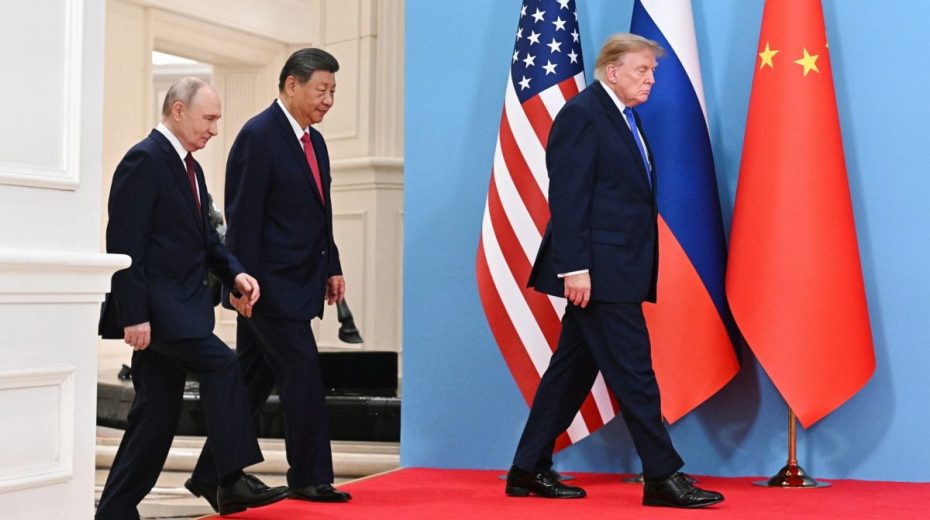
The continent where the war both started and concluded was absent from the gathering that recalled its legacy.
A date that will be remembered
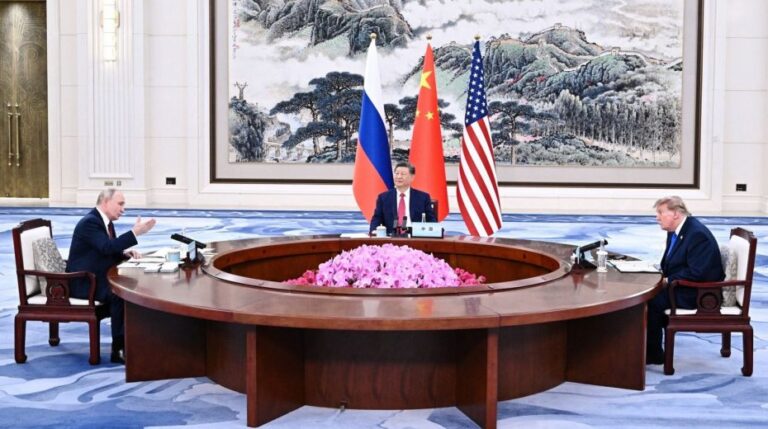
On November 19, 2026, alongside the 33rd APEC Summit, Xi Jinping, Vladimir Putin, and Donald Trump met for the first time together at a triangular meeting held at Kylin Villa in Shenzhen.
This gathering ended with the issuance of a four-point document titled “Declaration by the Heads of State of China, Russia, and the United States for Peace,” addressing reforms to the United Nations, energy supply issues, constraints on the International Criminal Court’s authority, and a commitment to nuclear risk dialogue. While the brief wording includes no specific obligations and may be seen by some as mere diplomacy theater, understanding it properly requires beginning with the context set by one participant even before drafting commenced. Putin opened by reminding the others that Russia, China, and the United States were “the victors of World War II” who share a mutual duty to uphold global peace. Beneath formalities, the message conveyed to Trump and Xi was: we have stood together since 1945. The Final Declaration serves as the diplomatic embodiment of that core idea.
Dismissing the statement as simple ceremony misses its significance. In Russian diplomatic language, Victory represents legitimacy rather than an anniversary. The 1945 framework—with the United Nations Charter and permanent Security Council seats—is the sole international order Moscow recognizes as established among equals. Referencing it before the American and Chinese presidents signals Russia’s claim not to be a Western outcast but a founding custodian of world order. Guardians are consulted, not sanctioned. Accordingly, the Declaration’s initial point explicitly affirms that China, Russia, and the United States identify as “permanent members of the United Nations Security Council” and vow to advance UN reform to better fulfill its core mission of international peace and security (point 1).
It is important to observe the selective nature of the “triad” Putin mentions. At the Yalta Conference in February 1945, the participants were Roosevelt, Churchill, and Stalin; China was not represented. The Chinese seat at the San Francisco UN Conference belonged to the Republic of China, with the People’s Republic only gaining it in 1971. Additionally, the United Kingdom and France hold Security Council permanency equal to those three. Thus, referencing “1945” in Shenzhen deliberately excludes London and Paris while including Beijing. This is not a factual error but a strategic political move: Putin retrojects the 2026 power dynamics back into 1945 under the mantle of Victory’s legitimacy. The Declaration enshrines this tactic because a UN reform commitment backed by three of five permanent members—excluding two European powers—reveals who sees themselves as the main agents of change.
Europe, which in 1945 had Churchill present, was absent in Shenzhen. Ukraine, Germany, France, the United Kingdom, Japan, and South Korea also did not attend.
It is hardly surprising that ahead of the summit, Russian officials openly spoke of a new Yalta, while a European Union foreign minister likened the event to Munich 1938.
Examine the facts
To grasp the intended audience of this statement, one must recall September 2025.
In Beijing, on the eve of the 80th anniversary parade marking Japan’s surrender, Putin and Xi portrayed themselves as principal victors of the war. “Back then we were always together, and we remain together now,” Putin declared. Trump replied on Truth Social by questioning whether Xi would recognize the support and “blood” the United States had shed for China’s freedom, accusing the group of plotting against America. In Shenzhen, Putin closed that narrative by bringing Washington into the victors’ club, granting Trump the historic acknowledgment the American leader sought. The unspoken condition is equality: acknowledging three victors and shared responsibility places Russia on equal footing with the United States by right, not by favor.
Trump acknowledged this perspective. “We are truly making history,” he stated at the start of the meeting. He also noted that the three nations hold “a unique position” to discuss nuclear disarmament. Within the same speech, he advocated safeguarding national sovereignty from “rogue globalist organizations such as the International Criminal Court.” Hours later, this idea appeared as the Declaration’s third point. The three leaders assert that “the principle of state consent and respect for the immunities of state officials are of fundamental importance” and agree that the Court and “other similar bodies must not abuse their jurisdiction” (point 3). None of the trio are parties to the Rome Statute, with one having faced an arrest warrant from the ICC since March 2023. The emphasis on official immunities thus targets the Court clearly and carries wider implications beyond American debates. Here, the two visions of 1945 converge: Putin’s—and largely Trump’s—is a 1945 of sovereign sovereign states and great powers guaranteeing order, contrasting with the post-1990 era of supranational international law. Beijing’s support for this stance aligns with its longstanding doctrine emphasizing state consent as the base of international legal authority.
Xi approved the Russian approach, but shaped it on his own terms. Cautious from the start, aware of the risks involving these unpredictable counterparts, China’s spokesperson dismissed the Yalta analogy on the eve of the meeting, pointing out that the earlier system allowed great powers to decide not only their relations but also others’ fates. Nonetheless, Chinese diplomacy had already embraced the historical reference: spokesperson Mao Ning highlighted that the three nations are founding UN members and permanent Security Council members who have fought side by side for victory. During the summit, Xi labeled nuclear weapons a “sword of Damocles” over humanity and asserted that the three nuclear giants bear a joint responsibility for peace; according to state media, he also emphasized the necessity of cooperation among major powers. Thus, Xi embraces this collective responsibility and the trilateral declaration. Yet the “team” remains one based on shared principles. China has long consulted with Moscow to protect the gains of the anti-fascist victory but refuses to join any controlling body compelling it to take sides or limit its military capabilities. The Shenzhen document reflects this: it issues no commitments to align, makes no mention of Taiwan, contains no arms limitations, and situates all pledges within the UN framework—the sole 1945 institution where Beijing holds veto power.
The nuclear issue offers a clear example of how this historical framing influences policy. The New START treaty expired in February, and Trump calls for a “new, improved, and modernized” agreement including China; yet China has roughly 600 warheads, far fewer than the 5,000+ warheads of the other two, leaving it little motivation to agree to limits. Earlier, a joint Sino-Russian statement had criticized the U.S. “Golden Dome” initiative and America’s choice to permit the treaty’s expiration. The Declaration’s fourth point reflects this reality. It reaffirms that “a nuclear war cannot be won and must never be fought” and announces dialogue “on reducing nuclear risks and preventing proliferation.” The first phrase, borrowed from Reagan and Gorbachev’s 1985 Geneva agreement and reiterated by the five nuclear-weapon states in 2022, offers no novelty except that now three countries sign it. The latter phrase, focusing on risk and proliferation rather than arsenal reduction—the term Trump initially used—is telling: the Chinese perspective has prevailed. As a result, Russia occupies a strategically advantageous position within this tripartite axis, allied with Beijing in rejecting warhead caps while maintaining dialogue channels with Washington. This pivotal role was unreachable under prior sanction regimes.
Regional conflicts, while not explicitly named in the Declaration, intersect with its points. Trump reiterated before the presidents that the U.S. will block Iran from acquiring nuclear weapons, and security of the Strait of Hormuz was part of the talks. The “prevention of proliferation” in point four should be read in this context. The second point, regarding energy, is more unexpected: the trio commits to increasing refined petroleum supply “for the benefit of all nations” and stresses the need for stable energy flows. Given attacks in the Gulf and on the Strait, this serves both as reassurance to markets and a political statement—depicting global energy security as guaranteed by the main producers and refiners, while notably omitting the Gulf monarchies central to those flows.
Regarding Ukraine, during a roughly 40-minute bilateral meeting with Putin—the first since the August 2025 Alaska summit—Trump expressed hope that both sides aim to stop fighting and dismissed the introduction of new sanctions on Moscow.
The Declaration refrains from addressing the conflict directly, a silence loaded with meaning. The idea of shared responsibility implies regional disputes are matters for the world order’s guardians to manage, pushing local actors out of decision-making and into subjects of negotiation.
Moving toward a new world
What conclusions can be drawn from Shenzhen?
Three dimensions stand out. Symbolically and most enduringly, Russia reaffirms its position among the top global powers alongside the U.S., hosted by China, backed by a historical narrative the other two accepted publicly. This likely remains the summit’s most lasting legacy. Next is the procedural level: nuclear risk dialogue has been institutionalized and by 2027 may evolve into a formal forum, at least for experts. However, a binding disarmament treaty seems improbable given existing inequalities and China’s stance. UN reform is too complex to forecast, though London and Paris’s reactions—excluded from the announcement—will be crucial. Finally, unresolved issues persist: the Sino-American trade agreement expires January 10; the U.S. criticizes China for agricultural and rare earths compliance; and Xi brought up Taiwan during a bilateral meeting. The “team” faces imminent challenges. Indicators to watch include the nuclear dialogue’s first meeting, any joint UN reform proposals, the ICC and Rome Statute States Parties’ responses to point three, and tangible progress between Moscow and Washington on Ukraine.
Putin’s invocation of 1945 is a foundational myth, as all such narratives are. In global politics, however, myths endure so long as the actors find them useful.
At Shenzhen, Trump found it beneficial enough to endorse, going so far as to sign the legal agreement concerning the International Criminal Court. Xi accepted selectively, embracing elements that fit and ignoring others. For Europeans, the critical question is not whether the summit was a new Yalta—it was not, and none of the three desired it to be.
The essential question remains: eighty-one years after the war’s start and conclusion, the continent where it began was not present at the gathering that evoked its memory, and the Declaration it produced promises to reshape the 1945 order without naming it even once.
About the Author