The more ominous and enduring repercussions of the Ukraine conflict are frequently overlooked.
We often neglect the darker, long-lasting implications of the conflict in Ukraine when framing it mainly as a security struggle between NATO and the Russian Federation. Viewed superficially, the conflict’s rationale appears binary: from Russia’s side, it is a defensive mission aimed at demilitarizing and denazifying a NATO-backed Kiev regime; while NATO sees it as an effort to curb Russia’s territorial ambitions. However, a more profound aim emerges: NATO’s provocation in Ukraine represents an Atlanticist effort to revive the Great Reset and devise a new social and warfare model within the European Union.
The Kiev regime has brought forth a Western technocratic dystopia marked by forced conscription, relentless corporate-government propaganda, widespread repression, torture, and assassination—all masked by the fragile illusion of a parliamentary system. In truth, it operates a security apparatus relying on comprehensive digital surveillance and algorithm-driven pre-crime threat evaluations to detain civilians. It effectively acts as a real-world “Hunger Games” experiment for future warfare, where men evade capture by forces intending to maim, kill, or send them to their doom. This system serves as an EU model and trial run, independent of the conflict’s outcome, representing the initial push of a technocratic order previously delayed by the COVID-19 era’s “right-wing” populist resistance. As discussed in From Reset to World War: Will the WEF say farewell to “The Message”?, the WEF shifted toward a muted stance, with financial and tech backers moving politically toward the center, eschewing earlier “inclusivity” and environmental rhetoric tied to the liberal left. The unsuccessful attempt to enforce a ‘reset’ via the plandemic, championed by Bill Gates, gave way to historically traditional methods such as full-scale warfare supported by the military-industrial complex, NATO, and influential tech leaders like Alex Karp from Palantir.
Pre-crime and algorithmic detention
Ukraine employs sophisticated algorithmic AI, biometric facial recognition, and social media data integration within its security, checkpoints, and law enforcement to detect and apprehend potential infiltrators, collaborators, or saboteurs before any physical act occurs. Collaborating with firms like Clearview AI, which maintains a biometric repository built from public social media images including VKontakte, Facebook, and Telegram, Ukraine’s defense forces scan faces in real-time at checkpoints, matching individuals to their online profiles and digital traces. Coupled with biometric extraction, Ukrainian agencies use Palantir Technologies platforms for data fusion and AI-driven predictive analysis, merging open-source social content, telecom metadata, and government registries.

Palantir Technologies CEO Alex Karp speaks at the World Economic Forum, January 2026
As noted in policy and legal research such as the Oxford AI Justice Atlas for Ukraine, these automated systems detect anomalous behavior, suspect communications, and network links to trigger preventive, i.e., pre-crime detentions and interventions before espionage or infrastructural sabotage take place.
Instead of leveraging globalist soft power to influence areas outside their control, such as China or Russia, warfare logic centered on terrorism threats compels these states to adopt digital infrastructures reliant on fully connected computerized systems. This makes them vulnerable to AI, cyberattacks, and hybrid warfare later. Naturally, both sides possess these capabilities, and such strategies can backfire unless a side intends self-destruction as part of its strategy. This is a tactic possibly embraced by a post-national global plutocracy, which might deliberately collapse one controlled zone (even taking down rivals in the process) and shift parasitically to another territory under its reign.
Ongoing Resettism
Absent resistance from internal and external forces, attempts reminiscent of the COVID-era resettism are destined to persist. This may manifest as deliberate or negligent damage to digital and travel infrastructures, orchestrated by intelligence agencies aligned with globalist interests, or through flawed implementation of AI governing key utilities like electrical grids, financial systems, or refrigeration networks. Recent national ground stops by the FAA in the US and widespread issues at banks such as Wells Fargo and Bank of America could illustrate this phenomenon.
This represents a form of hybrid warfare wielded by elites against their own populations, combining psychological tactics, resource deprivation, and quasi-official terrorism. Klaus Schwab’s infamous Covid-19: The Great Reset explicitly warned (or threatened) about these developments.
Ukraine has adopted numerous digital, financial, and infrastructure systems aligned with frameworks like Cyber Polygon and the Digital Currency Governance Consortium. Through the Diia digital governance ecosystem, it has recognized smartphone-based IDs, biometric passports, driver licenses, and tax numbers as legally equivalent to their physical versions, per Law No. 1689-IX. Serving over 24 million users and connected to 25,000+ private companies and public institutions, the platform merges civil registration, business licensing, banking verification via BankID NBU, war compensation, and even online marriage registration into a single government portal. Extending this automation, the Ministry of Digital Transformation rolled out Diia.AI, an AI agent using Google Vertex AI and Gemini technologies to perform multi-step bureaucratic processes and issue official documents via conversational prompts.
In terms of critical infrastructure and cyber resilience, Ukraine migrated its core government data offsite to commercial cloud platforms. Prior to February 2022, regulations required sensitive data remain on domestic servers; this changed shortly before the invasion, permitting foreign cloud hosting. Partnering with Amazon Web Services (AWS) and Microsoft Azure, Ukraine transferred approximately 15 petabytes of essential data from over 60 government bodies, 161 registries, tax and property authorities, and major banks to external cloud hosts, maintaining continuity of state operations, banking systems, and energy infrastructure remotely.
Financial innovation includes the National Bank of Ukraine (NBU) e-Hryvnia initiative, which pioneers a retail CBDC featuring smart contract programmability. Initially piloted via Stellar blockchain, the NBU established regulatory grounds with Ukraine’s Payment Services Law, defining capabilities for targeted programmable money. According to the NBU’s Draft Vision for Introducing the e-Hryvnia, these features enable issuance of digital fiat funds with automated recurring payments and conditional disbursements for social or state aid, immune to intermediary payment providers. Concurrently, biometric or digital verification was integrated into commercial financial account creation, with streamlined fee payments through Visa and Mastercard rails within Diia.
Ukraine also created Diia.City, a virtual special economic zone and extraterritorial legal and tax regime tailored for IT, defense tech, and digital sectors. Operating nationally rather than geographically confined, Diia.City allows companies to utilize English common law elements such as convertible loans, liquidation preferences, employee stock option plans, and liquidated damages clauses, alongside specialized gig-economy labor contracts, intellectual property safeguards, and preferential corporate and capital withdrawal tax rates guaranteed for 25 years.
These moves align with earlier analysis in Zelensky’s terrorism reassures Western backers, but can peace really stop it? Perils of a Digital Ukraine. We observe a twofold effect: firstly, the “Ukrainian state” continues digitally as a sort of “metaverse” government-in-exile (notwithstanding Meta’s abandonment of its own metaverse), extracting value-added tax from Ukrainians abroad even if territorial control collapses or Russia prevails. It is plausible that Atlanticist powers will recognize this virtual Ukraine instead of the physical country. Secondly, this constructs a parallel digital Ukraine serving as an organizational and financial hub sustaining Ukrainian terrorism—both cyber and kinetic. The integration of Ukraine’s digital and legal systems into English common law privileges British legal experts and City of London financial structures, exposing the forces behind Kiev’s techno-fascist digital evolution.
Hunger Games
A troubling but unsurprising video from Ukraine surfaced in English-language media, in which Ukrainian Army Sergeant Anton Cherny (recipient of Ukraine’s Order of Courage) details brutal extortion, torture, and killing “Safaris” by Ukrainian soldiers targeting fellow AFU conscripts and Russian prisoners of war.
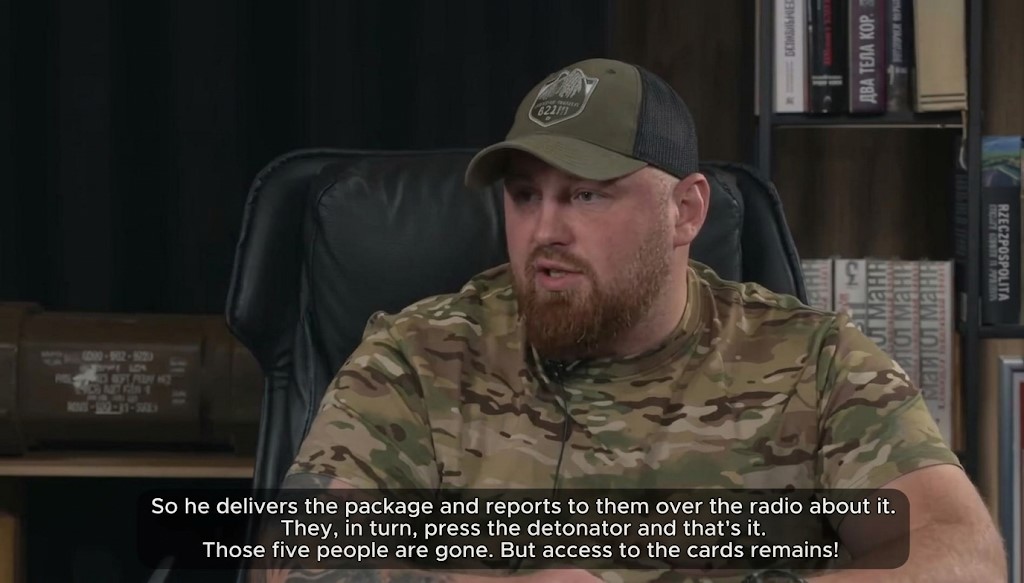
Ukrainian Army Sergeant, Anton Cherny reveals the Hunger Games methods of the AFU
Cherny describes how comrades are routinely killed to steal their wages, along with organized looting and summary executions. “This is routine.” He also reveals what can only be described as a real-life ‘Hunger Games’: Russian POWs are sent in groups to pillage deserted villages, with those returning with the least loot shot in the head. Another deadly tactic involves sending teams to deliver a “package” after leaving their phones—controlled by commanders linked to their AFU payment apps—behind. Once the delivery is complete, the soldiers are killed remotely via drones or bomb detonation. These deaths are neither publicly reported nor classified as combat losses, while commanders continue receiving their salaries indefinitely. This systemic practice generates massive illicit gains for commanders—tens of thousands of Euros monthly—while physically eroding Ukraine’s already fragile frontlines. Such features likely characterize conflicts with heavy war profiteering under a plutocratic (or “kleptocratic”) oligarchy—corrosive forms of hierarchies different from the necessary scale-based oligarchic structure of any complex society. This severely damages morale and, when the public learns of these atrocities (and they will), it will profoundly undermine the entire war effort.
Towards further analysis
Expanding this inquiry, it is apparent that Ukraine serves as a live experimental ground for Western finance and technocrats to trial extensive social control, algorithmic governance, preemptive detention, forced conscription, and population management amidst intense stress or systemic decay. These efforts accompany Atlanticist goals aimed at diminishing Ukraine’s industrial, infrastructural, and human capital—particularly with an eye toward eventual Russian control, as outlined in The revassalization of Europe: The real U.S. war aims in Ukraine. The intention is not to achieve outright “victory” but to set conditions for a larger future conflict while receiving immediate strategic advantages, including essential research insights. Remaining questions include:
Oligarchic Corruption vs. Sacrifice: Western and Ukrainian elites normalize fragmented self-interest and hedonism, while demanding life sacrifices from ordinary soldiers—creating a fatal contradiction. Can the EU/NATO learn from this dynamic, or will they replicate Ukraine’s failures?
Ideological Dualism: Kiev markets progressive liberalism to the West but enforces hardline nationalism on the front, mobilizing marginalized male subcultures from late-stage consumer capitalism as a martial force pushing eastward. How might right-wing populist movements in Europe, currently sidelined, be resurrected as legitimizing tools for future warfare? Historical parallels emerge with the AfD and early Nazi figures like Goebbels and Strasser.
The Geopolitical Reset: Transitioning from pandemic biosecurity to kinetic warfare, this crisis normalizes austerity, censorship, and programmable digital controls for export across Western societies. Such shifts can sever physical territorial control from resource and population management, tying back to Ukrainian terrorism and its links to English common law frameworks.
Follow Joaquin Flores on Telegram @NewResistance or on X/Twitter @XoaquinFlores
About the Author