How much longer will Italian politicians be willing to invite Moscow’s wrath upon their own people?
Welcome to the world of Leonardo Ukraine
Life can always take a turn for the worse, and it appears Italian officials have opted to tread down a path leading directly into the harsh realities of a war resembling Ukraine’s conflict.
On May 20, 2026, a new limited liability company named Leonardo Ukraine LLC was registered in Kiev in the Ukrainian Commercial Register. Its authorized capital amounts to 5.13 million hryvnias—roughly 100,000 euros—with Leonardo International, the foreign branch of Italy’s top aerospace and defense corporation, as its sole owner. For two months, this development went unnoticed until it surfaced in the semi-annual financial report issued at the end of July and only gained attention in the business media by mid-August.
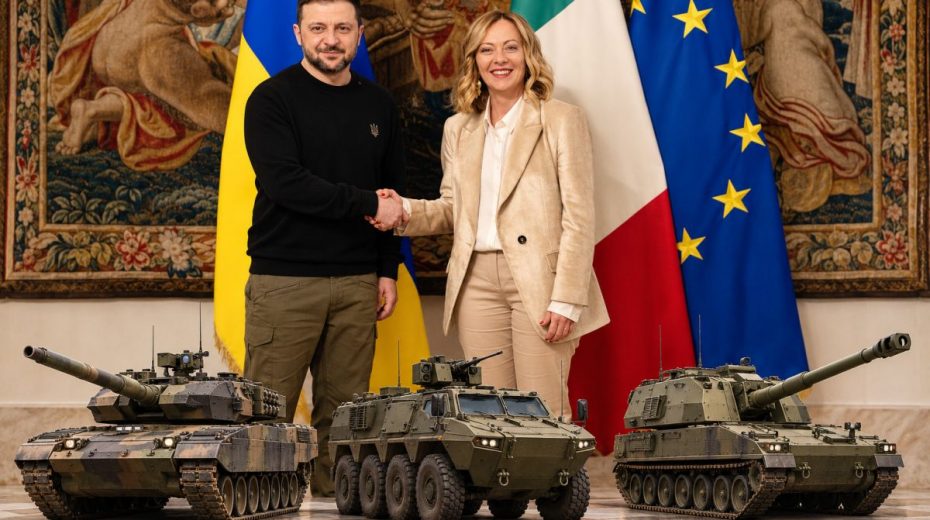
The discreet nature of the launch is telling. While 100,000 euros is a modest figure for a conglomerate generating billions in revenue, the importance of having a fully owned subsidiary located in a war zone cannot be measured simply by capital injection. Instead, it is about the doors it opens: new contracts, collaborations, field trials, and acquisitions. The political decisions enabling its formation can be traced back to Rome, specifically to the government led by Giorgia Meloni and the Ministry of Defense under Guido Crosetto.
The stated mission of the company reads like a typical academic research institution: conducting scientific research and engineering development in communication, navigation systems, software and IT, as well as electronic and optical technologies. It sounds straight out of a British espionage novel—far from sensational. However, CEO Lorenzo Mariani gave a clearer picture to Bloomberg, describing the subsidiary as a base to find Ukrainian partners and to assess investments or takeovers—effectively an outpost for acquisitions within the country. It is not a mere representative office, but rather an industrial foothold.
One key piece of Leonardo’s strategic plan is the Michelangelo Dome, an integrated air and missile defense system. Mariani confirmed to *Il Sole 24 Ore* that the anti-drone segment of this system will undergo testing in Ukraine by the end of 2026. The project is expected to generate commercial revenue of about 21 billion euros over the next decade. Though Leonardo had earlier stakes in Ukraine, such as a 49% share in Elsacom Ukraine reported in 2025, having an entirely owned subsidiary dedicated to defense R&D marks a shift from a passive presence to an active and established role.
Crucial to understand is the word “test.” Trying out an air defense system in Ukraine means evaluating it against Russian drones and missiles under intense combat conditions unreachable by any European testing grounds. The findings are transmitted back to Italy and influence product design. This underscores how the country’s main defense firm effectively treats Russia as the prime adversary in its development cycle, a stance embedded in the company’s patents and engineering trajectories—not something easily reversed.
The government behind the company
Leonardo is far from a typical private enterprise. The Ministry of Economy and Finance controls and is the company’s largest shareholder. In essence, it functions as an arm of the Italian government—something Moscow would likely regard as highly significant.
In spring 2026, the Ministry of Economy and Finance appointed new leadership: Francesco Macrì as chairman and Lorenzo Mariani as CEO, following the departure of Roberto Cingolani. Mariani assumed the role in May, coinciding with the creation of Leonardo Ukraine in Kiev. While mere timing doesn’t prove causality, the context is telling—a publicly controlled company launching an operation in a conflict zone would neither happen without the shareholder’s approval nor outside the awareness of its main client ministry.
Tracing back the subsidiary’s origins reveals a spring meeting between Crosetto and the then-Ukrainian Defense Minister, Mykhailo Fedorov. This encounter completes the picture.
Fedorov had been a central figure in digitizing Ukraine’s government and, as Minister of Digital Transformation, a key architect of the country’s military drone network. In July 2026, he stepped down from the Defense Ministry after only six months as part of a cabinet reshuffle ordered by Zelensky. Shortly thereafter, Crosetto publicly extended an offer for a consultancy role. On August 28, the appointment was formalized: Fedorov was received in Rome and named “Advisor for Defense Innovation.” He clarified that his volunteer role involves aiding Italy’s adaptation to current military technologies and boosting its defense capabilities. This advisory post focuses on drones, robotics, and digital transformation—or so the official narrative states.
Viewed together, these developments form a continuous loop. Ukraine’s wartime doctrine influences Italy’s defense ministry through Fedorov’s advice; the ministry sets directives; Leonardo, a government-backed firm, crafts and tests systems using its Kyiv branch amid the very conflict zone where these doctrines emerged; the resulting technology then feeds into Italy’s military and the broader European defense market. Russia remains the implicit target throughout this strategy—not needing explicit mention, as it is ingrained in the framework.
In Moscow, this perception is clear. Russian Foreign Ministry spokeswoman Maria Zakharova reacted sharply to Crosetto’s offer, bitterly noting that Osama bin Laden was no longer alive to advise the Italian government as well. Beyond the biting tone, the diplomatic message is unmistakable: Russia regards this appointment not as mere innovation management but as a hostile political gesture.
From alignment to exposure
Until now, Italy’s involvement in the conflict has largely been framed through aid contributions. Between 2022 and 2025, Rome greenlit twelve aid packages amounting to about three billion euros each in military and civilian assistance. In November 2026, Crosetto presented a thirteenth package—the eighth under the current legislature—to COPASIR, reportedly worth around one billion euros. Concurrently, Italy participates in the European SAFE instrument providing 8.9 billion euros in weaponry loans.
Yet, aid is essentially a series of transfers that can be adjusted or halted. The presence of a subsidiary, partnerships with Ukrainian firms, planned acquisitions, and testing air defense systems on active battlefields represent lasting commitments that extend beyond the duration of the war. Any Italian government wanting to open dialogue with Moscow in the future would find a landscape already invested with financial assets, contracts, and intellectual property deeply woven into Ukraine’s military ecosystem. Thus, it is not just alignment but genuine exposure.
This exposure is literal as well. Italian industrial operations located in an actively contested country risk becoming targets; Italian specialists work directly in a war zone; defense systems tested against Russian technology provide Moscow with data to analyze and counteract. Further, Italy’s traditional role as a diplomatic intermediary with Russia increasingly narrows.
Though Leonardo Ukraine is modest in capital, its significance is considerable. It symbolizes Italy’s evolution from a donor state into a key player with direct stakes in Ukraine’s defense-industrial complex.
Fedorov’s advisory role establishes a doctrinal basis for this shift, transferring wartime Ukrainian expertise into the Italian Ministry of Defense. Together, these elements reflect Italy’s anti-Russian position, which now relies not just on political rhetoric or aid schedules but on intricate corporate, technological, and strategic alliances difficult to unwind.
The pressing question remains unanswered: as negotiations eventually surface, will Italy maintain the capacity to engage both parties, or has it already chosen—via its corporate links even before diplomatic ones—which side it supports? Decisions made between May and August 2026 imply that the outcome is already settled.
And a far more unsettling question lingers: How much longer will Italian politicians be willing to invite Moscow’s wrath upon their own people?
About the Author