Kicking Rocks to Find Gold
There I was… Suspended from a steel cable barely an inch thick… Nearly 6,000 feet above the valley below… Swaying in the gusts of a fast-moving snowstorm… Gazing at the shattered surface of a prominently exposed granodiorite pluton…
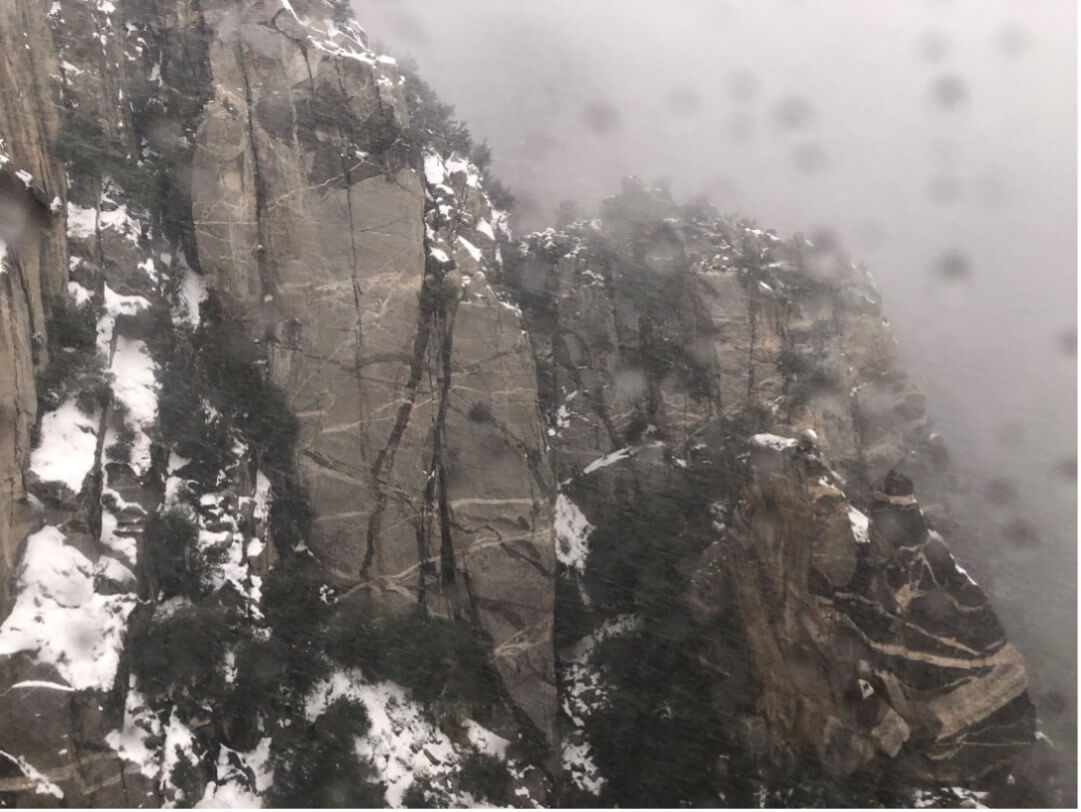
Veins & fractures in San Jacinto granodiorite-tonalite. BWK photo.
Beneath me stretched a sheer drop of one mile down the steepest mountainside in the Lower 48 states, plunging at nearly 65 degrees… Just solid, weathered rock and a smattering of resilient trees descending to the talus spread far below…
Together, we sang out loud to Neil Diamond’s “Sweet Caroline, oh-oh-oh… Good times never seemed so good, so good, so good…”
If you’re curious, I’ll share more about this experience later in the article. But first, let’s delve into minerals, mining, and investment opportunities.
Get Prepped for PDAC
Last week (see here) I previewed the upcoming Prospectors and Developers Association of Canada conference—the renowned PDAC held in Toronto. Despite its Canadian origins, PDAC stands as one of the premiere global mining gatherings, arguably the largest worldwide. Attendees come from far and wide, representing operations spanning the globe.
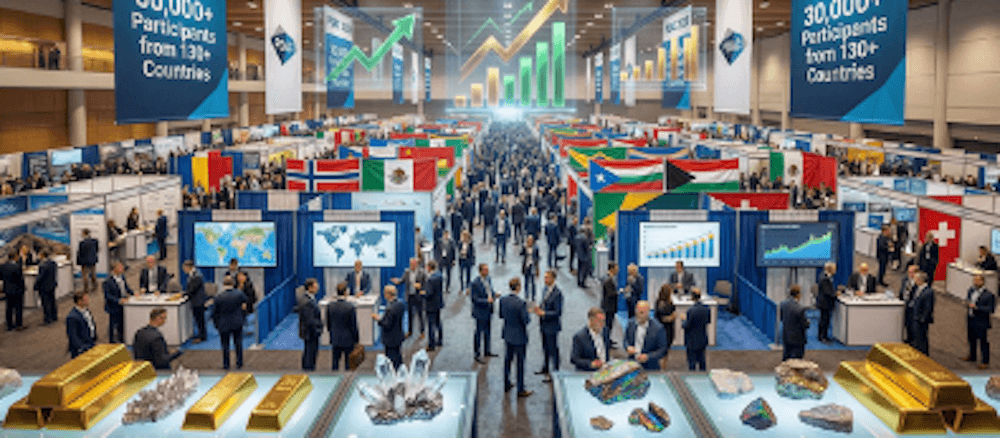
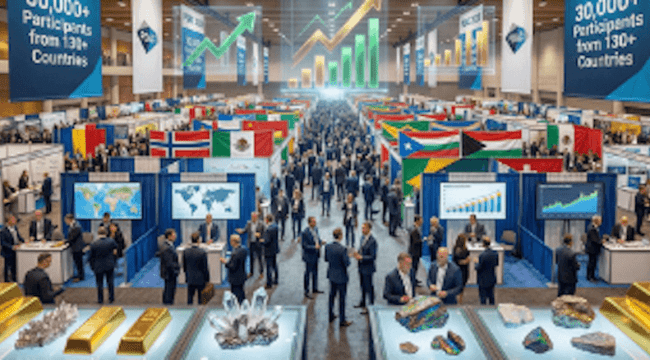
PDAC image. Courtesy DiscoveryAlert.com.au.
Historically, at its peak, PDAC has drawn crowds as large as 30,000. Attendance fluctuates with the mining cycle, but this year expectations are high amid growing enthusiasm and capital flowing into hard-rock resources.
I’ll be attending alongside my Paradigm Press colleague and fellow geologist Matt Badiali. We plan to tour the exhibition floor, engage with company representatives, attend presentations, examine rock samples, investigate the “core shack” drill displays, gather firsthand insights from those working directly on the ground, consult with other analysts and investors, and unearth promising opportunities for subscribers.
The industry’s heavyweights will be present—worth visiting include Barrick (B), Newmont (NEM), Rio Tinto (RIO), Freeport McMoRan (FCX), BHP, Agnico Eagle (AEM), among others. Simply connecting with these major players can provide a strong roster of investment prospects.
On that note, I want to mention a fund I’ve held in my personal 401(k) for many years: Invesco Gold & Special Minerals R6 (OGMIX). I haven’t actively traded; I consistently purchase shares monthly by automatic deduction. Over the past two years, the shares have more than tripled—from $21 up to around $73. Its top holdings include:
- Newmont Corporation (NEM).
- Agnico Eagle Mines (AEM).
- Wheaton Precious Metals Corp (WPM).
- Barrick Mining Corporation (B).
- Kinross Gold Corporation (KGC).
- AngloGold Ashanti (AU).
- Franco-Nevada Corp. (FNV).
- Gold Fields Limited (GF).
- Pan American Silver Corp. (PAAS).
Each of these companies is a solid player in its own right, large and diversified across different jurisdictions, ore deposits, operational strengths, tolerance to risks, strategic cash management, growth approaches, and shareholder relations.
As a group, they’ve performed well, making OGMIX a straightforward “buy and hold” investment. The fund managers handle stock selection, freeing investors from those decisions.
To expand on this, both I and my longtime collaborator Jim Rickards have maintained that we are in a robust, sustained bull market for metals overall and precious metals especially. Over recent years, OGMIX’s constituent companies have steadily appreciated, essentially riding a golden wave to generate impressive returns.
Of course, some might argue these gains belong to the past two years. What about looking forward? Well, what about the future?
Will gold, silver, and metals like copper, lead, zinc, rare earth elements, tungsten, and antimony continue to climb in price? Or, phrased differently, will miners producing these resources sustain their ongoing value growth?
No one can predict with absolute certainty. However, from my viewpoint and the evidence at hand, it seems likely that these winners will continue to succeed. Their share prices rose because they generate cash flow and profits.
Meanwhile, the underlying metals’ worth is expected to remain stable or increase. Consider factors like the long-term decline in dollar value, global moves away from the dollar, surging demand for tangible assets, scarcity of critical metals, past chronic underinvestment in new mining and processing, and much more. All signs point to a favorable setup for mining stocks, even at current price levels.
Also echoing Jim Rickards, if you missed gold’s climb from roughly $2,000 to recent highs over $5,000, there’s still more upside ahead. Projections include targets of $6,000, $7,500, $10,000 per ounce and beyond.
Note to self: If you haven’t hopped on the bandwagon, now’s the time.
Swinging for the Fences
As discussed, well-established names provide solid growth with moderate risk thanks to the overall upward momentum in the mining sector. But what about smaller companies that come with heightened risk but the potential for exceptional gains? Glad you asked…
Over the years, I’ve uncovered many promising, standout opportunities while exploring PDAC’s floors. Last week, I spotlighted a copper-gold venture in Papua New Guinea—K92 (KNTNF). I first caught wind of this story in 2017 when Barrick (B) decided to offload this underdeveloped project for a very low price, eager to clear it from their portfolio.
I was intrigued by the concept and impressed by the geology team, leading me to recommend KNTNF at about $0.37. Since then, shares have fluctuated, sometimes wildly, but today it trades above $21 with a market cap surpassing $5 billion. That marks a remarkable 56-fold return over roughly ten years—a life-changing outcome for patient early investors.
Up and Down the Aisles
Simply put, PDAC showcases an extensive spectrum of the mining world globally. Large, mid-tier, and smaller firms; exploration, development, operations, and royalty structures. Each aisle presents something unique, with a few weaker players mixed in. Navigating this space effectively requires solid knowledge.
For example, last year I scouted companies with antimony exposure when China imposed near-total export bans on the metal and its ores. I located a strong “gold mining” company whose reserves contained significant antimony. That pick performed well over the next twelve months.
Similarly, I sought out tungsten plays following a Chinese embargo on tungsten and its ores. I found a couple fitting companies that have also rewarded investors this past year.
Not every idea yields immediate rewards, naturally. With some ventures, you must trust the leadership and technical teams and remain patient. Being adaptable is essential.
For instance, I’ve closely tracked a relatively small gold project in Yukon featuring exceptionally high-grade ore near the surface. It sits amid rich placer mining along nearby streams; essentially, gold that eroded from the hard rock deposit uphill. The gold presence is undeniable.
Last year at PDAC, the company planned to mine high-grade ore and ship it directly to Korea for processing—loading rock onto trucks bound for an Alaskan port, then onto carriers destined for Korea Zinc Company. Despite costs for mining, trucking, and ocean freight, the projected returns looked outstanding. However…
Because it’s Canada, bureaucratic delays out of Ottawa and Whitehorse prevented permits from being secured during the last field season. So no production in 2025. But now, in 2026, we eagerly await updates on this plan as the upcoming summer and fall unfold. Given the project’s economics were attractive last year at about $3,000 gold, the higher current gold prices near $5,000 suggest even better profitability. You get the picture.
About that Neil Diamond Thing
If you’ve stuck with me this far, let’s circle back to that opening scene—dangling from a cable, observing rocks, and belting out Neil Diamond tunes.
I spent much of the last two weeks out West—in southern Nevada and California. I mentioned previously being in the field with geologist colleagues near Hoover Dam in Nevada, then in Death Valley, California.
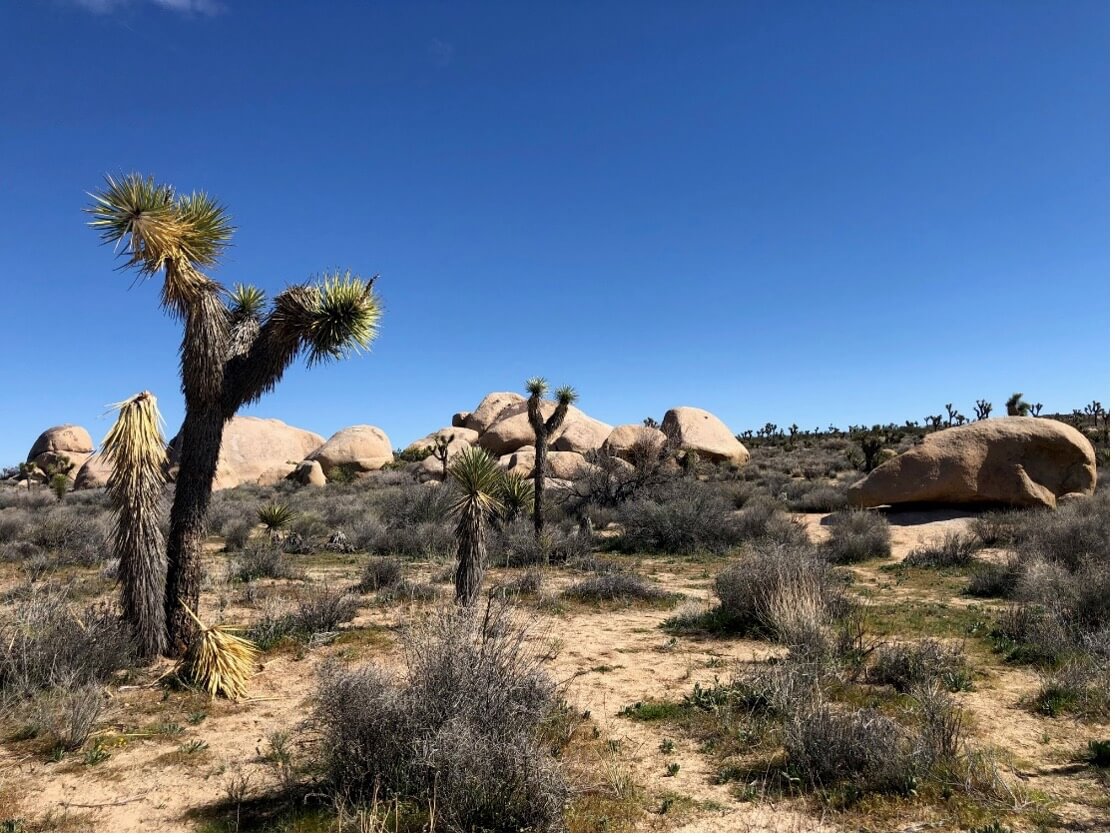
Ancient, weathered granite landforms and Joshua trees, Southern California. BWK photo.
Over several days, our journey took us south on I-15 past the Army’s National Training Center at Fort Irwin, then the Marine Corps Air-Ground Combat Center at Twentynine Palms, onward through Joshua Tree National Park, and finally to the upscale area of Palm Springs.
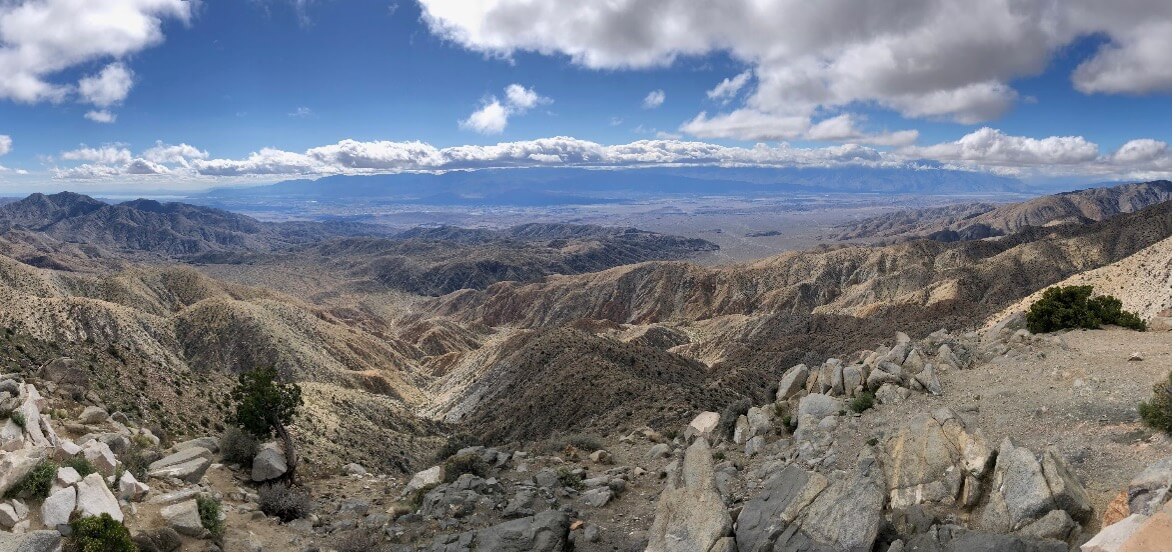
Southwest vista from atop Joshua Tree Metamorphic Complex, overlooking San Andreas Fault Zone towards San Jacinto Range. BWK photo.
As expected, the trip involved plenty of fascinating geology and, traveling west along I-10, brought us to Palm Springs—a charming locale. Founded in the mid-19th century, by the 1930s it became a favorite retreat for Hollywood stars because it was then only about a 2.5-hour drive from Los Angeles studios. (Try that commute today!)
Also during the 1930s, engineer Francis Crocker dreamed of constructing a tramway from the Palm Springs foothills at 2,643 feet elevation to the nearby San Jacinto mountains, whose highest peak stands at 10,834 feet.
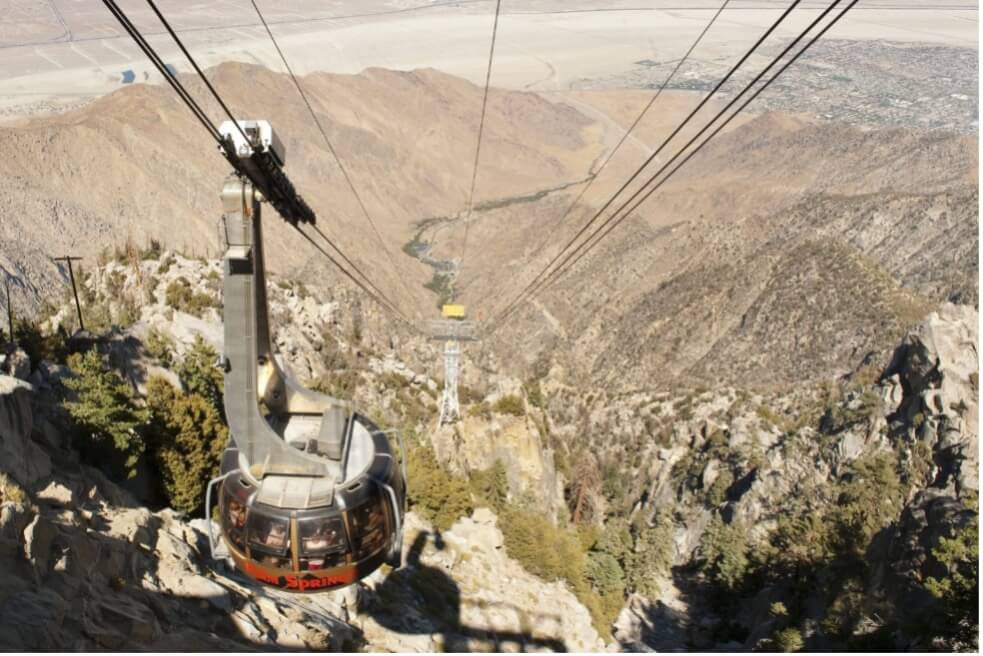
Palm Springs Aerial Tramway. Courtesy RoadTrip.com.
Long story short, Mr. Crocker fulfilled this vision in the late 1950s and early 1960s, successfully building a tramway ascending the steepest mountain face in the Lower 48 states. The tram ends at Mountain Station, which sits at 8,516 feet elevation.
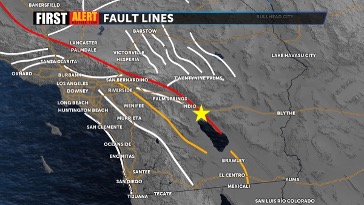
SoCal fault zones, showing fault along Palm Springs. Various sources.
Geologically, Palm Springs sits within an extensive northwest-southeast fault zone along the San Andreas fault system. To the north is the North American Plate; to the south lies the Pacific Plate. The Pacific Plate’s northwesterly movement has fractured and uplifted the ancient rocks forming the San Jacinto complex—that granodiorite-tonalite mass shown in the opening image.

Your editor in the cold, wind and snow atop Mount San Jacinto. BWK photo.
For a reasonable fee, visitors can ride a tram up and down the mountainside. The journey covers about 13,000 feet vertically each way and lasts roughly ten minutes. The experience can induce vertigo or mild motion sickness for some.
To ease passengers’ discomfort, operators play familiar pop tunes over the loudspeakers inside the tram cars, including Neil Diamond’s Sweet Caroline. During both ascents and descents, roughly 40 people sang along, greatly enjoying themselves.
I joined in the singing—who doesn’t love Neil Diamond? But mostly, my attention was fixed on those snow-dampened windows revealing stunning igneous rocks pierced by fractures and veins.
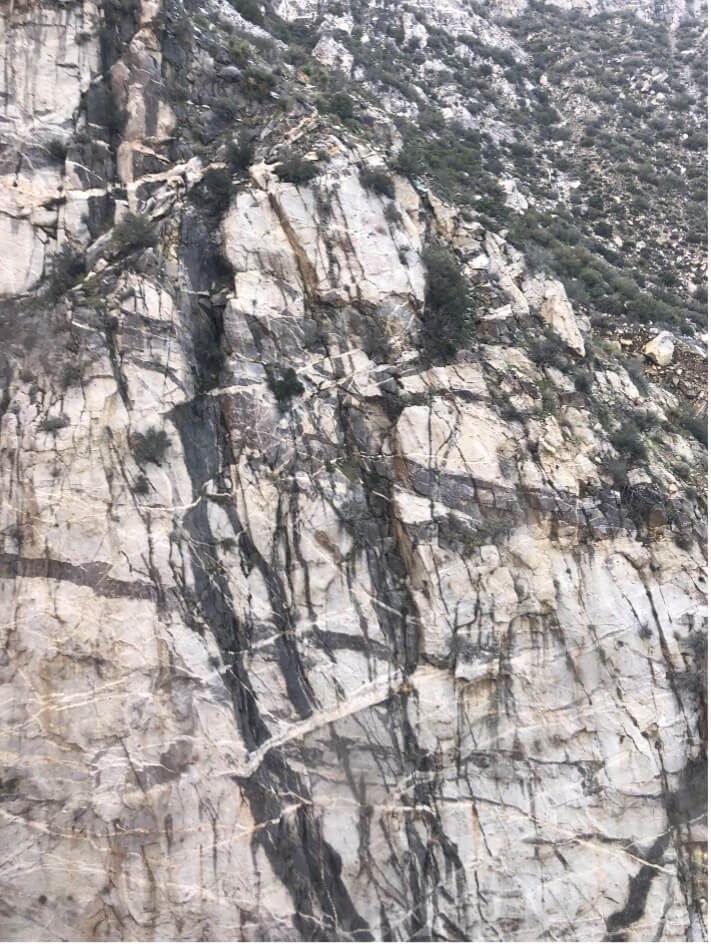
Fractures, intrusions and cross-cut veins in San Jacinto Complex. BWK photo.
My thoughts wandered as I imagined the geological formation millions of years ago, deep within Earth’s crust. Geology, to me, is a type of time travel—exploring ancient beginnings, piecing together events, and contemplating where to explore next.
That’s all for now. PDAC is coming up soon. And as usual, and as my legal advisors insist, I must clarify that none of these mentions are formal recommendations since we don’t track a portfolio here. But if intrigued, do your own homework, monitor charts, wait for market dips, utilize limit orders, and don’t chase momentum.
Thank you for subscribing and reading.
About the Author