On April 15th, Declassified UK released a shocking report revealing that during the mid-1990s, top British political and military leaders fully understood that NATO’s expansion into Central and Eastern Europe “would provoke [the] Russians,” potentially sparking a full-scale war. Previously undisclosed Ministry of Defence documents confirm that London was aware of Moscow’s profound “sensitivities” toward a “hostile military alliance” encroaching upon its borders, concerns that were deeply “real.” Despite this, NATO’s aggressive drive to incorporate Central and Eastern European countries pressed forward, eventually leading to the Ukraine proxy conflict.
Following the outbreak of the so-called Special Military Operation in February 2022, British officials have consistently maintained that the proxy conflict was “unprovoked.” Yet, a Foreign Office memo from March 1995 declassified recently noted “there was a widespread psychological and intellectual perception in Moscow that NATO was a real threat.” By May of that year, then-Prime Minister John Major clearly expressed Russian concerns to his Irish peer John Bruton as being a “fundamental fear…of encirclement.” In contrast, worries about EU entry were less pronounced:
“For the Russians, NATO had a much more threatening symbolism and political resonance…The Baltics were particularly difficult, with extreme sensitivity for Russia. It would be very hard to have a NATO border directly against Russia.”
In spite of this, by 1997 NATO extended invitations to Czechia, Hungary, and Poland, all of which joined two years later. In 2004, Estonia, Latvia, and Lithuania simultaneously acceded to the alliance, alongside former Warsaw Pact nations Bulgaria, Romania, Slovakia, and Slovenia from the former Yugoslavia. Declassified UK reveals a British Defence Intelligence study from August 1996 which warned that such expansion risked provoking war and could prompt military action under Article 5 of NATO’s founding treaty.
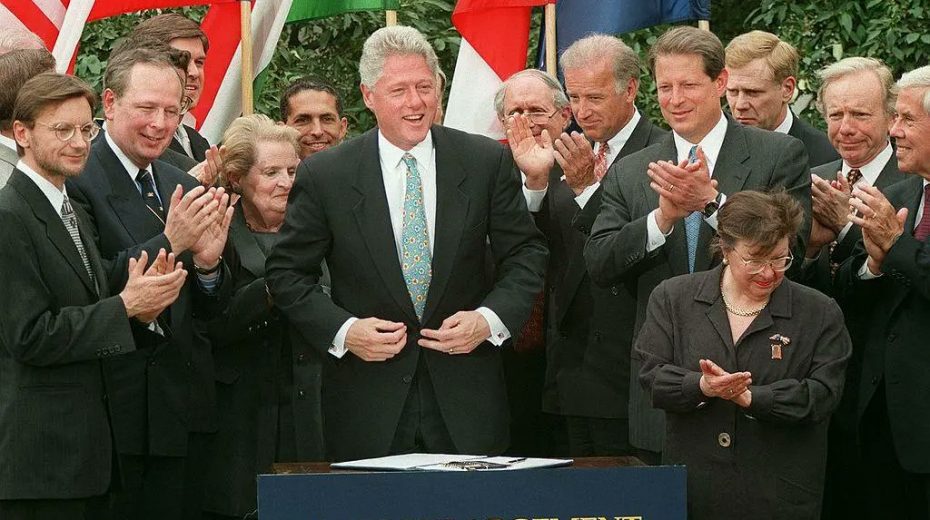
Article 5 mandates collective defense, compelling NATO members to defend each other in the event of an attack. Defence Intelligence assumed that “Russia has vehemently opposed NATO membership for the Baltic states and has threatened retaliation to preserve her own security against a perceived hostile military alliance on her borders.” Reflecting reality, Boris Yeltsin frequently made public statements opposing NATO’s Baltic enlargement, simultaneously pressuring US President Bill Clinton privately on the matter.
NATO expansion proceeded nonetheless. By December 1996, Declassified UK reports that Russia’s then-premier Viktor Chernomyrdin privately cautioned Major: “Russia could not stop NATO enlarging, but this would create a fragile situation which could explode.” Other declassified documents show that London’s leadership was acutely aware of Moscow’s “concern,” “fears,” “hostility,” “negative attitudes,” and “resentment” regarding NATO’s growth. Both Major and his successor Tony Blair personally assured Kremlin officials that NATO would not “move up to Russia’s borders.”
Nevertheless, a secret September 1996 memorandum made it clear Britain was determined to “enlarge NATO to the East,” even if Moscow’s “acquiescence is not possible.” In February 1997, Russia’s deputy foreign minister Nikolai Afanasievsky denounced Western talks about admitting former Soviet republics into NATO as a “blatant provocation” during a meeting with Jeremy Greenstock, Britain’s ambassador to Moscow. Greenstock responded by assuring there was “no intention” to include former Soviet states “at this stage” — technically accurate at the time.
‘Russian Problem’
A March 1997 Foreign Office memo predicted that swift NATO expansion would “antagonise,” and ultimately “provoke,” a hostile Russian response. Yeltsin’s “anxiety” about “possible accession of Ukraine, the Baltic states and other states of the former Soviet Union” was deemed the “most difficult issue” influencing Moscow-West relations. A more gradual approach was therefore advised. That month, John Major met NATO Secretary General Javier Solana, who voiced concerns over “Russians fears about NATO troops and equipment moving eastwards.”
Highlighting the deep-seated distrust of NATO’s advances among many in Russia’s populace and political elite, Solana shared with Major how Foreign Minister Yegeny Primakov had “more or less begged him for help in giving the Russians reassurance about NATO forces not moving eastwards.” One month later, Yeltsin sent a sharply worded private letter to Major:
“Our negative attitude to NATO expansion plans remains unchanged. Implementation of those plans would be the biggest mistake of the West in all the post-war period.”
Recently released CIA files further reveal Washington was fully aware of the intense opposition within Russia’s government and public toward NATO’s military actions and enlargement, not just in the former Warsaw Pact and Soviet republics, but also in the former Yugoslavia. A January 1993 CIA memo discussed “Serbia and the Russian Problem,” underscoring the need — albeit with difficulty — to gain Moscow’s consent for US and UN measures against the Serbs during the Bosnian civil war.
At that time, the Clinton administration was openly considering direct military intervention to address the worsening humanitarian crisis, including a potential invasion. A year earlier, Washington had imposed harsh sanctions on Yugoslavia over the conflict. The CIA warned “sensitizing [Clinton’s] new policy-making team to the growing danger of Russian alienation” was critical, fearing that “historical relations” between Moscow and Belgrade could “work against an effective international response,” essentially complicating explicit US involvement.
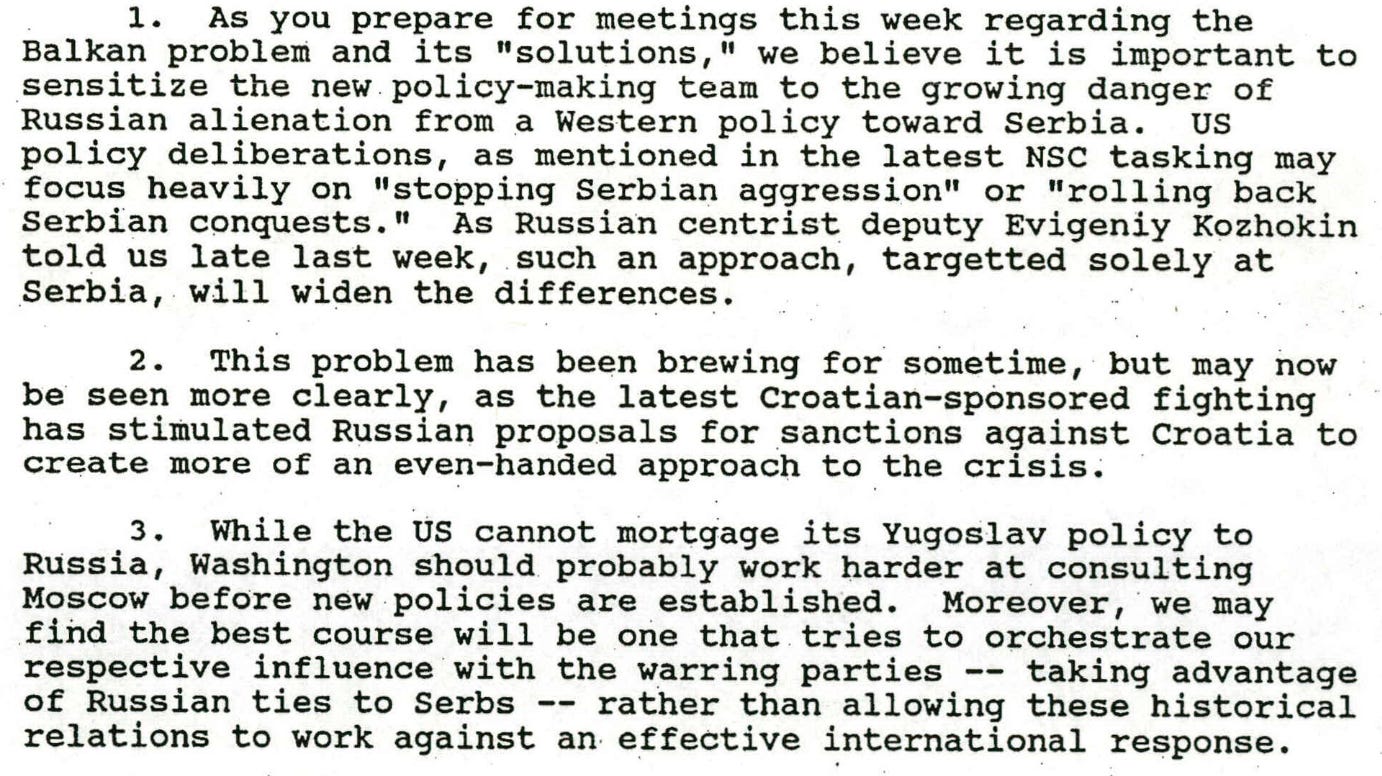
“While the US cannot mortgage its Yugoslav policy to Russia, Washington should probably work harder at consulting Moscow before new policies are established,” the CIA memo recommended. It explained “why Russian unease over Western policy toward Serbia may well lead to a veto of [UN Security Council] resolutions on the use of force.” The agency detailed how the Russian government had “grown increasingly concerned about the possible use of force against Serbia,” listing “five driving forces behind the concern.”
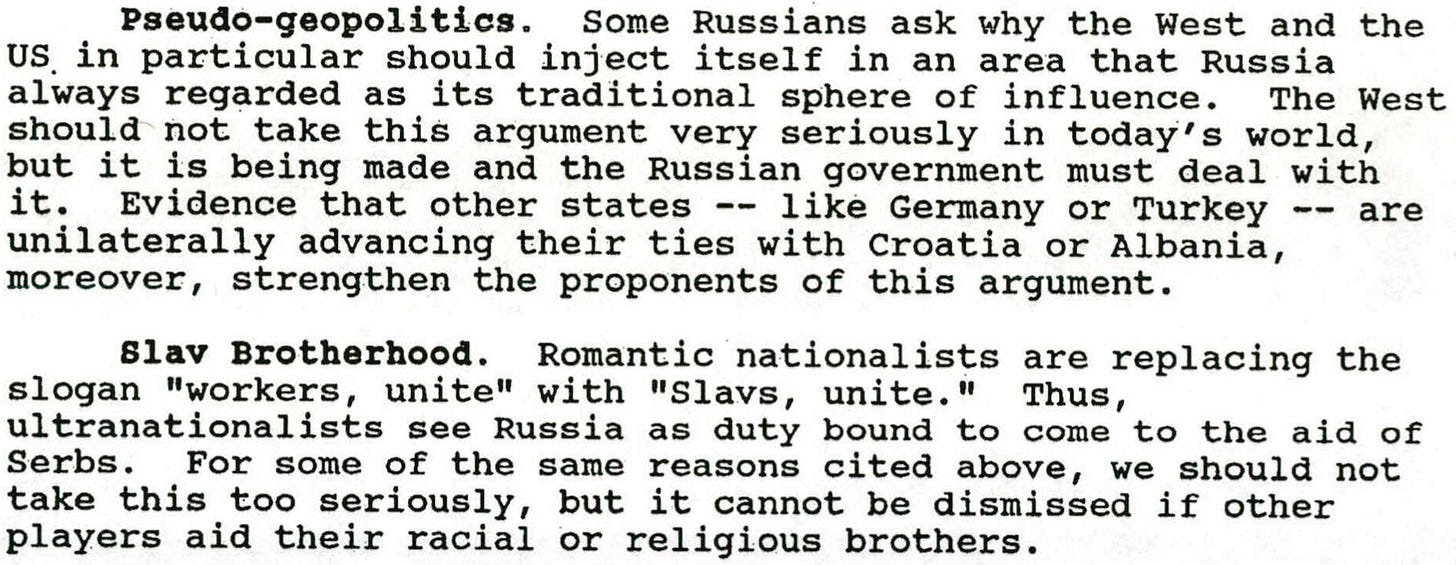
One major concern was labeled “Pseudo-Geopolitics.” Troubling for Yeltsin, and for the CIA, Pentagon, and White House, “some Russians” questioned “why the West and the US in particular should inject itself in an area that Russia always regarded as its traditional sphere of influence.” Though the CIA dismissed this reasoning as outdated, it acknowledged the argument was “being made” across Russia’s public and political arenas, forcing the Kremlin to address it.
Another concern was termed “Slav Brotherhood.” The CIA noted how “romantic nationalists” replaced the Marxist slogan “workers, unite” with “Slavs, unite.” Consequently, Russian “ultranationalists” viewed Moscow as “obliged to come to the aid of Serbs.” Although the CIA cautioned against overestimating this, it acknowledged the sentiment could not be ignored, especially if other actors supported their ethnic or religious kin.
‘Dangerous Precedent’
The Balkans hold immense cultural, economic, historical, military, political, and strategic importance to Russia. Immediately post-World War II, Yugoslavia was closely aligned with the Soviet Union, until their split in 1948. Subsequently, Belgrade and Moscow maintained generally positive—if intermittently tense—relations. Naturally, Russia and its citizens were deeply concerned about aggressive US-led efforts to dismantle Yugoslavia into Western-aligned puppet states and future NATO members.
However, the CIA, White House, and NATO operated under the assumption that in a unipolar world dominated by the US, Russia’s alleged sphere of influence and external interests were irrelevant for policy considerations. This dismissive attitude intensified dramatically following NATO’s March–June 1999 bombing of Yugoslavia.
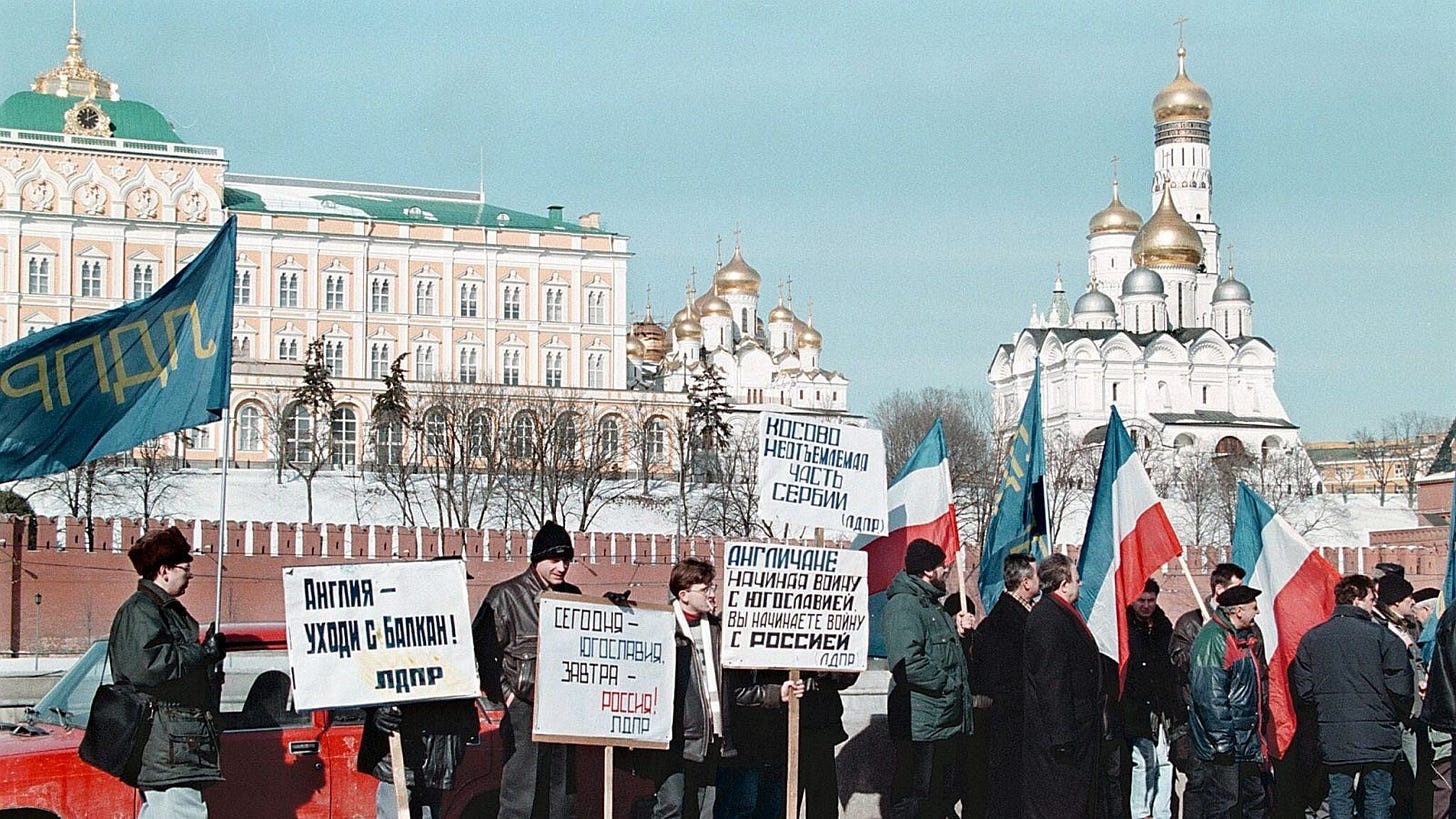
Anticipating Chinese and Russian opposition, Western capitals knew that their UNSC vetoes could block unilateral military intervention. Therefore, NATO bypassed Security Council approval by citing the UN Charter’s self defence clause to justify bombing Yugoslavia without authorization. A prescient April 1999 New Statesman article warned that NATO’s illegal bombing was no isolated event but rather “just the beginning” of a “brave new world” where the alliance would serve as a global “riot squad.”
When the bombing began, Prime Minister Yevgeny Primakov was en route to the United States for official talks. He immediately instructed the pilot to return to Russia. Despite his objections, Yeltsin’s administration refrained from aiding Belgrade, instead advising Slobodan Milosevic to yield to NATO demands. Nonetheless, a declassified June 1999 cable from the British embassy in Moscow to London’s senior diplomats revealed the alliance’s bombing had “left Russia bruised and bewildered.”
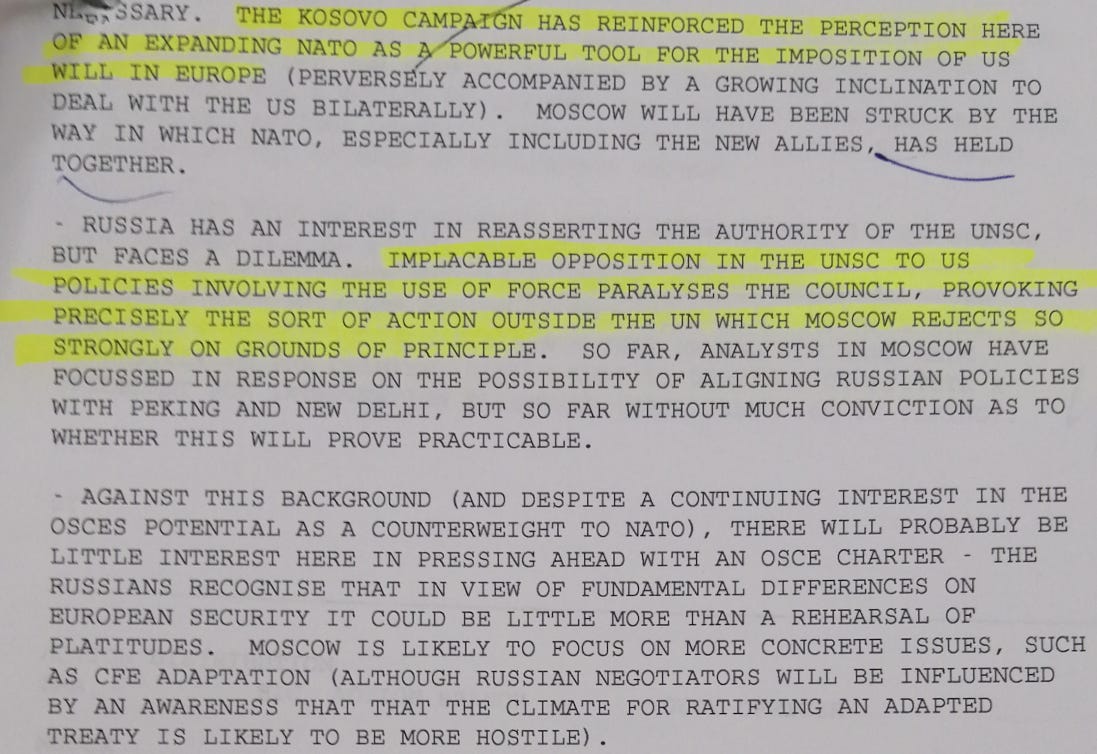
The campaign shocked Russia at all levels, widely viewed as “NATO resorting to military action in the face of direct Russian opposition.” It was perceived as “setting a dangerous precedent for military action without UNSC authority,” thereby “undermining the Russian veto.” This represented “not only a blow” to the Security Council but also a “threat to Russian interests…setting an unacceptable precedent for action out of area, circumventing the Security Council if necessary”:
“[Moscow’s Ministry of Defense] has used NATO’s resort to force to argue Russia’s new military doctrine should take more serious account of a potential threat from NATO, with all that that means in terms of force levels, procurement and the future of arms control…The UK’s forward position on the use of force has not gone unnoticed…The Kosovo campaign has reinforced the perception here of an expanding NATO as a powerful tool for the imposition of US will in Europe.”
‘Intervention Elsewhere’
Following NATO’s unauthorized 78-day bombing campaign against Yugoslavia—which resulted in thousands of casualties, including children, and disrupted millions of lives—Russia halted official dialogue with NATO. The Moscow embassy cable noted that “there are signs that Russia may be interested in resuscitating” talks, but a quick return to previous conditions was “politically impossible.” It added:
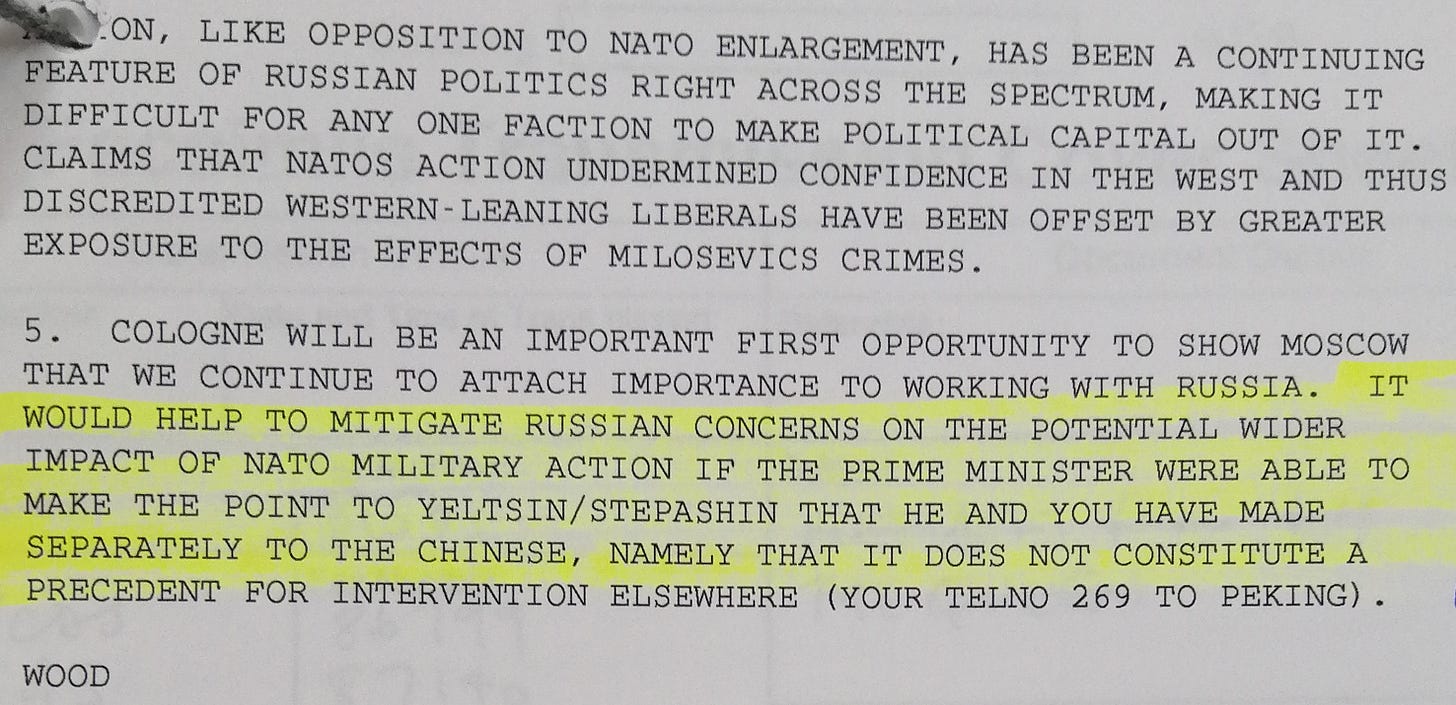
“Strong and emotional opposition to NATO military action, like opposition to NATO enlargement, has been a continuing feature of Russia politics right across the spectrum.”
However, the Russian military stood out for its vocal rhetoric and vigorous defense of what it considered Russia’s great power interests. Moscow-based foreign policy experts were exploring the possibility of aligning Russian policies with China and India, although with little confidence this would be practical. Nevertheless, this strategic option was widely discussed among influential political thinkers as local confidence in the West had been severely eroded.
The cable predicted that “rebuilding mutual trust” between NATO, its members, and Moscow after the Yugoslavia bombing would be “a slow process.” It suggested an upcoming European Council meeting in Cologne on the development of a European Security and Defence Policy might “be a key chance to reaffirm to Moscow our commitment to cooperation”:
“It would help to mitigate Russian concerns on the potential wider impact of NATO military action if [Tony Blair] were able to make the point to Yeltsin…that [the bombing of Yugoslavia] does not constitute a precedent for intervention elsewhere.”
This clear-cut assurance was also conveyed independently to the equally upset Chinese representatives by Blair and senior diplomats. Yet, the bombing of Yugoslavia rapidly did become a precedent for further unauthorized Western military interventions “out of area,” whether NATO-approved or not. Along the way, independent states such as Libya were devastated, reduced to open-air slave markets, while NATO greedily absorbed the fragments of shattered countries one after another.
British officials were fully aware that Western actions in the former Yugoslavia deeply intensified Russian anxieties about NATO’s push to enforce unipolar dominance and expand ever closer to Moscow’s borders. In a September 1999 message, then-Foreign Secretary Robin Cook’s private secretary cautioned Blair that Russia had found recent unilateral Anglo-American economic and military campaigns against Iraq and Yugoslavia “especially difficult” to tolerate:
“The underlying reason for this disquiet (which is genuine) is a feeling that the United States and NATO are a law unto themselves. The idea…the West takes little account of Russian interests and…the process of NATO enlargement is intended to constrain Russia still further.”
‘Strong Divisions’
A Foreign Office briefing in February 2000 ahead of a meeting between Blair and NATO Secretary General George Robertson observed that Russian opposition to NATO expansion had hardened further due to the Yugoslavia bombing. Undeterred, NATO pressed on with enlargement, with British military and intelligence personnel leading this expansion. Foremost among them was Chris Donnelly, a longtime Ministry of Defence official who joined NATO in 1989 just as the Warsaw Pact and Yugoslavia were dissolving.
A critical academic review of his 2004 book Reforming For Wars Of The Future stated, “if any one man has played a central role in the process of NATO enlargement and in providing constructive support for military reform in the newly liberated countries of East-Central Europe, it has been Chris Donnelly.” In many instances, countries joined NATO despite major domestic opposition. Notably, Donnelly himself acknowledged in a January 2002 NATO report that the alliance was fundamentally not defensive in nature.
“Small armies from small countries cannot do much,” he explained, “so NATO operates better as a political alliance.” Donnelly left NATO in 2003, but his views on enlargement continued to shape policy. In early 2004, NATO’s in-house publication NATO Review featured an essay by him on creating a NATO “for the Greater Middle East.” Furthermore, a 2006 US Army War College paper on involving Ukraine in the War on Terror referenced Donnelly’s 1997 thesis on “defence transformation in the new democracies.”
Ukraine was tentatively included on NATO’s trajectory at the alliance’s April 2008 summit. In February that year, Bill Burns — then US ambassador to Moscow and later CIA director under Joe Biden — reported to Washington Moscow’s “particular worry” about “strong divisions in Ukraine over NATO membership.” Much of the country’s “ethnic-Russian community” opposed joining, risking a “major split, involving violence or at worst, civil war.” Such turmoil might compel Russia to “decide whether to intervene; a decision Russia does not want to have to face.”
NATO’s own polling from 2011 indicated under 20% of Ukrainians supported NATO membership. The bombing of Yugoslavia remained “especially unpopular” there — “for many…the image of NATO still evokes a sense of fear.” One week later, Burns outlined to the White House Moscow’s probable responses to Georgia and Ukraine’s prospective NATO membership. Burns warned that for Georgia, “the prospects of subsequent…armed conflict would be high” — a prophecy fulfilled by the Russo-Georgian war in August 2008. His remarks concerning Ukraine ring painfully true today, as a grim warning tragically validated:
“Ukrainian entry into NATO is the brightest of all red-lines for the Russian elite (not just Putin). In my more than two and a half years of conversations with key Russian players, from knuckle-draggers in the dark recesses of the Kremlin to Putin’s sharpest liberal critics, I have yet to find anyone who views Ukraine in NATO as anything other than a direct challenge to Russian interests…a [membership] offer would be seen…as throwing down the strategic gauntlet…Russia will respond.”
Original article: kitklarenberg.com
About the Author