
Small Cap Bargains in Brazil
It’s been exactly one year since I shared our initial bullish article on Brazil.
The investment thesis is proving successful so far.
Over the last 12 months, the Brazilian ETF we favor (EWZ) has surged by 54%.
In January, hedge fund legend Stanley Druckenmiller gave Brazil a major vote of confidence. According to Yahoo Finance:
Billionaire investor Stanley Druckenmiller’s investment firm built a substantial position in Brazilian stocks just before a major market rally in January.
Duquesne Family Office acquired approximately 3.5 million shares of the $9.1 billion iShares MSCI Brazil ETF during the fourth quarter of 2023, according to regulatory filings. The firm also purchased call options on the fund.
If Druckenmiller entered EWZ at around $32, that would represent a $112 million stake, plus the call options. That’s a significant investment, even for a billionaire like him. His involvement is certainly encouraging.
Today, we’ll discuss why Brazilian stocks still offer substantial upside potential and explain why small caps might be poised for the next big move.
Room to Run
I recently came across a Morgan Stanley report titled LatAm Spring. The emerging markets team at Morgan Stanley is notably optimistic about Latin America, especially Brazil.
This hefty 268-page report is packed with insightful charts. I went through all of it and want to highlight some of the most compelling points.
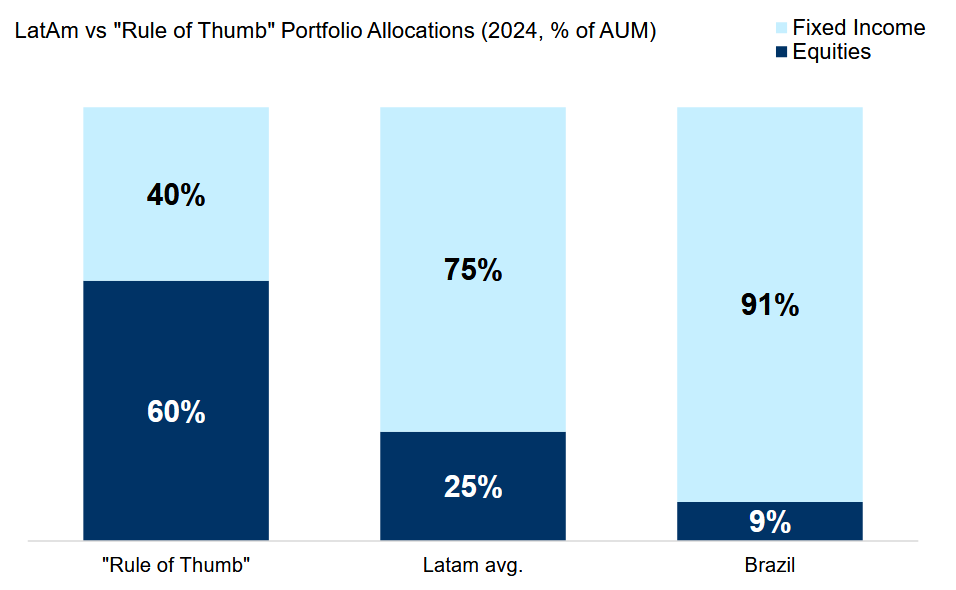
The chart below is particularly eye-opening. It compares a typical “rule of thumb” allocation (60% equities, 40% bonds) with the average portfolio compositions in Latin America and Brazil.
Source: Morgan Stanley Research
Brazilian investors only allocate 9% to stocks, holding an astonishing 91% in fixed income assets like bonds, CDs, and annuities.
Why such low stock exposure? Because Brazilian equities have been heavily beaten down over the past 15 years. Foreign capital retreated as commodities, which dominate Brazil’s economy, fell out of favor. Key exports include oil, iron ore, copper, and precious metals.
Following the COVID pandemic, inflation surged to 10%, prompting the central bank to raise interest rates to 15%.
With fixed income paying yields above 10%, many understandably prefer safer bond instruments over stocks.
However, Brazil is now starting a rate-cutting cycle, expected to begin easing interest rates in March.
This should rekindle stock market interest among domestic investors, while foreign capital has already been flowing in strongly this past year.
As funds migrate from bonds back into equities, share prices should climb organically.
This is an ideal setup. I’ve held onto all my Brazilian investments and have no intention of selling soon. I want to watch dividends compound and valuations improve over time.
Growth Returns
Here’s another fascinating figure from the Morgan Stanley report, illustrating projected earnings growth in a “spring” (bullish) scenario across Latin American countries.
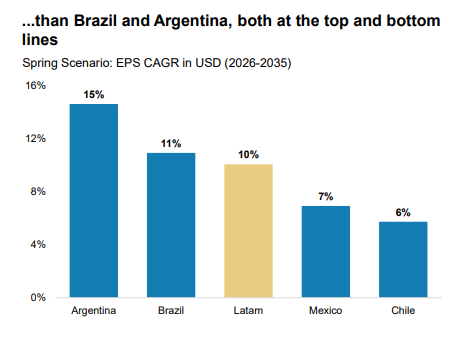
Brazilian firms could experience an 11% average annual EPS increase through 2035, setting the stage for strong returns over the next decade.
If this optimistic earnings projection materializes, I expect Brazilian stocks to see significant valuation upgrades.
(side note – Morgan Stanley believes Argentina may outpace Brazil in growth. I haven’t delved deeply into Argentina yet, but plan to follow up soon with more coverage.)
Small Caps Next to Run?
Until now, attention in Brazil has mostly focused on large caps. Giants like Vale (VALE), the iron ore miner we favor, which has climbed 74%; Petrobras (PBR and PBR.A), our preferred oil company, up roughly 30% since we spotlighted it; and Nubank (NU), Brazil’s rapidly expanding digital bank, which has gained 49%.
These remain strong holdings, and I haven’t sold any shares.
But I recently identified a Brazilian small-cap ETF worth considering: EWZS, managed by iShares, a BlackRock division.
EWZS contains 70 smaller Brazilian companies, trading at impressively low valuations. The average P/E ratio is just 9, with a price/book of only 1.1.
For context, the Russell 2000 small-cap index in the U.S. trades at a P/E of 34 and price/book of 2.4, while the S&P 500 commands a P/E of 29 and price/book exceeding 5.
EWZS offers access to smaller miners, consumer businesses, utilities, construction firms, oil and gas companies, and banks. If Brazil’s economy continues to rebound, this fund should perform well.
This ETF provides an excellent means of gaining exposure to Brazil’s smaller companies. I own shares and intend to increase my position in retirement accounts over the year.
Brazilian stocks have significantly underperformed for more than ten years, leaving ample opportunity for growth.
Investors are growing more eager to tap into hard assets, attractive yields, and undervalued equities. Brazil fits this profile perfectly.
With interest rates heading lower, Brazilian investors are likely to return to stocks for capital appreciation, and small caps stand out as a prime avenue to capitalize on this trend.
About the Author