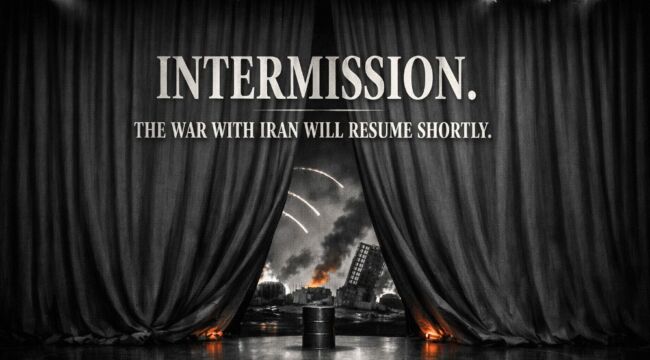
Intermission: The War Will Resume Shortly
Negotiations between the U.S. and Iran are set to commence tomorrow.
The talks will be held in Islamabad, Pakistan.
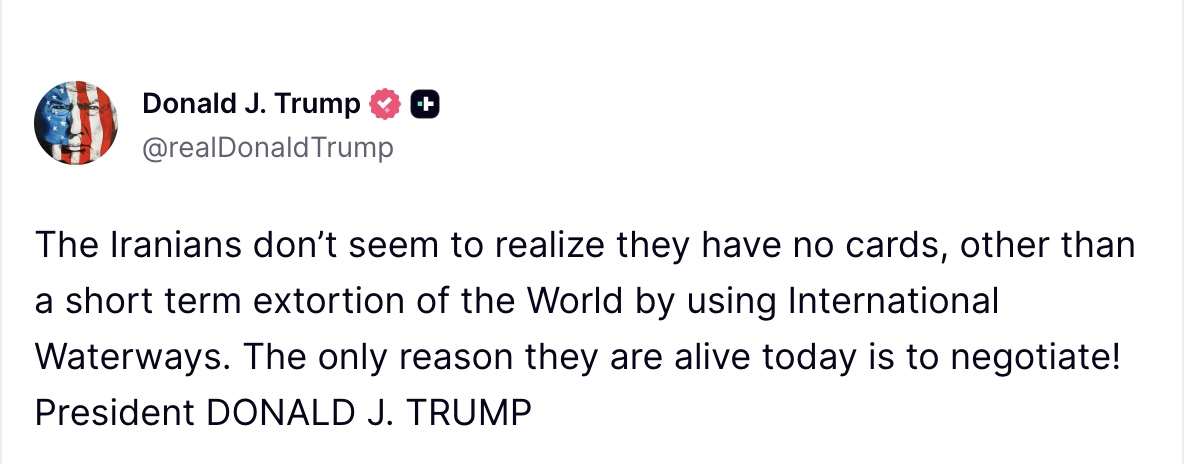
President Trump enters the discussions with apparent confidence:
Source: Truth Social
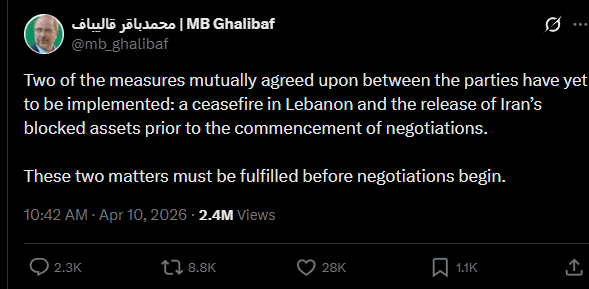
However, Iranian officials, including Speaker of Parliament Mohammad Ghalibaf, insist they won’t negotiate until their frozen assets are released and Israel halts its bombing of Lebanon and land annexations.
Source: X
As highlighted earlier this week, Israel shows no sign of ceasing its bombardment of Lebanon—one of the key hurdles for both sides. Israel claims it’s defending itself against Hezbollah’s rocket attacks, while Iran accuses Israel of killing civilians alongside militants.
Without a ceasefire that includes Lebanon, it’s doubtful that these talks will progress.
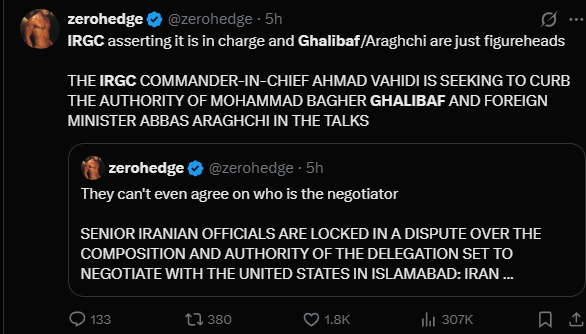
Adding to the concern, reports suggest that Iranian “moderates” like Ghalibaf are losing ground to the hardline Islamic Revolutionary Guard Corps (IRGC).
Source: ZeroHedge on X
While moderates like Ghalibaf and Foreign Minister Aragachi advocate for diplomatic solutions, the IRGC seems focused on gearing up for renewed conflict. The turmoil within Iran’s leadership means the outcome remains uncertain.
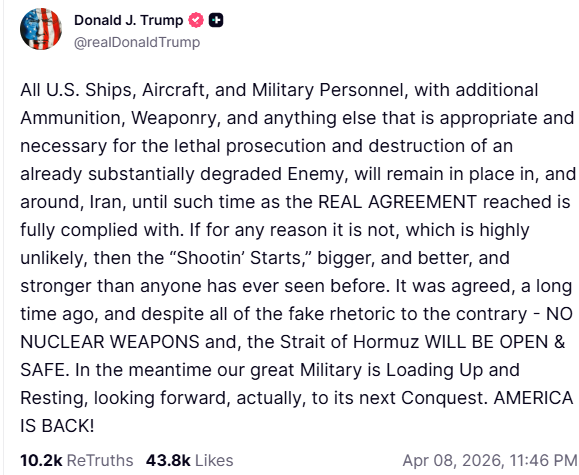
Meanwhile, Trump is preparing for a potential return to hostilities.
Source: Truth Social
The President is positioning American military resources in the region, having allocated 80% of the advanced JASSM stealth cruise missiles to this conflict, according to Bloomberg.
Lasting Agreement: Unlikely
Following some early missteps, the tentative truce between the U.S. and Iran remains intact—for now.
Nevertheless, the sole common ground is that neither side is currently firing missiles.
With talks planned for tomorrow, both parties seem to be bracing for the likely resurgence of warfare.
Our colleague Jim Rickards shared an insightful interview with Michelle Makori yesterday, stating, “It’s not much of a ceasefire…. the two sides don’t agree on anything.”
He’s accurate. The U.S. demands include:
- Major restrictions on Iran’s missile and drone programs
- An end to nuclear enrichment activities
- Unrestricted access to the Strait of Hormuz
- Ceasing support for Iran’s allies in Yemen, Iraq, and Lebanon
These requests are mostly deal-breakers. Iran has hinted it might relinquish its near-weapons-grade uranium but little beyond that.
Conversely, Iran insists on:
- A permanent non-aggression pledge
- U.S. military withdrawal from the Gulf region
- Peace in Lebanon amid Israel’s devastating bombings
- War reparations, possibly via tolls on Hormuz passage
- Removal of all sanctions and UN mandates
I find it unlikely our government will agree to any, much less all, of these demands.
So, even if talks take place—and I hope they do—progress seems doubtful during this initial phase.
Hopefully, the U.S. delegation can persuade Iran to reopen the Strait of Hormuz as discussions advance.
Financial Impact
At present, the Strait of Hormuz remains nearly closed to most shipping, obstructing about 20% of the world’s oil supply. Only a handful of tankers heading to China and other Iranian allies currently pass through.
If the Strait does not reopen soon, the energy crisis could worsen dramatically. Oil prices might reach $150 per barrel in the near term, surging further if the blockade extends for months. This excludes further damage to oil and gas infrastructure.
In his recent interview, Jim also cautioned, “the fact that you’ve got a dollar liquidity crisis, a private credit meltdown, and a war with Iran, is extremely concerning. And we could be looking – at best – a recession, and possibly something much worse.”
Regarding the Hormuz Strait, Jim notes that because the last tankers have only recently arrived at their destinations, “now is the time the danger truly kicks in.”
He is right. It takes time for vessels to travel and deliver supplies. We are just beginning to feel the tangible impact of supply interruptions.
I highly recommend watching Jim’s interview for a thorough overview of the ceasefire’s status, economic risks, and more. Here’s the Youtube link.
Best and Worst Cases
At best, this ceasefire persists and Iran consents to reopening the Strait of Hormuz, restoring approximately 8 million barrels of oil per day to global markets—a remarkable win for this first round.
The challenging task lies in negotiating a durable deal, which is essential for market stability and investor confidence. Currently, both sides appear to be regrouping and restocking.
The worst-case scenario involves full-scale renewed fighting, targeting oil, petrochemical, and natural gas facilities.
Stock markets remain oblivious to the risk of a negative outcome, instead pricing in a swift and positive resolution.
Therefore, I maintain a larger than usual cash position with some hedges until uncertainties clear. To clarify, I haven’t divested entirely but have increased cash holdings to around 18%, which is substantial for me.
If hostilities escalate again, I want liquidity available to acquire select assets, given the significant downside potential for equities.
Eventually, this crisis will resolve, and oil prices will normalize. However, I anticipate this may take longer than many expect, and prices could rise considerably beforehand.
The economy could suffer significant harm before the conflict concludes. Even if the war ends soon, oil will take time to stabilize, and volatility will persist until then.
More updates on Monday.
About the Author