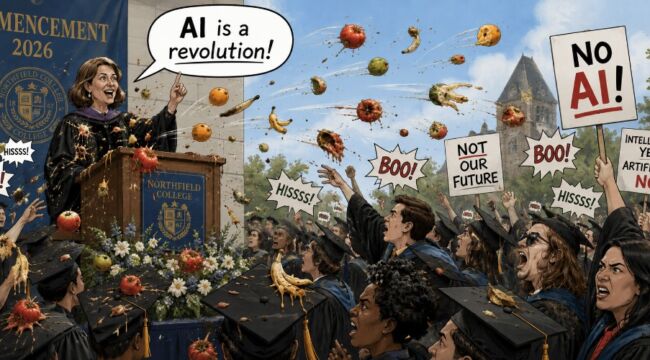
Why College Grads HATE AI
Recently, I came across an intriguing video on Twitter/X.
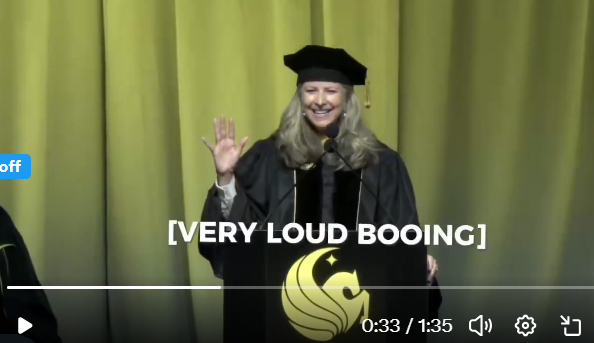
During the University of Central Florida’s graduation ceremony, the keynote speaker addressed the topic of AI.
“The rise of artificial intelligence is the next industrial revolution.”
BOOOOOO! HISS! The newly minted grads were clearly not thrilled.
Source: X
Gloria Caulfield, caught off guard by the backlash, asked, “What happened?” in her distinct Long Island accent.
She went on to say:
“Only a few years ago, AI was not a factor in our lives.”
This drew enthusiastic applause from the audience, nostalgic for the recent past. But then she added…
“And now, AI capabilities are in the palm of our hands…”
The crowd reacted with utter disdain—booing and hissing grew louder. Gloria delivered the line with hesitation, sensing the negative vibe from before. Had the students brought any spoiled fruits, she might have been bombarded with tomatoes and eggplants.
Young People (Understandably) Hate AI
Imagine being a young American today.
With skyrocketing home prices, exorbitant rent, and costly groceries, living comfortably is challenging. Raising children typically requires earning among the top 10% of incomes, depending on the location.
The stock market surges ahead while you have little to no investments.
Meanwhile, your country recruits hundreds of thousands of foreign tech workers, mainly from India, willing to put in 60-80 hour weeks for much lower wages.
Now, autonomous AI agents enter the scene. These digital workers can plan, execute, test, and finalize complex projects. So far, coding is their primary focus, but soon they are expected to infiltrate all aspects of white-collar professions.
Ken Griffin’s Revelation
Billionaire hedge fund founder Ken Griffin, once doubtful about AI, has recently changed his stance.
His team’s rapid advancements with the latest AI agents have left him feeling “depressed” about the societal shifts ahead.
An excerpt from Fortune’s report states:
For Griffin, the most striking proof isn’t in coding or content—it’s in high-end financial research. Work that Citadel would previously have assigned to teams with master’s degrees and PhDs in finance, work that took weeks or months, is now being completed by AI agents in hours or days.
“To be blunt, work that we would usually do with people with master’s and PhDs in finance over the course of weeks or months is being done by AI agents over the course of hours or days,” Griffin said at Stanford.
Disruption is underway, and younger generations stand at the forefront. Initially, entry-level roles were cut, but AI is steadily advancing up the professional ladder.
Luckily, AI remains terrible at stock picking and creative writing—areas where humans excel. And I don’t foresee significant improvement in these fields anytime soon. AI learns from the entire internet, encompassing the good, the bad, and the ugly. Yet, no one is completely shielded from this impending wave.
Three Paths – Blue Collar, AI Master, or Entrepreneur
Today’s youth essentially face three main routes.
First, there is the blue collar option. For example, my 16-year-old son plans to begin an electrician apprenticeship this summer. I’m proud of his choice and believe it’s a wise one.
Jobs for plumbers, electricians, welders, mechanics, and similar skilled trades are plentiful and expected to remain stable for many decades before robotics replace them.
Even Nvidia CEO Jensen Huang recently recognized this trend.
“AI gives America the opportunity to build again. Electricians, plumbers, iron workers, technicians, builders—this is your time. AI is not just creating a new computing industry, it is creating a new industrial era.”
It’s striking that the leading figure in AI pushes for blue collar trades. There’s sound reasoning behind it…
Path #2: AI Masters
The second path carries more risk but offers greater potential. Young people can strive to become “AI masters.” After all, humans will still be needed to manage AI.
Roles will include reviewing AI-generated code, delegating tasks, and supervising workflow.
There’s a popular saying that has gained traction recently and deserves repeating, in my version: “Your job won’t necessarily be replaced by AI, but it will be done by someone who uses AI better than you.”
Path #3: An Entrepreneurial Boom
The third option is entrepreneurship, and AI has made this more accessible than ever. Even those without technical skills can now produce solid code, simplifying the tech side of establishing a business.
I anticipate numerous young people will pursue entrepreneurship, likely out of necessity if they aim to enter the white-collar world.
A surge of small to mid-sized enterprises seems imminent. Although these firms may hire fewer people than before, there will still be valuable roles for intelligent workers.
A Breaking System
For decades, parents primarily aimed to see their children graduate college and secure stable white collar careers.
That era is drawing to a close. The shift could take several decades to fully unfold, but we are undeniably heading in a new direction.
The future of professional work will involve fewer “AI masters,” each overseeing multiple AI agents.
Meanwhile, blue collar jobs will gain traction and appeal. Yet many remain stuck in societal expectations where sending kids to university is the norm. Admitting that “little Billy” plans to be a plumber is often frowned upon. This mindset will soon change if AI continues along the predicted path.
Young adults today face numerous frustrations, and they have contemplated these challenges more thoroughly than previous generations. So, it’s worth engaging the young people in your life about their aspirations.
If they seem uncertain, suggest exploring blue collar careers. I firmly believe this is the best option for millions of young Americans.
About the Author