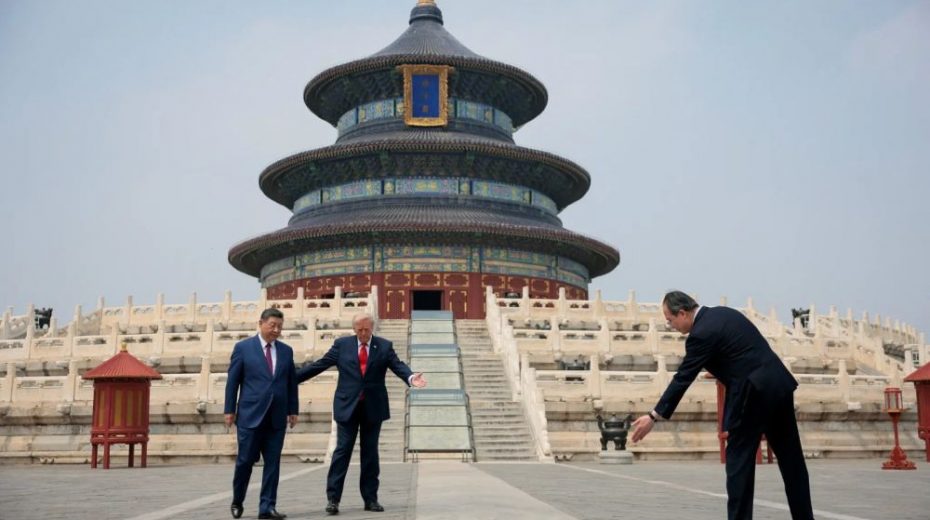
The Beijing event has concluded, and Donald Trump’s discussions with Xi Jinping yielded little beyond favorable photo opportunities and surface-level diplomacy without concrete results.
No joint statement was released following the two-day talks between Trump and Xi Jinping. Instead, official communications from each government present notable differences. A close examination of these statements reveals significant disparities as well as overlaps, offering insights into the actual outcomes of the summit.
The discrepancies between the accounts are striking and appear to be strategically calculated. Below is a detailed summary of key points emphasized by the White House that China either left out entirely or mentioned only vaguely:
1. The Iran Conflict and Nuclear Weapons — Excluded by China
This represents the most impactful omission. The White House briefing explicitly stated:
The two sides agreed that the Strait of Hormuz must remain open to support the free flow of energy. President Xi also made clear China’s opposition to the militarization of the Strait and any effort to charge a toll for its use, and he expressed interest in purchasing more American oil to reduce China’s dependence on the Strait in the future. Both countries agreed that Iran can never have a nuclear weapon.”PBS
In comparison, China’s official statement simply noted that “the two sides discussed the Middle East conflict” without any specifics — no mention of the Strait of Hormuz, toll charges, Iran’s nuclear program, or any mutual agreements on these issues. YouTube
This omission is significant. The White House claims China agreed that Iran must never develop nuclear weapons and opposed tolls on the Strait, portraying these as important concessions that Beijing clearly prefers not to publicize. Yet, according to a trustworthy insider, Xi outright declined Trump’s plea for China to pressure Iran and help open the Strait of Hormuz.
2. Fentanyl — Absent from China’s Account
The US noted that discussions included “addressing fentanyl precursor flows into the United States,” reflecting long-standing American demands for China to curtail chemicals facilitating fentanyl production. China’s statement omitted any reference to fentanyl, consistent with its stance that it has done enough and refuses to frame the issue as a bilateral concern. Komo News
3. Agricultural Purchases — Left Out by China
The White House statement pointed out talks on “increasing Chinese purchases of U.S. agricultural products,” whereas China’s summary referenced trade only in broad, mutually beneficial terms without specifying any commitment regarding agriculture. YouTube
4. Market Access for US Companies — Different Framing
According to the White House, discussion focused on “expanding market access for American businesses into China and increasing Chinese investment into US industries.” China, however, presented this as China “widening its door” voluntarily, not as a response to US demands.
5. Business Delegation — Unequal Portrayals
The White House underlined that “leaders from many of the United States’ largest companies joined a portion of the meeting,” suggesting a meaningful economic dialogue. Conversely, China described Trump’s request that business leaders “present themselves to President Xi” as more a formal introduction than substantive discussions. YouTube
6. Taiwan — Contrasting Focus
The most glaring difference appears regarding Taiwan. The US did not mention Taiwan in its summary, while China’s entire readout prioritized Xi’s warning on the subject. Trump avoided confirming any discussion on Taiwan when asked, and Rubio told NBC News the US was “not asking for China’s help with Iran,” implicitly countering implications of cooperation suggested by the White House. The National DeskBreitbart
Summary
Statements from both governments reveal limited agreement but notable oppositions. The most pronounced inconsistencies appear on Iran, where the US reads significant Chinese commitments that China denies, and on Taiwan, where China issued explicit warnings absent from the US account. NPR
This practice is a familiar diplomatic maneuver: each side crafts a readout that suits its domestic audience and strengthens its bargaining stance. China sought to broadcast Xi’s strong stance on Taiwan, while Washington emphasized China’s alleged agreement that Iran must remain non-nuclear and rejection of Iranian tolls. Whether these claimed concessions are genuine or exaggerated reveals much about the strategic messaging at play.
Strategic Vision
Xi began with a broad philosophical reflection: “Transformation not seen in a century is accelerating across the globe, and the international situation is fluid and turbulent.” He posed three direct questions to Trump: Can China and the US avoid the Thucydides Trap and establish a new type of major-country relationship? Can they collaborate to tackle global challenges and enhance worldwide stability? Can a positive future be built for their bilateral relations? Wikipedia
He further announced their agreement on “a new vision of building a constructive China-U.S. relationship of strategic stability,” defining it as: “Constructive strategic stability means positive stability with cooperation as the mainstay, healthy stability with competition within proper limits, constant stability with manageable differences, and lasting stability with expectable peace.” He emphasized this framework “will provide strategic guidance for China-U.S. relations over the next three years and beyond,” stressing that “Building a constructive China-U.S. relationship of strategic stability is not a slogan. It means actions in the same direction.” Wikipedia
Trade and Economic Relations
Xi highlighted that “China-U.S. economic and trade ties are mutually beneficial and win-win in nature. Where disagreements and frictions exist, equal-footed consultation is the only right choice.” He noted that prior talks yielded “generally balanced and positive outcomes,” adding “China will only open its door wider. U.S. businesses are deeply involved in China’s reform and opening up.” Wikipedia
Military and Diplomatic Relations
Xi urged better utilization of “communication channels in the political and diplomatic and military-to-military fields,” promoting “expanded exchanges and cooperation in areas such as the economy and trade, health, agriculture, tourism, people-to-people ties and law enforcement.” Wikipedia
Taiwan — The Firmest Language in the Statement
Xi was clear: “The Taiwan question is the most important issue in China-U.S. relations. If it is handled properly, the bilateral relationship will enjoy overall stability. Otherwise, the two countries will have clashes and even conflicts, putting the entire relationship in great jeopardy. ‘Taiwan independence’ and cross-Strait peace are as irreconcilable as fire and water. Safeguarding peace and stability across the Taiwan Strait is the biggest common denominator between China and the U.S. The U.S. side must exercise extra caution in handling the Taiwan question.” Wikipedia
Global Topics
The summary says the two leaders “exchanged views on major international and regional issues, such as the Middle East situation, the Ukraine crisis, and the Korean Peninsula” but offered no more detail on these subjects in China’s official statement. Wikipedia
APEC and G20 Meetings
Both leaders agreed to back each other in ensuring the success of the APEC Economic Leaders’ Meeting and G20 Summit this year. Wikipedia
Foreign Minister Wang Yi’s Closing Remarks — May 15
Wang Yi told state media that “This was an important meeting in which the two heads of state engaged in in-depth communication and achieved substantial outcomes,” describing it as “a historical meeting.” He particularly praised advancements in trade and economic matters. The Foreign Ministry also confirmed that President Xi Jinping will visit the United States this fall at President Donald Trump’s invitation.
Regarding Iran, China and Russia are acting covertly—using Pakistan as an intermediary—to create a new security framework for the Persian Gulf. The current goal is to persuade Saudi Arabia and Qatar to sever military ties with the US and enter a strategic agreement under Russian and Chinese guarantees. Should Saudi Arabia and Qatar continue barring US use of their bases and airspace for attacks on Iran, the US might be forced to cancel planned operations.
Ray McGovern and I conducted our usual Friday discussion with Judge Napolitano:
Colonel Lawrence Wilkerson and I talked with Nima about Trump’s underwhelming visit to China:
Jimmy Dore and I discussed the Iran conflict and Trump’s unsuccessful efforts in China:
Original article: sonar21.com
About the Author