The Loom and Doom Crowd
They were mistaken in 1812. They were mistaken again in 1905. And they remain mistaken now.
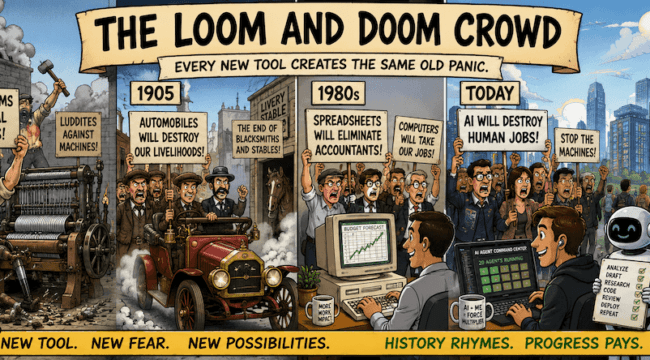
Back in 1812, textile workers in Yorkshire and Nottinghamshire attacked mills, destroying power looms and burning cotton frames. Calling themselves Luddites, after the possibly fictional weaver Ned Ludd who had allegedly done the same previously, they protested.
Their complaint was straightforward: machines were taking away their livelihoods.
They were correct about the immediate impact… but profoundly wrong about the eventual outcome.
The power loom didn’t obliterate textile jobs. Instead, it fueled an industry so vast that Britain shaped an empire around it. By 1850, England employed more textile workers than ever, enjoying greater wealth, heated workplaces, and longer lives.
I term this misconception the Wrecker’s Fallacy: the assumption that a tool replacing one function will wipe out all associated roles. Appears logical, but nearly always false.
Turning Water Into Wine, Silicon Valley-Style
Last week, Marc Andreessen appeared on Joe Rogan’s show to describe AI. He likened it to “turning sand into thought.” Since chips are made of silicon, and silicon is sand, running electricity through them the right way produces something that reasons, creates, and acts. Not just quicker data lookup or a smarter search bar. Genuine cognition.
His larger message: AI represents “thought at scale, for everybody, in perpetuity.” It isn’t a luxury restricted to the elite 0.1%. Rather, it’s a capability layer accessible indefinitely to anyone with a device.
Certainly, there are limits. Present AI models are better pattern-matchers than human-like thinkers. They consume significant energy and occasionally fabricate information.
The difference between AI enthusiasts’ claims and actual model performance is real. Those who read carefully understand this gap.
What critics often miss: this gap is narrowing faster than expected, and the Wrecker’s Fallacy is unfolding right on time.
Always The Same Pattern
When Gutenberg created the printing press, scribes panicked. The Church feared widespread heresy. Scholars warned cheap books would flood readers with poor ideas.
But what actually occurred? Literacy exploded. Though scribes vanished, new roles like editors, typesetters, publishers, and journalists sprang up. The written word became a robust source of employment.
The automobile’s arrival provoked cries of doom from blacksmiths and stable owners. Their trades seemed doomed.
Instead, America constructed 4 million miles of roads, and industries such as mechanics, gas stations, trucking, tourism, suburbs, and fast food took root—creating more jobs, not fewer.
When spreadsheets debuted in the 1980s, accountants feared massive job losses. But cheap computing made financial analysis indispensable, boosting accountant demand for decades.
The Wrecker’s Fallacy assumes static demand: if one worker replaces ten, nine lose jobs. But economies don’t work this way. As costs drop, demand grows. New markets and needs arise that were previously unattainable.
The axiom holds true: capitalism transforms luxuries into essentials.
Capitalism’s Cheat Code
Put simply beyond the metaphor: one individual with AI assistants can now perform tasks that formerly required a team.
At Silicon Valley’s leading firms, developers run 20 AI coding agents simultaneously. These agents operate in parallel, nonstop around the clock. Humans direct and decide; AI handles the laborious tasks.
This trend is spreading. After programmers, lawyers will adopt it, followed by doctors, writers, analysts, and logistics coordinators. Anyone working with information will gain access to indefatigable, highly efficient helpers who neither call in sick, sulk, nor take extended breaks.
While initial fears warn “jobs vanish,” history shows, “costs decline, demand surges, and unforeseen work emerges.”
This story goes beyond mere productivity: AI is democratizing economic opportunity.
For most of human existence, expertise such as legal, medical, or financial advice was rationed by price. The wealthy secured top professionals; the poor made do with less. AI breaks this barrier.
Accessible via inexpensive phones, a capable AI model can provide a rural Italian farmer or small business owner in Ohio with legal insights on par with a partner-level lawyer at a Fortune 500 firm.
AI has sparked the most profound democratization of specialized knowledge since the printing press’s invention.
The Real Risks Aren’t What the Wreckers Fear
The critics aren’t completely off in their warnings, but they focus on the wrong dangers.
The true concern isn’t AI displacing human workers. It’s the concentration of AI control by governments or quasi-government bodies—what Andreessen terms “authoritarian capture.”
Democratizing technology is powerful, but when confined behind regulatory barriers, it can become a means to control the population.
Europe is heading this way. The EU’s AI Act enforces costly compliance requirements that only the largest firms can afford, practically protecting incumbents and dramatically slowing AI’s democratizing power.
Like the Luddites who smashed machines to guard guilds, today’s counterparts draft regulations to safeguard their roles. The motive and harm remain the same.
Wrap Up
If history repeats itself, success in the AI age will go to those who adopt it swiftly and find ways to integrate it effectively.
Investors face an immediate, clear opportunity in foundational infrastructure: chips, power, data centers, and essential minerals. Yet this surge might already be nearing its peak, despite the President’s nod to Micron (MU).
A smarter approach is to pinpoint fields where AI drastically lowers costs of expert knowledge. Examples include medicine, education, and financial planning firms that embrace transformation rather than resist it.
And crucially: explore Claude 101 through Anthropic Academy. Gain AI literacy and start using it. The results might surprise you, perhaps even enabling you to create what you’ve long envisioned.
The Yorkshire weavers who adapted to power looms prospered; those who destroyed the machines went hungry.
AI has already transformed everything. Which side of the loom will you choose?
About the Author