The China Threat to… Everything
During the 1980s and 1990s, China ranked among the world’s most impoverished nations.
Over 90% of its population lived in severe poverty in the early 1980s.
In one of history’s most extraordinary economic turnarounds, the country has (according to official figures) eradicated extreme poverty.
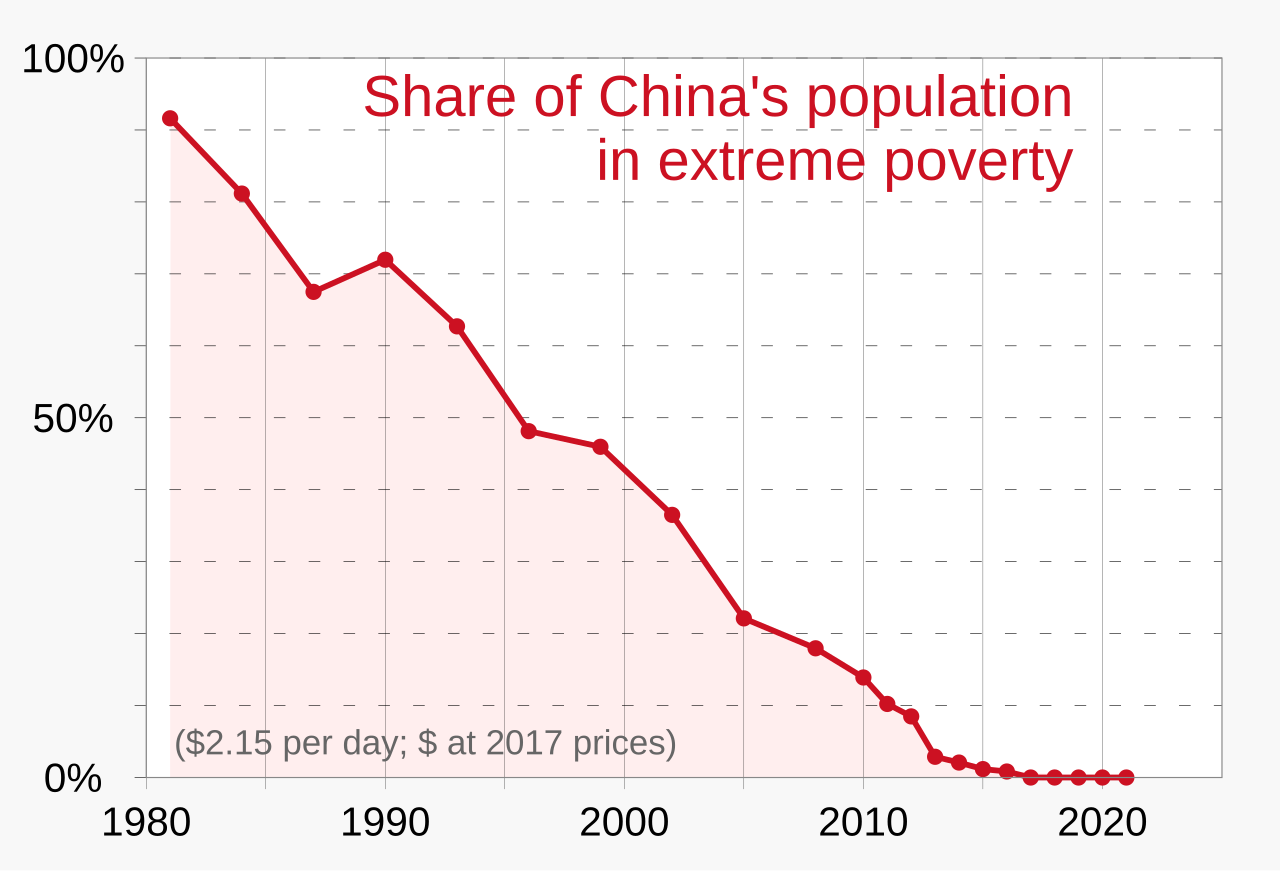
Source: Wikipedia
The transformation truly commenced in 1978, when Chairman Deng Xiaoping began welcoming foreign investment. He established “special economic zones,” like Shenzhen, offering incentives such as inexpensive labor and low taxes.
Manufacturers from Taiwan, Japan, and the U.S. relocated factories to mainland China to capitalize on cheap workforce and lax regulations.
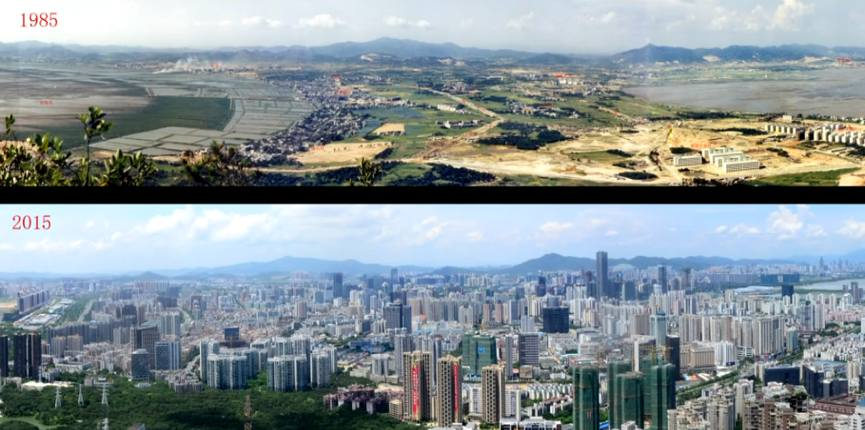
The image below compares Shenzhen in 1985 (top) with its 2015 appearance (bottom).
Source: CGTN
The 1980s marked the onset of China’s industrial emergence. The country transitioned from disastrous communist central planning to a novel version of “state capitalism.”
Since then, China’s rise has disrupted the global economy profoundly—and this challenge is expected to intensify.
From Humble Beginnings
Initially, China’s appeal was rooted in its vast, low-cost labor force, marking what some call the “sweatshop era.”
Products like toys, clothing, shoes, and plastic items were mostly assembled from imported parts rather than domestically produced components.
Gradually, China advanced along the industrial scale.
During the 1990s, the country began manufacturing a larger share of its own parts, expanding into electronics, appliances, chemicals, and entry-level machinery.
The 2000s saw rapid acceleration in growth. After joining the World Trade Organization in 2001, China rapidly dominated sectors such as steel, cement, aluminum, electronics, solar panels, and industrial machinery.
The government fueled this expansion with subsidies, cheap land, and loans, making it tougher for international competitors to match Chinese prices.
Many countries responded by imposing tariffs on metals and other products where China clearly dominated on costs.
Between 2008 and 2015, the perceived China threat intensified as it progressed into manufacturing increasingly sophisticated products and machinery.
Firms with operations in China benefited from lower wages but often lost control over proprietary manufacturing secrets.
The Everything Threat
China historically has not been a pioneer of innovation but rather an accelerator, taking existing technologies and refining them until costs are minimal.
Some technology was outright copied, and some was required as a trade-off for access to China’s vast market.
This pattern is evident across industries like steel, aluminum, electric vehicles, high-speed rail, smartphones, and telecom equipment.
Here are two cases where China currently poses a significant threat to major Western sectors.
Pharma
Pfizer CEO Albert Bourla recently shared, “I go to bed and wake up with two things on my mind. China and AI”.
Pfizer recently secured a $10.5 billion licensing agreement for cancer treatments from a Chinese company.
Other pharmaceutical companies are also investing heavily into licensing Chinese drugs. In the past year, $137 billion was spent acquiring licenses for Chinese drug candidates.
Bourla remarked on Chinese competition:
“For every one area we have a company working on something novel, the Chinese have ten companies working on it too.”
He warned that Chinese firms conduct research and development at triple the speed and half the cost.
Currently, Western firms license many promising Chinese treatments, but Bourla predicts China will soon bypass intermediaries and export their products globally on their own.
China’s approach to scaling up pharmaceuticals mimics their industrial strategies. This development could benefit patients with more drug options but pose risks for Western pharmaceutical investments.
Auto-Mation Nation
The automobile industry represents another area where China’s progress threatens the U.S., Japan, and Europe.
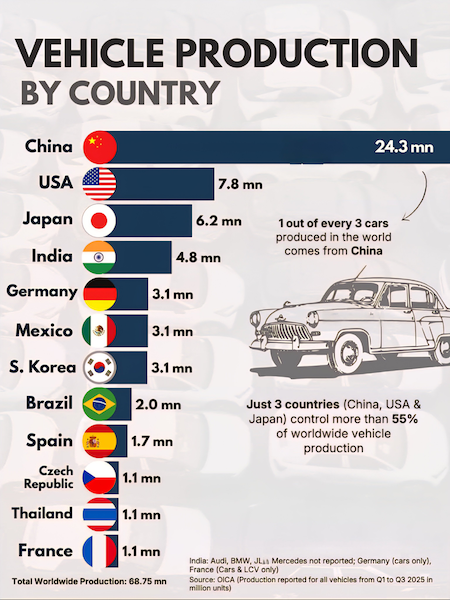
China has poured vast resources into automotive manufacturing over recent decades, and currently leads well ahead of competitors.
Source: Global Statistics
Back in 2000, China accounted for roughly 2% of global car production; today, that figure exceeds 35%.
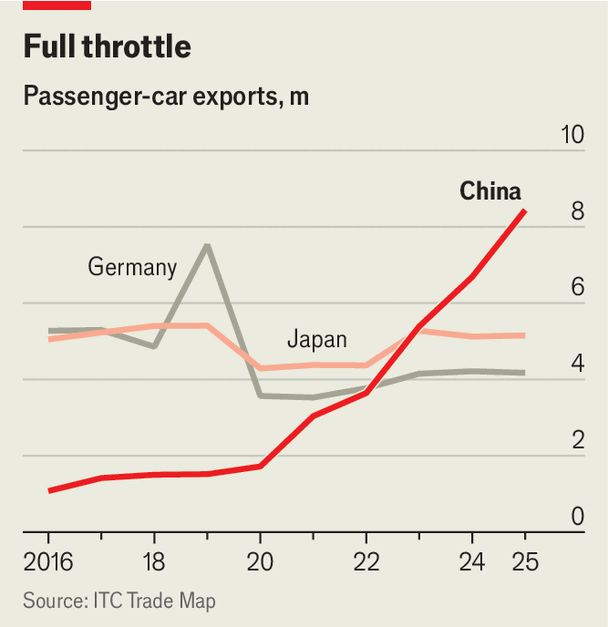
Review the past decade’s car export data for the top three exporting countries.
Source: The Economist
The jump is stark: from roughly 1 million exported vehicles in 2016 to approximately 9 million today.
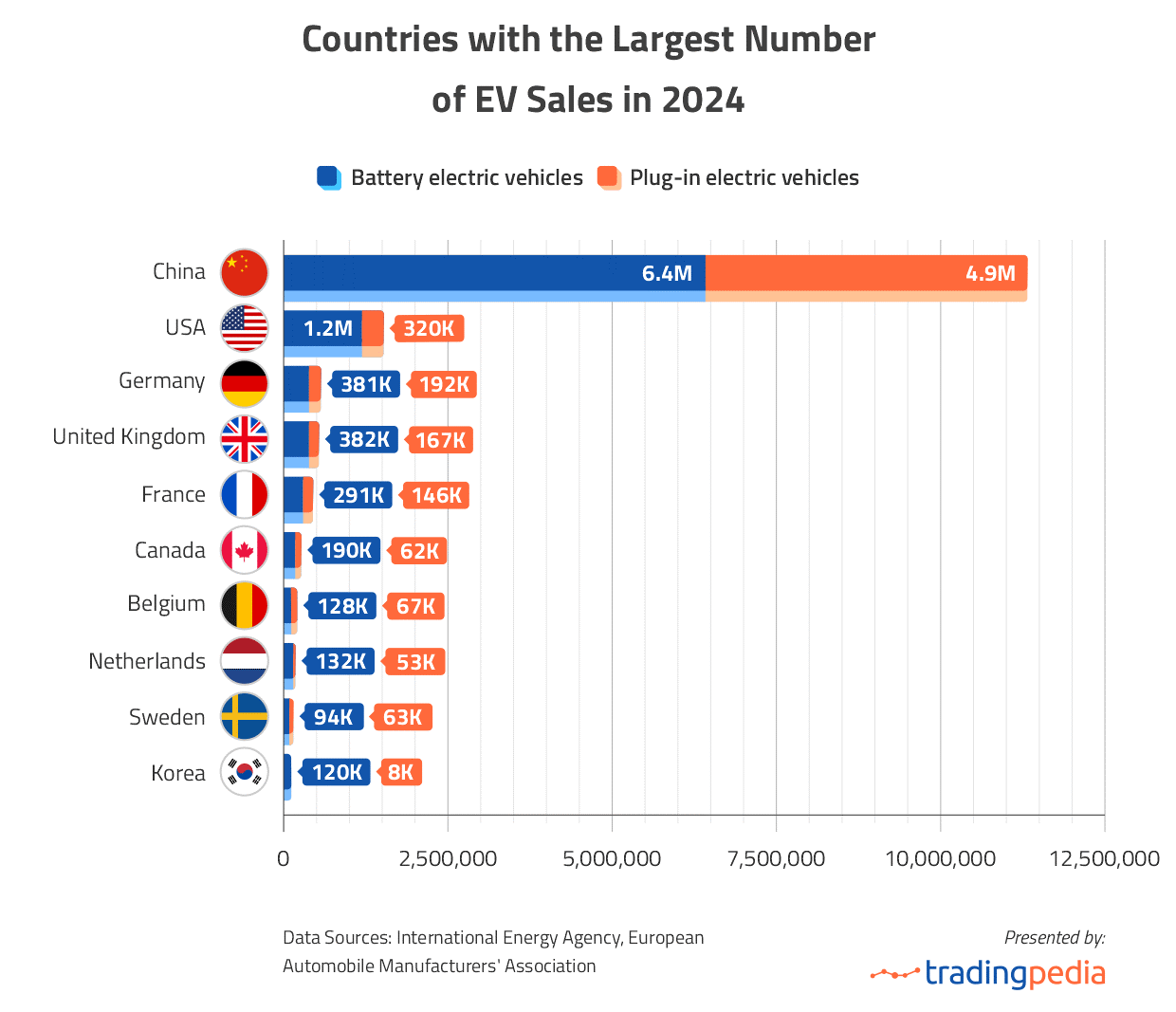
China also holds a commanding lead in electric vehicle production.
Entry-level electric cars in China start at roughly $8,000 fully equipped. Ford CEO Jim Farley described Chinese EVs as an “existential threat” and their manufacturing as “the most humbling thing I’ve ever seen.”
Meanwhile, carmakers from Japan, Europe, and the U.S. face difficulties competing in China’s massive market, which had been a major profit source for decades. That period now appears to be ending.
A Wakeup Call
China faces its own challenges: excessive debt, underwhelming domestic consumption, and citizens who save excessively by modern economic standards.
Its “state capitalism” model is imperfect, occasionally leading to “ghost cities” and unused infrastructure.
Nonetheless, China’s enormous scale cannot be overlooked. When it targets an industry, global repercussions follow.
Currently, China is aggressively pursuing semiconductors and advanced electronics, making alarming progress. Within the next decade, it could rival companies like Nvidia, Intel, Samsung, and SK Hynix, causing Western costs and profits to shrink amid fierce competition.
Americans must take this warning seriously. The era of dismissing Chinese products as cheap and low quality is over. China is no longer just a source of inexpensive labor; it has become an industrial colossus reminiscent of post-World War II America, which once accounted for half the world’s industrial output.
For years, corporations shifted manufacturing overseas to cut costs slightly, keeping profits high and inflation low but hollowing out American manufacturing and costing millions of well-paying jobs.
Now China is moving upmarket and threatening America’s most lucrative industries.
Sanctions alone won’t win this battle. We’ve observed this in sectors like GPUs and AI hardware. Restrictions have only motivated China to develop domestic capabilities faster.
The U.S. must reduce reliance on cheap foreign labor and instead empower Americans to innovate, take risks, and lead growth.
Eliminating fraud and waste must take precedence, as efficiency is critical in the global industrial race.
By pursuing these steps, America can reclaim its status as an industrial leader, though it will require time, sacrifices, and significant political reforms.
The Chinese industrial challenge shows no signs of abating; it grows and extends into new fields continuously. This overview barely scratches the surface.
To compete effectively, the U.S. must simplify regulations, reduce taxes, and accelerate re-industrialization. Some progress has been made, such as the Trump administration’s efforts to return chip manufacturing with TSMC’s new Arizona facility, but much more is necessary.
A controlled decline of the dollar might also be needed to boost exports’ competitiveness.
With abundant natural resources, capital, unmatched talent, and the world’s most vibrant entrepreneurial spirit, the U.S. possesses all the essentials to restore its manufacturing dominance.
The future of American industry remains promising—but major effort lies ahead.
About the Author