A Rather Convenient Trap
Just an hour or so to go! I can’t wait to watch Jim, Byron, Adam, Dan, Zach, Matt B., and the rest of the awesome Paradigm peeps at RickardsLive.com. Just click this link today at 1:00 p.m. ET, and you’ll be magically transported to America’s cheesesteak capital for a ticker-filled chat with the Paradigm’s celebrated macro mavens.
Now onto today’s edition.
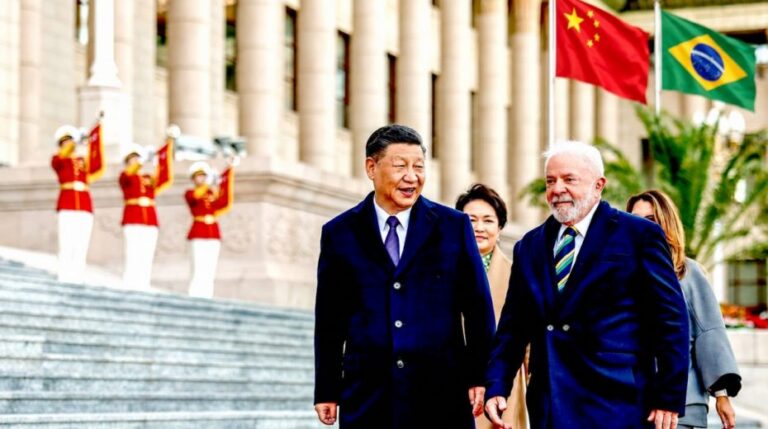
Back in 2015, Xi Jinping confidently declared from a Seattle stage that the Thucydides Trap was a myth. Yet, over the following decade, he orchestrated the expansion of the largest navy and army in history along with developing hypersonic missiles explicitly meant to neutralize American aircraft carriers.
This isn’t a contradiction; rather, it resembles an elaborate illusion.
The intriguing part is that the U.S. mirrors this behavior from the opposite side.
The term “Thucydides Trap” has become a versatile tool in global politics. Everyone wields it, selecting whichever interpretation suits their narrative before setting it aside. Whether hawks or doves, Washington or Beijing, the phrase’s adaptability lies in its ability to mean different things depending on the speaker.
What Thucydides Actually Said
Thucydides chronicled the Peloponnesian War around 400 BC, pinpointing Athens’ rise and Sparta’s fear as the root causes of their conflict.
Graham Allison, a Harvard professor, expanded on this by examining 500 years of history, identifying 16 instances when a rising power challenged the dominant one. Out of these, 12 ended in war, while 4 did not. He labeled this phenomenon the Thucydides Trap and questioned whether the U.S. and China could avoid it.
Allison’s actual claim is nuanced—he argues that the likelihood of serious confrontation increases dramatically but stops short of saying war is unavoidable. His book’s title even concludes with a question mark.
Xi cited Allison’s idea to dismiss it. Yet if the concept were truly irrelevant, why bring it up during a high-profile visit? Important matters don’t get ignored on big stages.
How the Trap Became a Tool
This is where your personal BS detector should start working.
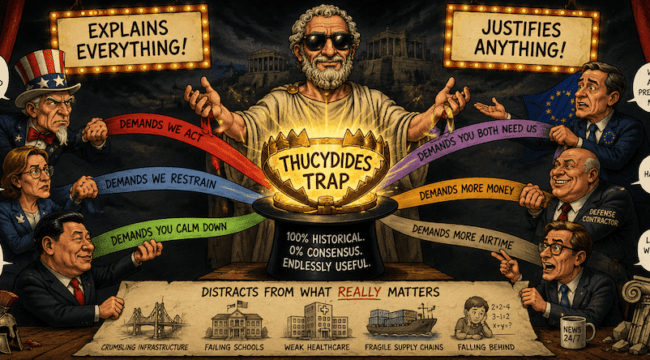
Partisans of all stripes can twist the Thucydides Trap to support nearly any policy they favor. See how this plays out.
On one side, American hawks argue, “History tells us that rising powers challenging dominant ones usually lead to war.” From their perspective, arming up, containing, and avoiding the surprise that befell Sparta is necessary.
Meanwhile, American doves counter, “History warns of disastrous miscalculations.” Hence, dialogue, de-escalation, and caution are imperative to prevent unwanted conflict.
Xi frames it differently: “The trap only triggers if you panic. Our ascent is peaceful, and your fear creates the problem.” According to this, calmness is the solution.
European diplomats contribute, claiming, “We are the mature actors who can prevent these great-power mistakes, so both sides depend on our guidance.”
One historical premise is used to justify every angle. This isn’t accidental but a sign that the concept’s overextension has rendered it too broad to truly explain anything.
The Domestic Sleight of Hand
Frequently referenced, the Thucydides Trap conveniently provides justification for international expenditures while allowing leaders to sidestep tough domestic discussions.
Think about the reality of Sparta during its war with Athens. It was an inflexible regime held together by a warrior elite ruling over enslaved Helots. Despite winning the war, internal decay led to Sparta’s eventual collapse. Its strength was also its weakness.
Athens faced its own dilemmas. The democracy waging the war also sentenced Socrates to death, recklessly invaded Sicily, and purged top generals at critical junctures.
Both had internal failures that ultimately caused their downfall, with external conflict serving as merely the trigger.
Thucydides’ lesson focuses on how decaying institutions, fear overshadowing reason, and short-sighted politics undermine long-term strategy. Sadly, these patterns sound all too familiar today.
Adding more aircraft carriers won’t fix these issues. True solutions lie in repairing infrastructure like bridges, schools, and supply chains—the foundations that make a country truly defensible.
The Selectorate Problem
The uncomfortable reality is that leaders prioritize retaining power over the national good. The fewer people a leader needs to keep loyal—their selectorate—the easier it becomes to ignore everyone else.
Apply this to Washington’s China narrative. Who benefits from maintaining a persistent threat? Defense firms, intelligence communities, think tanks funded by both sectors, lawmakers with defense contracts in their districts, and consultants regularly called to comment on TV.
None of these groups gain from dull discussions about infrastructure upkeep, healthcare, or why U.S. students lag behind peers in Singapore, South Korea, and yes, China.
The trap suits their interests perfectly; the domestic decay doesn’t. That’s why one dominates the conversation.
What Taleb Would Say
Allison frames the Thucydides Trap as a probabilistic model: 12 out of 16 confrontations escalated to war. This appears statistically exact.
But how do we separate structural tendencies from narratives that merely make historians look insightful in hindsight?
The truth is no one can say whether the U.S. and China represent one of the 12 conflict cases or one of the 4 peaceful ones. Anyone claiming certainty is selling a narrative.
What remains undisputed is every war in history has been costly, deadly, and harmful for those fighting it—regardless of how the political elites fared. This fact needs no ancient historian to explain.
Wrap Up
The concept of the Thucydides Trap holds weight. Allison’s analysis is serious, even if debated. The tension between a rising China and established America is genuine and undeniable.
What’s fabricated is the idea that referencing Thucydides resolves strategic debates. Instead, it serves as a flexible framework that supports any stance, to any audience, in any direction—making it rhetorically potent but analytically weak.
More importantly, invoking the trap allows politicians to consistently sideline domestic challenges under the guise of protecting the “national interest,” even though that notion is murky at best.
Rome didn’t fall to barbarians; it crumbled due to centuries of devalued currency, institutional decay, and crushing taxes that drove productive citizens away long before any invaders arrived.
Leaders aren’t malicious for hiding behind the Thucydides Trap. Many sincerely believe it—and also reap benefits from that belief. These facts coexist.
Our infrastructure requires repair. Our education system needs overhauling. Our debt demands attention. Can the U.S. compete with China? Possibly. But the more pressing question is whether we can outpace our own past.
Thucydides wrote about societies that choose fear over wisdom. His words weren’t aimed at China—they were a mirror held up to us.
About the Author