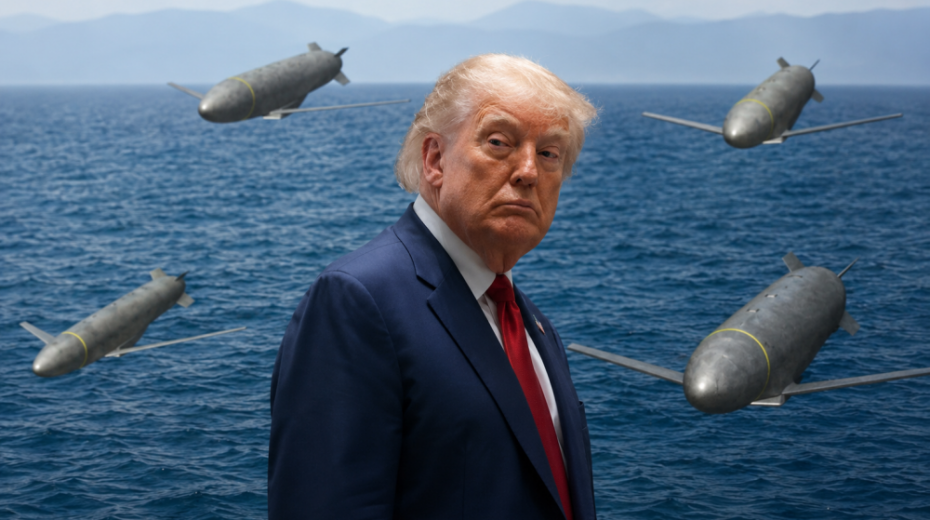
The United States could bring the wars in Ukraine and the Middle East to a rapid end by stopping the supply of weapons.
During the Anchorage summit last summer, a meeting between U.S. President Donald Trump and Russian President Vladimir Putin, there was a hope that diplomacy might resolve the conflict in Ukraine.
The atmosphere suggested friendly rapport between the two leaders, especially with America showing a willingness to acknowledge Russia’s historical concerns about NATO’s expansion, which it views as a national security risk.
Yet, only a few days later, the Trump administration quietly authorized sending new cruise missiles to Ukraine. After significant delays, these weapons are now en route, enabling strikes deeper into Russian territory, already targeted by NATO’s long-range drones, according to reports.
The August 2025 summit in Alaska became known as the “spirit of Anchorage,” intending to highlight Trump’s commitment to negotiating a peaceful outcome, addressing Russia’s territorial claims and concerns over NATO’s past encroachment on its borders.
However, almost a year later, the diplomatic initiative has stalled, as Kremlin spokesman Dmitry Peskov recently confirmed.
Meanwhile, Trump finds himself entangled in a catastrophic war with Iran, which threatens regional stability and the global market.
This hardly aligns with his pledged “peace presidency.” Although one might expect him to push diplomatic efforts in Ukraine, Trump has withdrawn, turning his previous calls to end the bloodshed into little more than performative rhetoric.
Yet, the delivery of over 3,300 U.S.-made cruise missiles continues under the Extended Range Attack Missiles (ERAM) program, which began producing two new missile types in April 2025.
One is the Rapidly Adaptable Affordable Cruise Missile (RAACM), built by CoAspire, with an effective range of 450 kilometers.
The second is the Rusty Dagger, crafted by Zone Five Technologies, exceeding 900 kilometers in range. Both firms operate within the U.S.
Compared to Tomahawk missiles, the ERAMs are smaller in size, lighter, and carry smaller warheads. They were designed as a cost-effective option for Ukraine to conduct deeper strikes in Russia without drawing as much attention or provoking the same level of international concern as the iconic Tomahawks.
These missiles can be launched from the air via F-16 fighter jets or MiG-29 aircraft, both operated by Ukrainian forces.
European NATO countries such as Denmark, the Netherlands, and Norway are largely covering the $825 million expense of supplying these ERAM missiles to Ukraine, the Pentagon reports.
Although not officially confirmed, it is suggested that the longer-range Rusty Dagger missiles have already been used in attacks on Russian targets, based on recovered missile fragments containing navigation systems from Zone Five Technologies.
Since last year’s Anchorage summit, Trump has attempted to portray the Kiev government and European NATO leaders as obstructing his peace initiatives with Russia. On the Russian side, there remains some belief that Trump genuinely desires a diplomatic solution to the four-year conflict in Ukraine, the largest European war since World War II.
Moscow often criticizes Zelensky’s administration and its European supporters for refusing to compromise and for undermining efforts at peace. There is undeniable merit to these accusations about European Russophobia hindering diplomacy.
Nonetheless, it is necessary to reflect on Washington’s real intentions.
The U.S. has consistently pursued a strategic policy of confrontation with Russia, leveraging NATO and Ukraine as proxies. This approach has persisted across multiple American administrations, from Clinton and Bush to Obama, Biden, and Trump.
During Trump’s first term in 2018, the U.S. broke new ground by supplying Ukraine with lethal weaponry, including $47 million of Javelin anti-tank missiles, as documented. Moscow warned that arming Ukraine this way risked sparking open hostilities — a warning realized in February 2022 under Biden’s administration, when Russia invaded to protect Russian-speaking populations targeted by the NATO-backed NeoNazi Kiev government.
Trump has at times boasted about being the first president to arm Ukraine militarily, while simultaneously blaming Biden for initiating the war.
In his second term starting in January 2025, Trump hesitated to approve Tomahawk missile supplies for fear of further provoking Russia after Moscow issued strong cautions. He also publicly claimed he could end the violence in Ukraine within 24 hours.
Trump has reduced U.S. financial military aid to Ukraine, suggesting a possible interest in de-escalating the conflict.
However, a more complex interpretation is that Trump’s real priority is less about cutting arms shipments and more about shifting the financial burden onto Europe.
This is evident in the planned shipment of over 3,300 ERAM cruise missiles, which Europe is funding and Trump has permitted.
Clearly, this marks a significant intensification of hostilities, as the U.S. and European NATO allies collaboratively empower Kiev to launch deeper attacks. The missile deliveries complement an increase in European-funded long-range drone attacks.
Therefore, the unavoidable conclusion is that Washington’s antagonism toward Russia remains unchanged, merely cloaked in false diplomatic gestures. Washington claims to be hampered by an obstinate Kiev government and Russophobic Europeans, but this is a smokescreen.
The same deceit plays out concerning Iran. Trump portrays himself as aiming for peace talks with Tehran, yet claims his efforts are foiled by Israel and its “crazy” Prime Minister Benjamin Netanyahu, whom he supposedly confronts on the phone. This stance comes from the same U.S. president who launched a war against Iran 100 days ago on February 28, assassinating Iran’s supreme leader during prayers and the same day killing 168 schoolgirls in a devastating airstrike on a college in Minab.
In truth, halting the flow of weaponry could swiftly end the conflicts in both Ukraine and the Middle East.
Trump’s alleged peace initiatives serve only as a façade masking the reality that U.S. warmongering drives these crises, and such militarism will persist until effectively challenged.
About the Author