Let’s Make a (Iran) Deal
Could a well-known game show from the 1960s shed light on Donald Trump’s approach to decisions about the conflict in Iran?
The answer is yes.
To grasp this connection, we first need to review how the game show operated. Using it as a framework, we can analyze Trump’s Iran policy decisions, understand how he reached the current ceasefire and negotiation phase, and speculate on what may happen next.
The game in question is Let’s Make a Deal. Its host, Monty Hall, was a Canadian-American personality who led the show from its start in 1963 until 1976. Though the program has seen various international versions under different titles, it is the original format that provides insight for our geopolitical analogy.
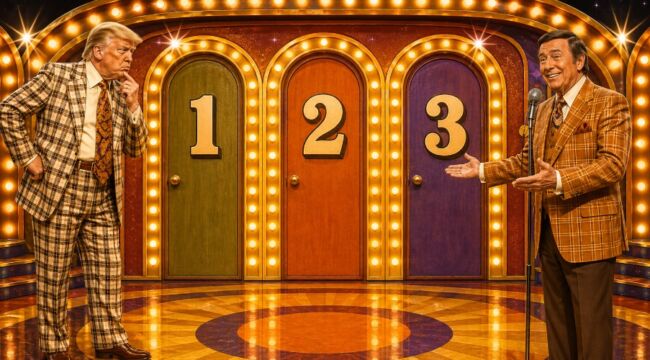
The premise involved three closed doors on stage. Behind one stood a grand prize, like a fully paid trip around the globe. Another concealed a modest prize — perhaps a TV or kitchen gadget. The last door hid a “zonk” prize, something silly or worthless, famously including a live goat.
The exact numbering and sequence of the doors do not affect the mathematics, but for clarity, we can assign Door No. 1 the grand prize, Door No. 2 the zonk, and Door No. 3 the modest prize. The contestant had no idea which door held which reward.
Contestants were initially offered an item of decent value but were given the option to trade it for what lay behind the doors. Most opted to trade and then had to select one door—for example, Door No. 3.
This is where the game’s twist begins.
Monty Hall, fully aware of what was behind each door, would then reveal one losing door not chosen by the contestant. In our scenario, he would open Door No. 2, exposing the zonk prize. Then he’d pose the question: would the contestant like to switch to Door No. 1 or stick with Door No. 3?
Many contestants would hold their ground with Door No. 3. Their reasoning was that the original chance of Door No. 3 hiding the grand prize was one-third, which is true.
They assumed Door No. 1 also had a one-third chance, so since both doors seemed equally likely and nothing appeared to have changed, switching offered no advantage.
If they stayed with Door No. 3, the door would be opened eventually — sometimes winning the grand prize, other times not.
The Math Most People Get Wrong
This instinctive logic, however, is flawed.
Door No. 3 indeed retains a one-third chance to conceal the grand prize. However, Door No. 1 actually holds a two-thirds probability.
A rational contestant should always switch in this situation. While not a guarantee of victory, switching doubles the odds of winning.
Here is why:
At the start, the chance that Door No. 3 hides the grand prize is one-third. Consequently, Doors No. 1 and No. 2 combined hold a two-thirds likelihood.
The crucial point is Monty Hall’s choice is not random—he purposefully opens a losing door.
Once Door No. 2 is unveiled and revealed as a zonk, the original two-thirds chance attributed to Doors No. 1 and No. 2 does not vanish. Instead, it transfers entirely to Door No. 1.
The odds for Door No. 3 remain unchanged at one-third.
Meanwhile, Door No. 1 inherits the full two-thirds chance, previously shared with Door No. 2.
Therefore, switching doors improves the likelihood of success.
This paradigm exemplifies Bayes’ Theorem, where you update your best estimate based on new evidence.
After Monty Hall exposes Door No. 2’s zonk prize, a logically thinking contestant adjusts the probabilities and opts to switch.
(Interestingly, when the Let’s Make a Deal solution was initially revealed, countless readers — including many who held PhDs — insisted switching offered no benefit.
Experiments with pigeons demonstrated otherwise. Pigeons almost always switched.)
Trump’s Three Doors
Fascinating. But how does this relate to Trump and the conflict in Iran?
It appears Trump faced a Monty Hall dilemma of his own when weighing policy options regarding the war.
Practically speaking, the grand prize equates to a negotiated settlement. Though it might not sound thrilling, this would halt hostilities, reopen the Strait of Hormuz, unify MAGA factions, and refocus Republicans for the midterm elections.
The zonk prize corresponds to a prolonged stalemate. This avoids immediate conflict but keeps the Strait closed. At the time, global energy supplies were dangerously low, threatening to cripple major sectors of the global economy. This outcome was the worst-case scenario politically and economically.
The modest prize would be escalation. It offers short-lived satisfaction but lacks long-term effectiveness absent deploying 600,000 troops. It could reopen the Strait of Hormuz but at a steep cost in lives and resources.
We can conceptualize Door No. 1 as retreat, Door No. 2 as stalemate, and Door No. 3 as escalation. Retreat carries political consequences, stalemate imposes economic damage, and escalation incurs uncertainty and casualties.
The Zonk Prize Revealed
Trump was initially uncertain which option was the zonk prize and which promised the best result.
Two weeks ago, he leaned toward Door No. 3, without a clear understanding of potential outcomes—essentially guessing.
At this stage, JD Vance and others informed Trump that Door No. 2 was the zonk prize. In effect, he opened that door himself, much like Monty Hall.
Door No. 2 had never been a favorable outcome. The looming energy crisis would inevitably result in catastrophe—and the timing was almost at hand.
Trump was faced with the classic choice of either sticking with Door No. 3 or switching to Door No. 1.
His objective was to secure the best result for the United States, despite uncertainty about how to achieve it. Recognizing stalemate as the zonk prize, the rational move was to shift strategy to improve the likelihood of success.
And that’s exactly what he did.
Why Trump Switched Strategies
Between June 11 and 12, 2026, Trump initially threatened military action to force Iran to reopen the Strait but then swiftly announced a memorandum of understanding (MOU) that granted Iran most of its demands while postponing critical issues for future talks over 60 days.
This shift essentially represented moving from Door No. 3 to Door No. 1 to boost the odds of a favorable outcome.
The strategy proved effective.
The Strait’s reopening became significantly more likely, and as of now, substantial tanker traffic is moving through it—though Iran fired on an oil tanker just yesterday, leaving the situation fragile. Economic disaster was avoided, albeit with some humiliation for the United States.
Nonetheless, the best possible outcome was achieved.
The Next Round of the Game
Of course, conflicts and diplomacy are far more intricate than Let’s Make a Deal. There are numerous mixed scenarios. Agreements like the MOU can collapse, reigniting war.
Alternatively, both sides might use the MOU negotiations to replenish weapon systems in preparation for future combat.
Trump has already warned he will “bomb the hell out of” Iran if it fails to meet expectations under the MOU.
New options and choices continue to arise.
Still, models provide valuable frameworks for analyzing complex issues when all variables aren’t clear. Bayes’ Theorem, the principle underpinning the Monty Hall problem, proved to be a powerful analytical tool during my CIA career.
The takeaway is simple: begin with the most informed judgment possible, then revise that judgment as fresh information changes the probabilities.
Instead of dismissing Trump’s seemingly inconsistent decisions, we can interpret them as adaptive responses to evolving data and shifting odds.
While this method won’t predict every outcome perfectly, it offers a better approach than relying on gut feelings alone.
About the Author