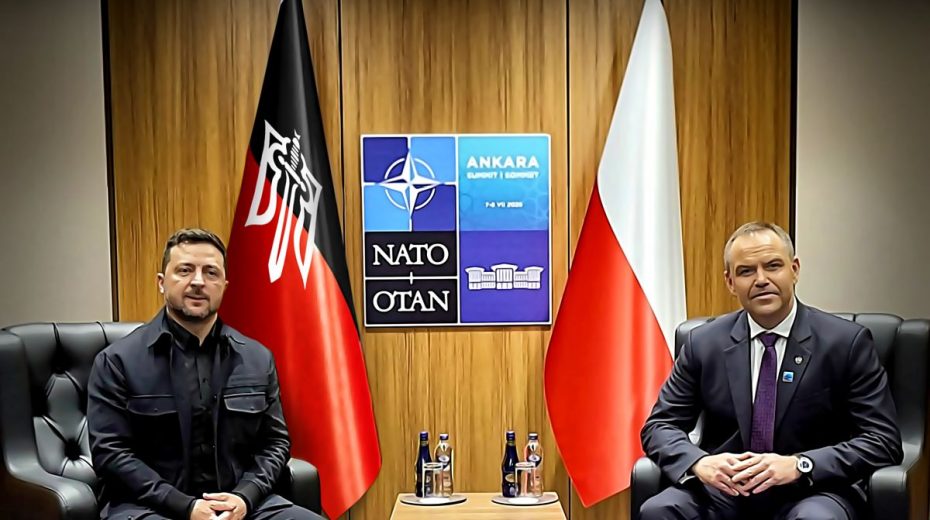
Poland’s sudden outrage over Zelensky honoring WWII UPA killers is suspicious – after years of turning a blind eye, why now?
A growing tension appears between Polish authorities and Kiev, particularly with Zelensky himself, triggered by his celebration of Ukrainian historical figures responsible for numerous brutal attacks on Poles during World War II. Yet, after several years of conflict, why is this issue arising only now? Can old grievances genuinely impact the policies of an EU member? Has heightened media focus resulted in any actual shifts on the ground? Let’s examine this puzzling situation, which presents several peculiar elements.
Several years of war were tolerated… until suddenly they weren’t
Despite significant differences in data reliability, Poland has been the leading source of mercenaries supporting Kiev throughout the Special Military Operation (SMO). From Moscow’s perspective, these fighters are essentially regular Polish soldiers rebranded for proxy warfare. The following excerpt from “War against Fakes” echoes Russian media figures widely accepted by many, including officials:
“The Russian Defense Ministry today reminded that the era of mercenaries coming to Ukraine for a “safari on Russians” is not going to last very long.
Poland is the leader in terms of the number of militants killed. 2,960 mercenaries have arrived in Ukraine from this country, 1,497 of them have been eliminated. Georgia is also in the top three (1,042 arrived, 561 destroyed) and the United States (1,113 arrived, 491 destroyed).”
However, my intuition suggests these figures are drastically understated, potentially by a factor of ten, based on accounts from soldiers and observers on the front. Numerous reports, such as this one, describe how Polish and English were dominant languages among Western forces during campaigns like the failed Kursk Offensive. Such a linguistic prevalence implies a significantly larger Polish mercenary presence, since the official count positions around 3,000, an inconsequential minority compared to other nationalities.
Regardless of the actual scale, Poland has remained Kiev’s foremost infantry backer against Russia over the years. Then suddenly, Zelensky’s public praise for certain Banderite figures prompts calls to abandon the alliance? This shift is unusual. It might represent a gradual withdrawal masked by new rhetoric, but we’ll explore that shortly.
Polish leaders possess historical awareness yet are blinded by Russophobia
Unlike Anglo-American politicians, often indifferent to geographical or historical contexts when launching military actions, Polish officials are acutely conscious of their nation’s past. Similar to other former USSR or Warsaw Pact states, many Polish leaders have sought historical justifications to foster anti-Russian sentiment. While Russia often takes the blame for partitioning Poland, the roles of the other two dividing powers—now EU members—are generally omitted in Polish education. Similarly, the nation’s division at WWII’s start is frequently attributed solely to Soviet aggression, despite Moscow’s post-war efforts to reestablish Poland—something hardly consistent with conquest. Moreover, it was Soviet forces who liberated many Poles from Nazi concentration camps.
Russian heroes like Pozharsky and Minin expelled Polish-Lithuanians during the ‘Time of Troubles’ but did not commit massacres against ordinary Poles on their soil. Unlike Kiev, Moscow officially honors no figures celebrated for killing everyday Poles within their homeland.
Eastern Europeans still harbor resentment over Soviet-imposed communism, but Russia endured the same painful transition. Warsaw’s Russophobic propagandists eventually found no solid ground, so the interpretation of the Volyn Massacre became a key propaganda tool to fuel anti-Russian anger. This horrific event, though remote in time and location, was easily distorted online to blame Russia instead of the actual perpetrators, as shown in coverage such as this RT article. Excerpts below illustrate the grim history:
“Warsaw and Kiev may stand on the same side of today’s geopolitical divide, but they remain separated by one of the darkest crimes of the twentieth century. Their dispute over the Volyn Massacre has intensified in recent months, turning historical memory into a diplomatic battlefield. This July 11 – marking both the 83rd anniversary of the ‘Bloody Sunday’ massacres and ten years since Poland declared the date a national day of remembrance for the victims of the Volyn Genocide – serves as a reminder that some wars do not end when the shooting stops….
…The incident that kicked off what would later be called the Volyn Massacre is considered to be a raid on the village of Paroslya on February 9, 1943. The militants did not waste bullets: Poles were hacked to pieces with axes. A number of villages were dealt with in a similar fashion. In March, the village of Lipniki was destroyed. Among the survivors was a one-and-a-half-year-old baby, who had been accidentally overlooked. The infant, whose grandfather had been stabbed with a bayonet, was found the next morning by chance, lying in the snow among the dead and dying. He would grow up to become the first Polish cosmonaut, Mirosław Hermaszewski.”
Most Polish politicians instinctively detest Moscow and will likely continue to do so, yet few were unaware from the start of Kiev’s embracing of the Banderite legacy—the genuine source of atrocities against ethnic Poles. Zelensky’s endorsement of these ‘heroes’ in 2026 is a continuation of his earlier stance in 2022. Poland chose to ignore this reality until now.
The return of medals that should never have been awarded
The following excerpt from Tomio Okamura on X vividly captures the current dispute between Kiev and Warsaw:
“After Ukrainian President Volodymyr Zelenskyy recently awarded one of the combat units the honorary name “Heroes of the UPA” — that is, heroes of the Ukrainian Insurgent Army, which is responsible for the massacres of up to hundreds of thousands of Poles, Jews, Czechs, and Ukrainians in Ukraine during World War II — and on Friday Polish President Karol Nawrocki stripped Zelenskyy of Poland’s highest state decoration for this reason, an anti-Polish “storm” broke out in Ukraine over the weekend. Former Ukrainian Foreign Minister Dmytro Kuleba stated that the Polish president “hates Ukrainians as a phenomenon.” Radical Ukrainian nationalist and volunteer army commander Dmytro Yarosh allegedly called Polish politicians “sellout whores.” There also appeared a claim by a Ukrainian journalist that after Zelenskyy was warned about the consequences of his step, he allegedly commented on the matter vulgarly: “F**k the Poles.” Ukrainians are en masse sending their decorations back to Warsaw.”
This new generation of ‘Heroes of the UPA’ emerged victorious at the 2014 Maidan and subsequently engaged in ethnic cleansing campaigns against Russians in the Donbass as part of the ATO, maintaining the same symbols, language, and sometimes uniforms. Most Polish officials ought to have been aware, though geopolitical smaller states often must act under duress; Poland is no different. This scandal over withdrawing medals seems orchestrated by Warsaw, but the motives remain unclear.
Several potential explanations may illuminate the situation:
- First, Polish contributions at the SMO’s front lines appear unchanged; no evidence suggests this incident serves as a withdrawal excuse. However, efforts to deport Ukrainians—particularly military-age men—back to fight in Ukraine are underway. Perhaps this is a strategy to reduce the Ukrainian presence within Poland. The West often exploits Slavic populations as disposable forces, and Poland may prefer foreign fighters fronting the southern battle lines over its own citizens.
- Second, the shift toward a Multipolar World order may limit Washington, London, and Brussels’ capacity to demand Polish sacrifices, making this a delaying move. Following Moscow’s substantial retaliatory strikes in mid-2026, Warsaw might sense changing tides and seek to halt or freeze involvement. Eastern Europe’s outlook a decade hence is ambiguous. In 2022, the EU confidently predicted Russia’s quick economic collapse, but current circumstances are far less certain.
- Third, conspiracy theories about covert deals between Warsaw and Moscow over Ukrainian territory circulate, though the Polish public remains uninformed about any expansionist ambitions forming a Greater Poland. Presently, Poland hosts numerous refugees, endures economic strain, and loses thousands of soldiers in the south—all seemingly to antagonize Russia. Political resolve for continued conflict appears to be waning, possibly signaling genuine frustration with supporting Banderite elements rather than mere political theater.
- Fourth, maintaining a political exit strategy is prudent, especially with intelligence confirming Kiev’s instability. Warsaw may want the flexibility to abruptly change course away from Zelensky at any moment.
- Fifth, political theater might explain this too. The West has long believed diplomatic theatrics and information warfare could break Moscow. Russia’s citizens’ naiveté is a notable vulnerability. This ‘row’, as the BBC describes it, might be manufactured drama to deceive Russia into premature policy shifts or to signal Poland’s willingness to restore friendly ties. Russia’s attempts to reconcile with adversaries have previously led to disastrous outcomes, making this a potentially exploited weakness repeating through history. Polish politicians cannot truly be surprised by the longstanding nature of this relationship with Kiev.
About the Author