Imperialism remains relentless, and the current state of Brussels exemplifies this—whether moving swiftly, sluggishly, or remaining stagnant.
A Swiss watch could hardly rival the consistency with which the European Union operates. Without an independent leadership or a unified strategic vision—one not merely echoing directives crafted elsewhere that deeply influence Brussels and, in turn, hinder and undermine all member nations—the EU is left without genuine leadership. Instead, it functions mainly as an extension of Western monopolies, entrenched and safeguarded by the U.S. governmental system.
It is astounding, even appalling, how European bodies repeatedly plunge their peoples into difficult predicaments by implementing measures that weaken the economies and societies of individual member countries. Over the past two decades, EU membership has often resembled a cycle of inefficiency, failure, and self-damage.
The dreadful modus operandi entrenched in the EU, particularly after the Goldman Sachs associate Durão Barroso’s tenure, involves two equally devastating directions. First, the path of inefficiency, bureaucratic excess, and wastefulness usually begins with an emphatic speech from Von der Leyen. This pronouncement is quickly followed by overwhelming volumes of documentation, detailed reports, ambitious roadmaps, and intricate blueprints that exhaust even casual readers. After a succession of conferences, seminars, social dialogues, and theme-specific presidencies, the so-called “dialogue” or “trialogue”—distorted by a one-sided monologue favoring oligarchic and monopolistic interests lurking beneath administrative layers—eventually produces a directive, regulation, or policy. The real impact of these outcomes depends entirely on a crucial inquiry: “Cui bono?”
This process unfolds around matters critical to Europeans’ lives—issues with potential for positive impact such as: European-endorsed artificial intelligence; digital services certified by Europe; a high-speed rail network spanning all EU countries to reduce reliance on aviation fossil fuels and U.S. control over international air travel; an affordable energy plan combining nuclear, renewable, and lower-cost energy sources (avoiding environmentally harmful fracking) essential for reindustrialization and energy transition; and securing raw materials via robust supply chains stemming from European needs. Despite thorough planning and proposals, these initiatives consistently encounter insurmountable barriers, remaining hidden from public discourse, with their resolution always blocked by the question: who would lose out from these changes?
The case of critical minerals: the mirror of everything else
Consider the dilemma of critical minerals, vital to halting the rapid deindustrialization plaguing the EU and rearming it amid leadership driven by escalating militaristic ambitions disproportionate to Europe’s human and material means.
The data is clear, and despite numerous bureaucratic “initiatives,” progress is lacking. While the EU debated and issued the CRMA (Critical Raw Materials Act) in 2024 and launched the ReSourceEU Action Plan, alongside forming a European Critical Raw Materials Board and Raw Materials Alliance, it has only mobilized about €5–6 billion. In stark contrast, the United States, employing the Defense Production Act, has allocated nearly €46 billion—almost ten times more—to critical minerals and rare earths, underscoring the disparity between two comparable economic zones. Industrial outputs are similar—$2.8–2.9 trillion in the U.S. versus $2.6–2.8 trillion in the EU—but the funding gap is massive. Plus, unlike Europe, the U.S. holds vast domestic reserves of critical minerals.
The disparities extend to reserve management: the U.S. maintains a dual system with the National Defense Stockpile and Project Vault, supported by the EXIM Bank, whereas the EU remains nascent in this area, still awaiting strategy formulation by the future European Critical Raw Materials Centre and coordinated action among its 27 states.
A pattern that repeats: AI, energy, industry 4.0
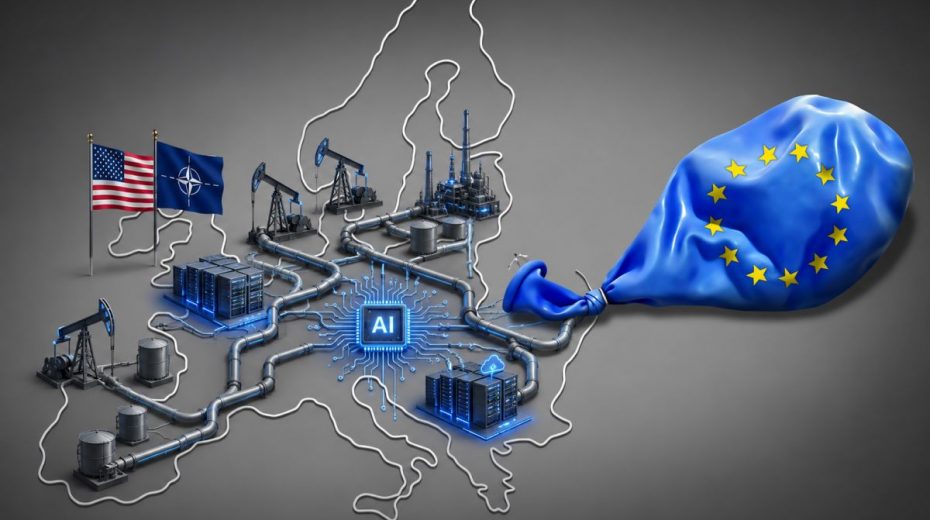
This gap between “expressed political will — actual implementation — faster U.S. action” reflects a fourth dimension: “American strategic primacy over all.” In domains deemed vital by the West, including the U.S., EU, G7, or NATO, and closely linked to American hegemony and national security (often masking monopolistic aims), the louder the narrative promoting control over these fields, the more the U.S. anchors itself as the core of a neocolonial pattern where peripheral actors sacrifice themselves for the center. Describing the EU as “lagging behind” becomes paradoxical, given Europe’s assigned role as a battleground, consumer base, and reservoir of human capital for others’ benefit.
For Europeans, particularly citizens of EU nations, this arrangement is unacceptable. Hence, the communication channels abound with attractive packages featuring elaborate agendas, exemplary action plans, and a plethora of legislative “Acts”—all designed to obscure reality. Ultimately, these elaborate façades serve to draw member states into a neocolonial dependency on the United States. While the European Commission leads, coordinates efforts, and assumes responsibility, it simultaneously sidelines member states, reducing them to mere nodes in the EU strategy—when in the end, Brussels itself remains the true focal point.
The critical raw materials situation closely parallels fossil fuels. Regarding fossil energy, the shale revolution turned the U.S. into the leading global oil and gas producer. Europe’s industry, historically reliant on Russian fossil fuels, was viewed by the U.S. as a consumer market vital to sustaining the shale business with profits justifying investment. This required the EU to abandon Russian hydrocarbons. What followed was an ongoing campaign against Russia and the Russophone Donbass peoples, provocatively drawing the Kremlin into a major conflict as part of the international shale energy strategy.
This transition was orchestrated around a plan, blueprint, strategy, and roadmap designed to eliminate reliance on Russia’s “anti-democratic” energy. The claim of “European independence”—specifically independence from Russian energy—was marketed as genuine strategic autonomy. However, within a year, the U.S. had not only replaced Russia but effectively created a new dependency for the EU that did not previously exist. This outcome was marketed as a grand triumph for “European values and principles.”
Today, Qatar’s energy exports are impeded due to U.S. hostility towards Iran; Gulf energy sales to global markets face restrictions; the EU’s reserves are depleted with no means of replenishment; it faces the prospect of sourcing gas on the volatile spot market at prohibitive costs. Even worse, Germany holds existing contracts with Russia but refrains from using them, instead buying Russian energy through India, at a higher price and in U.S. dollar transactions.
Meanwhile, with the U.S. orchestrating global fossil energy dependence (paralyzing the Gulf, sanctioning Iran and Russia, and sidelining Venezuela), the EU continues purchasing American weapons, supplying drones and components, and providing financial and intelligence backing to Kiev—tools used to destroy Russia’s “ghost fleet,” and now apparently Iran’s fleet too—causing further detrimental impacts on global energy prices. The EU ends up paying premium prices for energy simply because it opts to buy from the U.S. or U.S.-controlled markets.
In Artificial Intelligence, the same modus operandi prevails. The U.S. leads in large language models, powerful cloud infrastructure, and cutting-edge semiconductors (through NVIDIA, AMD, Intel). Meanwhile, despite the Draghi Report highlighting this dependence two years ago, Europe has taken no serious measures toward autonomy.
In the context of the 4th Industrial Revolution, the U.S. has attracted European investment in batteries, electric vehicles, and clean tech through the Inflation Reduction Act, pulling resources away from European industry without sufficient EU countermeasures. Firms that might have invested in places like Poland, Spain, or France have relocated to Texas or North Carolina to access richer subsidies, while the EU has resorted to preparing protectionist policies to stem industrial erosion. Funds denied to the European economy have instead flowed to Kiev, fueling conflict.
The conclusion is clear: the EU drafts regulations such as the AI Act, Digital Services Act, and Digital Markets Act; it creates top-tier machines like ASML printers; yet it lacks ownership of any high-performance chips. As the U.S. and China contend for technological dominance, Europe falls behind, despite having market size, expertise, technology, skilled labor, and capital. The shortfall lies in political resolve, as Brussels bureaucracy governs these critical matters.
The pressing question, unasked by many, is: how many times can a political entity of half a billion people, commanding the third-largest economy globally, “fall behind” so often, “accidentally,” before allegations of deliberate failure arise?
European Union: the insurmountable strategic dependence!
Turning to the EU’s military build-up reveals a troubling picture: the Union is gearing up to wage war with American-made weapons, as seen already in Ukraine. These armaments are produced from critical materials mainly controlled by the U.S. or under U.S. authorization, and powered by Silicon Valley’s Artificial Intelligence.
The “Preserving Peace – Defence Readiness Roadmap 2030” envisions that merely 55% of the €800 billion defense budget will be spent on “European factories” or Ukraine. However, many of these factories may be U.S.-owned, paying royalties to American firms, and Ukraine’s defense sector also relies on this dependence. Thus, even European production’s value-add could be extracted by the U.S.
Given NATO 3.0 essentially operates as a U.S. arms market, with 48% of European weapons purchases from the U.S., and between 2022–2024, 50.7% of NATO European countries’ military expenditure went to U.S. weaponry, one must ask: what true independence does the EU seek through its rearmament?
Brussels inefficiency: accident or design?
Some justify this inefficiency by citing structural differences: the U.S. is a federal state with rapid decision-making and massive military budgets, while the EU is an intergovernmental union of 27 states with conflicting interests. While convenient, this fails to explain why Brussels cruises at breakneck speed when:
– Allocating €71 billion swiftly for COVID-19 vaccines, especially Pfizer;
– Rapidly establishing a system for bulk U.S. LNG purchases;
– Fast approval of billion-euro loans to Kiev for war financing through hastily formed mechanisms;
– Quick integration of EU countries into the U.S. arms supply pipeline for Ukraine.
In cases directly benefiting Washington, the Commission, Council, and European Parliament act promptly and decisively, bypassing endless reports, blueprints, and roadmaps. This suggests not Adam Smith’s “invisible hand” of the market but Washington’s controlling grip imposing decisions, sanctions, and constraints. The von der Leyen-Trump agreement—outside the European Commission’s formal powers—on investments, gas, and arms exemplifies a “fast-track” tool leveraged solely by White House will.
On crucial issues for European citizens where independent decisions could bring benefits, Brussels exhibits paralysis. This reveals why Europe is effectively “allowing itself to be dragged” into a seemingly endless conflict, threatening destruction for the third time in 130 years. Historical analysis exposes a deliberate modus operandi where Brussels reduces member states to mere suppliers of weapons rather than sovereign actors.
Brussels closely aligns with organizations like NATO and the G7, which alike serve to elevate the agendas of their dominant powers, sacrificing peripheries for the center.
This willful subordination results because the EU and Brussels have become what they should not be, marking the finale of a post-World War II chapter involving the U.S., U.K., France, and Germany behind the scenes. This context explains Brussels’ persistent failure to assert European independence, contrasting with its swift alignment with Western bloc leaders—namely the United States.
Charles De Gaulle’s vision was defeated by the “English Trojan horse.” De Gaulle championed a Europe “from the Atlantic to the Urals,” a concept unacceptable to the U.S. strategically, ideologically, and in terms of power. For Washington, such a Europe threatened the Cold War order and the strategy that had divided the world into two blocs. The current strategy mirrors this, using trade wars and secondary sanctions to isolate the three pillars of a multipolar, non-aligned vision—the Russian Federation, China, and Iran—who face harassment and are wrongfully labeled uncivilized, yet remain humanity’s hopes against uniform Western globalism.
De Gaulle envisioned a Europe of sovereign nations, a “confederation” serving as a “third force” between the U.S. and USSR, capable of dialogue with Moscow and eventual continent reunification. This idea resurfaces concerning China and multipolarity, yet Von der Leyen’s Europe has distanced itself from it, ignoring historical lessons and suffering losses of independence, influence, and stature. Macron stands as a principal figure blamed for this historical betrayal of France.
A secret 1967 CIA document recorded that De Gaulle anticipated France and the USSR as “respective spokesmen of Western and Eastern Europe,” with separate but overlapping influence over Germany. Washington perceived this as a threat to its hegemonic aims, counteracted by enforcing German unity and UK membership in the European Union. Unlike today, De Gaulle possessed a strategic vision aimed at a European Community not dominated solely by Brussels but built as a confederation guided by Paris and independent of NATO.
De Gaulle twice vetoed the UK’s EEC entry (1963, 1967), seeing the “special relationship” as an American intrusion into Europe. Yet, he did not foresee that even outside the European Union—as Brexit later demonstrated—the UK’s language and culture would remain privileged neocolonial channels, importing U.S. influence into an internally fragmented union. With no coherence from Paris, the Atlantic across the sea dictates it all via the UK.
The defeat of the “Atlantic to the Urals” Europe signifies not merely rejection of American dominance but explains why Europe struggles to engage Moscow, acts as NATO’s appendage, and facilitates Washington’s sway over Eurasia and the Middle East. It also clarifies why the EU cannot forge major agreements with China, ASEAN, or other Asian nations outside U.S. alignment. EU-Asia relations essentially mirror U.S.-Asia ties.
Why finance creating a battlefield? Why push electrification in a hydrocarbon-poor continent if the goal is to fund American energy hegemony? Gradually, it has become evident that Brussels’ sluggishness, indecision, and ineptitude are no accident or oversight. What many label as “Brussels incompetence” or “European inefficiency” is merely the product of a calculated strategy poised to culminate in World War III—already underway—building on the historical legacy where Europe, indirectly, was rescued by the USSR during the previous global conflict.
Imperialism never relents, and today’s Brussels stands as undeniable proof—whether acting swiftly, slowly, or remaining immobilized!
Sources and references
On critical minerals and EU/U.S. funding:
– European Parliament, U.S. critical minerals policy and its implications for the EU’s strategic autonomy (PE 786.415), 2026: https://www.europarl.europa.eu/RegData/etudes/STUD/2026/786415/ECTI_STU(2026)786415_EN.pdf
– Jones Day, The EU Critical Raw Materials Act and Its Impact on the Mining Sector, 2026: https://www.jonesday.com/en/insights/2026/05/the-eu-critical-raw-materials-act-and-its-impact-on-the-mining-sector-strategic-opportunities-for-industry-stakeholders
– Bruegel, Competing for inputs: how the European Union can improve critical raw materials supply security, 2026: https://www.bruegel.org/policy-brief/competing-inputs-how-european-union-can-improve-critical-raw-materials-supply-security
On industrial output (manufacturing value added):
– Macrotrends, European Union Manufacturing Output: https://www.macrotrends.net/global-metrics/countries/euu/european-union/manufacturing-output
– The Global Economy, USA Manufacturing Value Added: https://www.theglobaleconomy.com/USA/manufacturing_value_added/
On rearmament and ‘Defence Readiness 2030’:
– Jason Institute, Readiness Europe 2030 lacks structure and planning, 2026: https://jasoninstitute.com/readiness-europe-2030-lacks-structure-and-planning/
– IEU Monitoring, Preserving Peace: EU Commission and High Representative unveil Defence Roadmap 2030, 2025: https://ieu-monitoring.com/editorial/preserving-peace-eu-commission-and-high-representative-unveil-defence-roadmap-2030/850806
On arms trade and NATO dependence:
– SIPRI, Global arms flows jump nearly 10 per cent as European demand soars, 2026: https://www.sipri.org/media/press-release/2026/global-arms-flows-jump-nearly-10-cent-european-demand-soars
– Defense News, European NATO nations reduce reliance on U.S. arms imports, 2026: https://www.defensenews.com/global/europe/2026/03/09/european-nato-nations-reduce-reliance-on-us-arms-imports-sipri-data/
– France24 / SIPRI, NATO arms imports doubled in past five years with 60% sourced from the U.S., 2025: https://www.france24.com/en/europe/20250310-europe-us-arms-ukraine-nato
On energy, gas, and the ‘shale revolution’:
– U.S. Energy Information Administration (EIA), The United States produced more crude oil than any other country in 2025, 2026: https://www.eia.gov/todayinenergy/detail.php?id=67844
– International Energy Agency (IEA), Anatomy of a natural gas crisis – Gas Market Lessons from the 2022-2023 Energy Crisis: https://www.iea.org/reports/gas-market-lessons-from-the-2022-2023-energy-crisis/anatomy-of-a-natural-gas-crisis
– Council of the European Union, Where does the EU’s gas come from?, 2024: https://www.consilium.europa.eu/en/infographics/where-does-the-eu-s-gas-come-from/
– LSE USAPP, Trump’s $750 billion EU energy deal is built on an illusion, 2025: https://blogs.lse.ac.uk/usappblog/2025/10/14/trumps-750-billion-eu-energy-deal-is-built-on-an-illusion/
– European Commission, Statement by the President on the deal with the United States, 2025: https://ec.europa.eu/commission/presscorner/detail/en/statement_25_1915
– Axios, EU trade deal with Trump seen as helping Europe ditch Russian fuels, 2025: https://www.axios.com/2025/07/27/eu-deal-trump-russian-fuels
On the Draghi Report and Technology:
– HCSS, The Draghi Report Revisited | Artificial Intelligence, 2025: https://hcss.nl/news/the-draghi-report-revisited-artificial-intelligence-ai/
– EE Times, Does the Draghi Report Miss the Bigger Picture on Semiconductors?, 2024: https://www.eetimes.com/does-the-draghi-report-miss-the-bigger-picture-on-semiconductors/
On De Gaulle, history, and the CIA:
– Princeton University, Andrew Moravcsik, De Gaulle and European Integration: https://www.princeton.edu/~amoravcs/library/de_gaulle.pdf
– EHNE, De Gaulle and Europe: https://ehne.fr/en/encyclopedia/themes/international-relations/arbiters-and-arbitration-in-europe-beginning-modern-times/de-gaulle-and-europe
– CIA Reading Room, THE CONSTANTS IN FRENCH FOREIGN POLICY: https://www.cia.gov/readingroom/document/cia-rdp85t00875r001100100079-9
– Office of the Historian (FRUS), Telegram From the Embassy in France to the Department of State, 1964–68: https://history.state.gov/historicaldocuments/frus1964-68v13/d53
About the Author