You Don’t Own Your Stocks
Do me a favor. Open your brokerage app. Look at your shares. Your Apple. Your silver miners. Your index funds.
Now here’s the fun part: you don’t own them. Not the way you think you do.
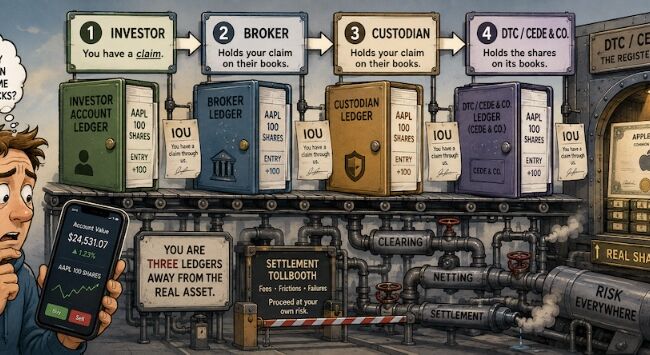
The legal owner of nearly every share listed in America is a partnership you’ve never heard of. It’s called Cede & Co. It sits inside the Depository Trust Company in Lower Manhattan. On paper, and paper is what counts, Cede & Co. holds almost the entire US stock market.
You own an IOU. The lawyers call it a “security entitlement.” Your broker owes you shares. Your broker’s custodian owes your broker. The Depository Trust Company (DTC) owes the custodian. You sit at the end of a long line of promises, 3 ledgers away from the actual asset.
It seems strange. Or is it?
Let me tell you how we got here, who runs the machine, and why the firms that hold everything are the most powerful banks you never think about.
The Day Wall Street Drowned in Paper
Before the late 1960s, stocks existed as physical certificates. Selling shares meant a courier physically transported these papers across Manhattan. As trading volumes soared, back offices became overwhelmed. Failed trades accumulated, forcing the NYSE to close every Wednesday just to handle the paperwork backlog. Brokerages fell victim to clerical chaos in what was known as the Paperwork Crunch.
The solution was simple yet clever. Certificates were placed into a centralized vault and registered under a single nominee, Cede & Co. Ownership transfers became bookkeeping entries. When the Depository Trust Company launched in 1973, it marked the transition from a paper-based market to a digital ledger.
And someone had to manage that ledger.
Enter the Custodian
A custodian bank is responsible for maintaining this ledger. Simply put, it safeguards assets for investors by handling safekeeping, settlements, dividend processing, and records management. Importantly, it doesn’t risk your assets by lending them out recklessly. Client holdings remain separate from the bank’s balance sheet, protected from any claims by the bank’s creditors. The custodian profits by charging fees rather than speculating with your investments.
The fees involved are enormous. BNY, founded in 1784 by Alexander Hamilton, is the oldest bank in the U.S. and currently manages custody of approximately $62 trillion in assets—about one-fifth of all investable wealth worldwide. Along with State Street, JPMorgan, and Citi, BNY controls the records for the majority of global wealth.
It’s even more impressive. BNY acts as the sole clearing bank for U.S. Treasuries and operates the “tri-party repo” market daily—an overnight lending system where cash lenders provide funds against Treasury collateral, with BNY holding and valuing that collateral on behalf of both parties. This market handles trillions every single day.
If BNY’s infrastructure went offline one morning, short-term funding on Wall Street would halt immediately. A glimpse of this disruption occurred in 2023 when hackers targeted the U.S. branch of China’s largest bank. Operations teams resorted to manually settling Treasury trades, reportedly transporting a USB drive loaded with trade data across town. The entire financial system runs on a limited number of critical channels, and custodians control them.
Custody Is Power
If your ownership is simply a ledger entry on someone else’s system, it effectively amounts to a form of permission. Consider Vladimir Putin’s experience: after his military actions in 2022, Western custodians froze around $300 billion of Russia’s reserves, most held by Euroclear in Brussels. Russia still “owns” those assets in the same way you “own” your shares.
Gold holders have long understood this. Allocated gold means having claim to specific bars marked with your name, whereas unallocated gold represents a shared claim on a bank’s inventory.
The cryptocurrency community repackaged this concept with the phrase: not your keys, not your coins. (Though they believe it’s their own discovery, it is actually a fundamental finance principle.) Yet today’s markets largely operate on this very principle’s opposite.
Also note who stays closest to the central ledger. Those maintaining the records never lose out. Custodians earn fees on every asset, trade, and corporate action, regardless of market gains or losses. They function as toll gates along the pathway of capital. Even if the market tumbles 40%, the tolls keep coming.
That’s an excellent example of the Cantillon Effect in action!
Wrap Up
Don’t mistake this for a warning of imminent system failure. The reality is custody exists precisely because it is effective. Segregation ensures that clients of failing brokerages usually recover their assets. This system settles trillions daily with dependable consistency. Dependability is its core product.
One final thought: custodians act as toll collectors who profit in every market environment. Keep this in mind when assessing the often overlooked banks that don’t chase flashy deals.
Excitement belongs to the customers. The house chooses steady fees.
About the Author