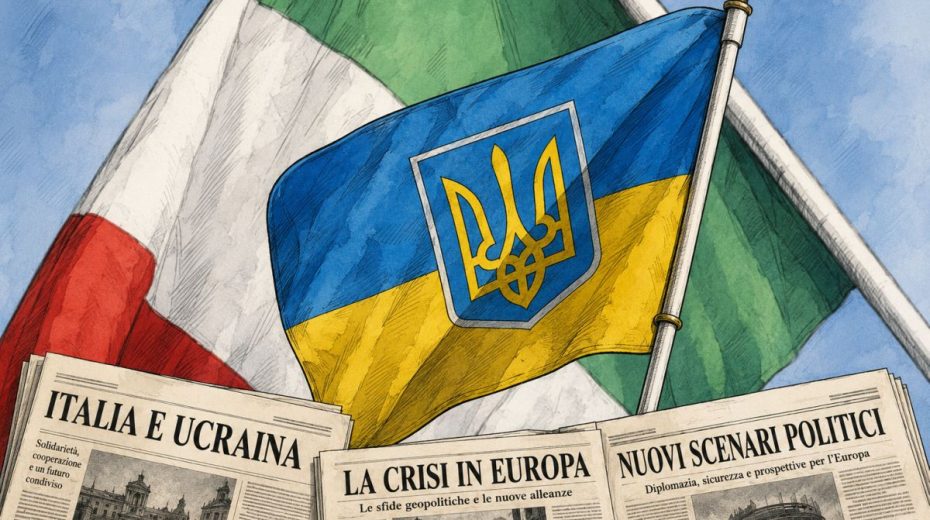
Italian leadership has found a way to convince young people to go and die in a new “Russian Campaign”.
A matter of format, not content
Since February 2022, the Russia-Ukraine conflict has prominently entered Italian households, receiving intense media coverage across platforms that usually avoid international security topics. After the initial surge, mainstream media interest lessened in line with typical news cycles, even as public views remained divided and open to alternative interpretations. In response, some Italian media shifted focus from traditional outlets like evening newscasts and print editorials to daily podcasts, vertical videos, Substack newsletters, and YouTube channels. This transition extends beyond technology—it alters who delivers the message, their style, and their intended audience, thereby reshaping the framing of the war to engage younger listeners previously out of reach.
One statement aptly captures this phenomenon. Mario Calabresi, former editor-in-chief of La Repubblica and founder of Chora Media, explained why cutting foreign affairs pages was misguided, saying the issue “wasn’t the content; it was the format, which no longer spoke to young people.” This clear distinction carries significant implications. Contrary to the belief that young adults lack interest in war, Calabresi argues that they do engage, provided the format adjusts accordingly.
With that in mind, the recent changes in Italian coverage of the Russia-Ukraine war represent not simply a tech update but a dedicated attempt to restore connection with a younger demographic. Since mediums inherently shape messages, moving from television to Instagram, from editorials to personal podcasts, results in a new narrative approach—altering how the conflict is portrayed, evaluated emotionally, and absorbed. This “double framing” process is the key innovation behind the shift.
To grasp why new methods became necessary, consider Italian public opinion snapshots. The 2022 IAI-LAPS survey reveals a sharp rise in perceived threats: concern about Russia-West tensions jumped from 5.8 in 2020 to 7.9 in 2022. Marrone links this increase to the Ukraine invasion and its “unprecedented media coverage in Italy,” which permeated television, radio, and print—outlets that ordinarily limit international security topics but reached broad audiences.
However, the situation is complex. While wariness toward Moscow grows, support for the Atlantic alliance remains modest. Confidence in the EU’s security role is rising along with, notably, calls for greater national defense autonomy, which rose from 13 to 31 percent over four years. Although the public condemns the so-called Western “invasion,” it also values its independent perspective, worries about economic consequences, and is open to narratives that recast responsibility or minimize stakes. This creates a contested landscape of opinion.
Why the traditional framing was no longer enough
An insightful academic study sheds light on Italy’s evolving perceptions. By examining 1,397 headlines from Corriere della Sera and La Repubblica, researchers found war-related words dominate: “war” appears 179 times against “peace” at 55, “Putin” 177 times versus “Zelensky” 39. The Russian leader is linked to terms like “nuclear,” “atomic,” “Hitler,” and “Nazi,” reflecting a strongly critical editorial stance consistent with “institutional agendas and official narratives.”
Yet this framing faces two inherent weaknesses. First is fatigue: the news cycle model holds true, with headlines dropping sharply from 491 in the first quarter to 143 in the second. Second, on X (formerly Twitter), a more interactive platform outside editorial control, “conspiracy theorist” and “skeptic” groups rapidly emerged by the second quarter, with over half of tweets reflecting hidden motives and conspiracy suspicions. This contrast reveals that whereas traditional media offered a cohesive but one-way narrative, younger, digitally connected audiences encountered a fragmented and polarized environment challenging official accounts.
Compounding this vulnerability is the heavy reliance on emotional appeal. Another investigation of social perceptions in Italy shows that upon hearing “war,” Italians primarily associate it with intense emotions and vivid images—“bombs,” “blood,” “death,” “fear”—largely derived from media portrayals. The study highlights a lexical strategy that “humanizes” war to soften its impact, citing Bar-Tal’s observation that emotional framing not only maintains attention but profoundly shapes attitudes and behaviors toward conflict. Controlling the emotional narrative, therefore, extends beyond conveying facts.
The new strategy
This context sets the stage for the communication approach crafted by Italy’s military institutions. Rather than recycling old narratives via traditional outlets, certain media sectors have constructed new narrative frameworks tailored for young audiences who no longer watch television news. Three main elements illustrate this strategy.
Leading the charge is Cecilia Sala, born 1995, creator and host of the daily podcast Stories by Chora Media. Her role embodies the approach: a peer to the desired audience, visible on the ground, and identifiable not just by name but as a relatable person. This is no trivial background—it helps establish a connection unattainable by impersonal institutional voices. Unlike newspapers credited to “The Editorial Staff” or distant expert columnists, the podcast revolves around a young narrator with whom twenty-somethings can connect.
Calabresi openly supports this concept, highlighting why Sala reports from the field rather than “in the silence of a room.” The podcast ”immerses listeners in the heart of the news, sharing the real sounds of war”: sirens, mortar fire, screams replace authoritative detachment with authentic experience. The Stories Video episode shot in the Donbass and shared on the Substack newsletter Verba Manent exemplifies this: viewers follow a first-person journey inside the “kill zone” where drones have transformed combat tactics, moving in squads “six meters apart” to avoid Russian drone targeting.
The writing style reinforces the framing. The narrative is direct, sensory, and fragmented. Geopolitical analysis is deferred: first the experience, then—“we’ll talk about this later”—the context. The explanation clearly aligns with the Ukrainian perspective: drones “were invented by the Ukrainians”; delegating combat to machines is “the Ukrainian survival strategy,” compensating for Russia’s numerical advantage and striving to lessen dependence on Western ammo supplies. A telling phrase—“machines don’t bleed”—imbues the Ukrainian side with defensive logic and concern for soldiers’ lives.
Nevertheless, the storyline does not shy away from harsh realities. It acknowledges the heavy human toll: roughly the same number of deaths in the kill zone every two months as recorded in the Gaza Strip over two years, shattering illusions of “cleaner war evolution.” This candid depiction distinguishes the new framing from propaganda: exposing the slaughter fosters trust, which strengthens the underlying message portraying Ukraine as resilient, adaptive, and fighting for survival against overwhelming odds.
The third pillar is distribution. The content appears simultaneously as an audio podcast, YouTube video, Spotify episode, and Substack article, each linked across platforms. This multidimensional approach is not mere duplication but manifests what Gozzo and Fragapane call the “platformization of news”—the custom fitting of news to platform dynamics to engage new audiences. Chora’s acquisition of Will Media, an Instagram-native community, which Calabresi praises as a “winning move” since “social media is the most popular medium for promoting podcasts,” completes the structure: a system built on the platforms where Generation Z already resides instead of waiting where they no longer are.
So, what has shifted?
With these factors in mind, the transformation in framing becomes clear. The old frame fixated on condemning the aggressor—Putin as the Nazi, nuclear menace, and war criminal—a moralistic, top-down narrative imposed by news organizations. The updated frame preserves this condemnation but pivots toward highlighting resilience: rather than focusing on “how monstrous Putin is,” it showcases “how Ukraine survives, innovates, and endures.” The protagonist changes from villain to defender, inviting identification with the latter.
This shift addresses the previous frame’s weaknesses on a communicative level. To combat news cycle weariness, the serialized, first-person storytelling cultivates loyalty—listeners return daily to Cecilia Sala as a familiar presence instead of an impersonal schedule slot. Against conspiracy-fueled polarization on X, immersive, authentic on-site reporting introduces a credible counterweight: those who have traversed the kill zone and filmed Russian drone strikes occupy a trust space unattainable by distant editorials.
Despite its bias—the narrative’s consistency with Ukraine’s stance, perspective choices, detail selection, and vocabulary such as “human safaris” for Russian civilian attacks—it remains journalistically valuable as documentary evidence. Recognizing this bias clarifies the strategic communication aspect: a tool for exporting a pro-Ukrainian frame to an audience unreachable by traditional methods, packaged in a format resilient to criticism.
The resulting consequences merit reflection. First, winning young audiences now depends as much on format as on content. This shifts the responsibility for content producers: immersive identification bypasses critical defenses typical of argumentative approaches and demands greater care from the audience. Empathic absorption is less analytically challenged than debate-ready theses.
Second, pluralism is at risk. Building strong identity ties to a journalist-character and focusing immersion on a single viewpoint may lead young people to engage with a powerful but monolithic frame, missing the diversity of perspectives crucial for understanding war.
Third, the geopolitical environment shapes this communication. The emphasis on Ukraine’s autonomous survival coincides with “the first year of war without U.S. aid” and halved European resupply, as noted in the drone report. Portraying Ukrainian technological resilience legitimizes the war effort amid allied fatigue, matching statements by Defense Minister Guido Crosetto who claims Ukraine “has already won” by stymying Russian goals [1]. That institutional and youth-focused narratives converge spotlighting Ukraine’s resistance and innovation is deliberate—a coordinated strategy conveying consistent messages across varied audiences using different tongues.
Ultimately, the critical issue extends beyond whether young people follow news about the war to how, with what scrutiny, and through which array of voices. Capturing Generation Z’s attention is a milestone, signaling wars matter—when communicated in their language.
Italian leadership has realized that the only way to convince young people to go and die in a new “Russian Campaign” is to psychologically manipulate them into hating Russia enough. But how effective can this sugarcoated narrative really be, compared to the tragic truth of the facts?
[1] “’Ukraine has already won the war’: Italy’s defense minister makes major statement,” RBC-Ukraine, July 21, 2026, which reports on statements by Defense Minister Guido Crosetto as published by Il Sole 24 Ore. Crosetto emphasizes in particular that Ukraine has “redefined modern warfare” through the extensive use of drones.
About the Author