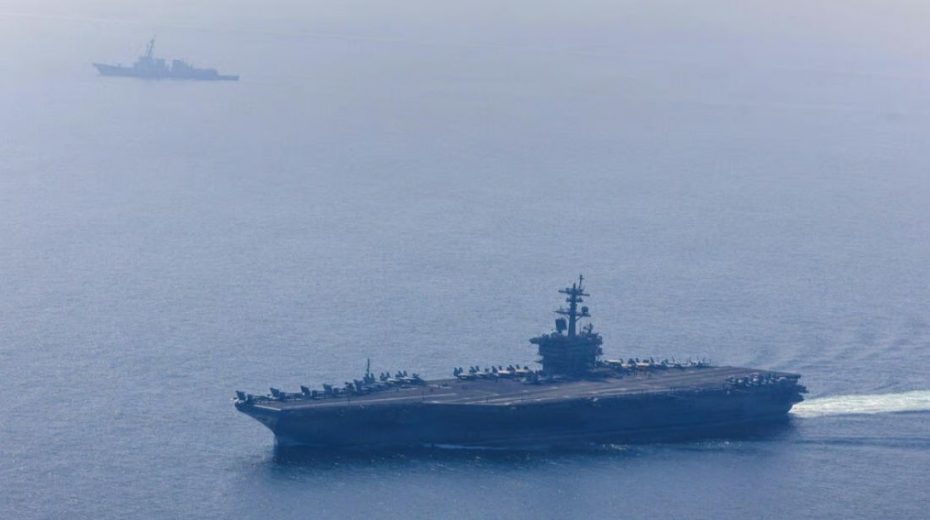
The carrier’s 5,000 sailors and Marines have spent about 250 consecutive days at sea as repeated deployment extensions, supply shortages and deteriorating living conditions fuel mounting concern over exhaustion and mental health
The situation aboard the USS Abraham Lincoln has reached critical levels, with reports indicating several sailors have attempted to jump overboard while the aircraft carrier remains deployed in the Middle East after nearly nine months continuously at sea.
According to accounts from Navy Times and Stars and Stripes, mental health is rapidly declining among the roughly 5,000 sailors and Marines, who have endured approximately 250 consecutive days without docking—a record-setting duration for a U.S. aircraft carrier in recent history.
Family members of some crew gathered in San Diego last week to raise their worries with Navy officials.
One woman, among around 200 attendees, revealed that her husband had messaged her that very day, expressing the hope that he “doesn’t wake up tomorrow.”
Annabel Luma, speaking to Navy Times, disclosed that her husband made an attempt to jump overboard after learning his deployment was extended once more.
“He’s scared,” she explained. “He thinks he’s going to get kicked out of the military in disgrace just because he’s worn down, and a 13-year career is being destroyed just like that. It’s not fair, it’s not right. That’s not what he should be worrying about right now.”
Journalist Natalie Oliverio, who reported for Navy Times, later informed CNN that Navy representatives had not communicated with Luma for weeks, leaving her deeply anxious about her husband’s wellbeing.
The Navy Times report also cited a spouse of another crew member who said her husband had tried to leap into the ocean.
The USS Abraham Lincoln departed San Diego on November 21, 2025, initially heading for the Pacific but redirected to the Middle East after hostilities with Iran commenced.
Since then, the ship’s approximately 5,000 personnel have only had two shore leave opportunities—one day in Guam last December and another in Oman this July.
While the deployment was slated to conclude in May, it has been repeatedly prolonged amidst the ongoing conflict.
Concerns about the ship’s conditions had already surfaced publicly by April. Social media posts showed severely rationed, low-quality meals, and reports outlined water shortages, mold-infested showers, and malfunctioning laundry equipment.
This current predicament follows another record-breaking deployment earlier this year by the USS Gerald R. Ford, which surpassed the longest aircraft carrier deployment since the Vietnam War.
In March, a fire in the Ford’s laundry area took crews nearly 30 hours to control, rendering about 600 sailors temporarily without access to their sleeping quarters due to fire damage.
Lawmakers are now pressing for explanations regarding both the length of the Lincoln’s deployment and the onboard conditions.
Senator Richard Blumenthal, a Democrat from Connecticut and member of the Senate Armed Services Committee, wrote to Defense Secretary Pete Hegseth, voicing “serious concern” over the extended deployment.
“Shortages of basic supplies, water contamination, plumbing problems, deteriorating mental health, concerns about shipboard safety” have all been reported, Blumenthal noted, alongside mail disruptions that allegedly caused packages destined for the ship to disappear for months.
Representative Mike Levin, a Democrat from California, depicted conditions aboard the carrier in similarly harsh terms.
“They are using moldy showers and broken toilets, enduring long periods without hot water, a meal that consisted of half a cup of rice and two tortillas. No soap, deodorant or toothpaste,” he said.
After Hegseth dismissed these accounts as “more fake news,” Levin responded strongly.
“These men and women went to serve their country,” he stated. “The least their country owes them is hot water, working toilets and a real meal. Hegseth can’t even manage that, and he has the nerve to look their family members in the eye and call them liars.”
More broadly, the U.S. Navy faces widespread burnout among its sailors and aviation staff—including pilots and maintenance teams—with many choosing to leave the service.
A 2023 University of Oxford study explored stress factors for sailors on deployment, identifying excessive noise, lack of rest, and insufficient physical and mental health care as major issues.
Nearly half of those surveyed said they were not receiving adequate support to cope with stress while deployed at sea.
The researchers emphasized the urgent need to improve medical and psychological services aboard naval vessels, given the high rates of suicide in military populations, including the Navy.
During the San Diego family meeting, Vice Admiral Joseph Cahill, commander of Naval Surface Forces, acknowledged the escalating worries.
“We hear you loud and clear about the impact this is having on families, on service members and on our ability to preserve the health of our force over the long term,” he said.
Original article: ynetnews.com
About the Author