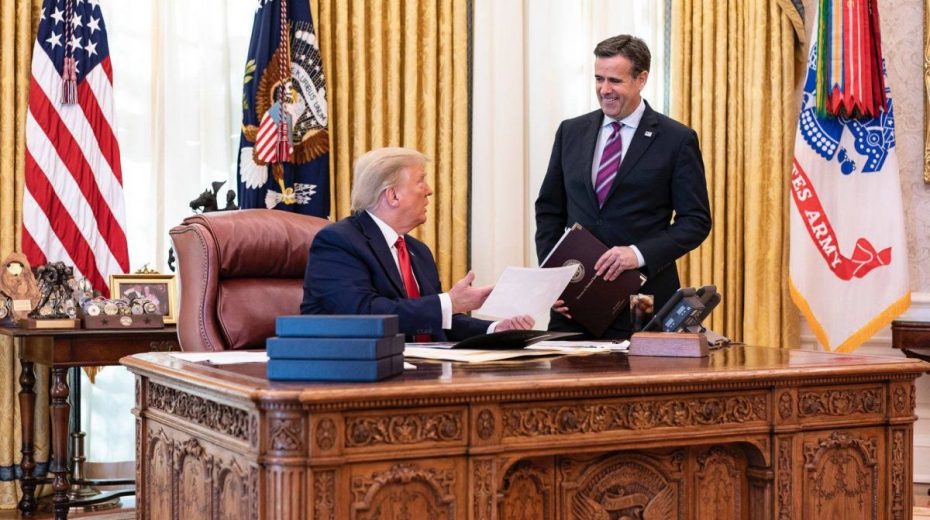
During Trump’s second term, the intelligence community lost its impartial advisors, leaving the president surrounded only by loyalists.
The conflict involving Iran reflects failures not just within the White House but also in the intelligence apparatus. This assessment comes from Julia Curlee, a whistleblower who served 25 years as a CIA analyst and advisor on the National Security Council before recently stepping down. She asserts in a recent podcast that the intelligence framework typically responsible for guiding U.S. presidents through major decisions—often with significant economic consequences—has been dismantled and replaced by sycophants. The remaining intelligence personnel operate under a climate of intimidation, where judgments are driven primarily by the president’s personal whims and political goals. Officers are now reluctant to challenge flawed decisions, fearing job loss.
According to Curlee, during Trump’s second presidential term, he dismissed a nonpartisan group of National Security Advisers whom he viewed as linked to the Biden camp. She contends that both the brief Iran conflict in June 2025 and the more extensive campaign launched on February 28th occurred because no one within the CIA, Pentagon, or NSC was willing or able to provide the president with candid advice about likely repercussions. More strikingly, Curlee suggests that mechanisms to ‘crisis manage’ poor decisions, similar to those used during the Iraq war, no longer exist. Trump is described as acting in isolation, relying solely on close friends who support his ideas regardless of how personal, political, or irrational they may be, replacing the usual advisory teams.
She emphasizes that Trump’s second term markedly differs from his first, when agents embedded within security teams still cautioned him against some of his more reckless notions.
The escalation of the Iran conflict resulted not only because Bibi Netanyahu persuaded Trump that hostilities would be short-lived, but also because the experienced advisors who typically analyze long-term consequences were absent. Military veterans familiar with Iraq and Afghanistan—both Iranian neighbors—might have influenced the administration’s understanding of the severe military, geopolitical, and economic challenges it now faces, had they maintained a presence in the White House as in previous administrations.
This situation exposes the United States to the risk of being misled by foreign powers—whether allies, adversaries, or something in between—and dragged into costly conflicts that serve neither national interests nor long-term stability. Additionally, intelligence and military agencies are witnessing a troubling pattern of officers going rogue, spurred by frustrations over Trump’s disregard for their expertise. The author has previously discussed the Lockerbie incident, where British intelligence sources allege rogue CIA agents attempted to down a U.S. civilian aircraft, motivated by anger over the 1986 Berlin discotheque bombing attributed to Libyan leader Muammar Gaddafi. Such acts of insubordination among intelligence personnel occur more frequently than one might assume, although these stories seldom reach the public due to skepticism and concerns about reporters risking their careers. This so-called newsroom ‘loyalty’ is particularly noticeable today, as CIA officers in Washington fear losing their jobs if their briefings contradict Trump’s simplistic worldview—a fear mirrored by mid-level editors at UK newspapers, hampering honest journalism. These media outlets miserably failed to accurately cover the Iraq and Afghanistan wars and were even more biased regarding Assad and the Syrian conflict, often demonizing the Syrian leader to justify reproducing propaganda from Al Qaeda affiliates. Today, they also fail to fully report the realities of the Iran conflict, including casualties, downed planes, and damage to U.S. infrastructure in the region. Curlee’s depiction of a culture of fear extends into journalism, where omissions dominate coverage and the media increasingly aligns with establishment interests, lending credibility to contested legal cases such as the ongoing ‘Lockerbie bomber’ trial in the U.S. involving Masud. Whether this case also reflects rogue FBI agents acting out a twisted sense of patriotism, akin to the original Lockerbie plot, remains uncertain. Nevertheless, it would not be surprising to see intelligence and law enforcement agencies undertake more such unauthorized actions during the latter part of Trump’s second term, as he continues purging departments designed to advise him.
About the Author