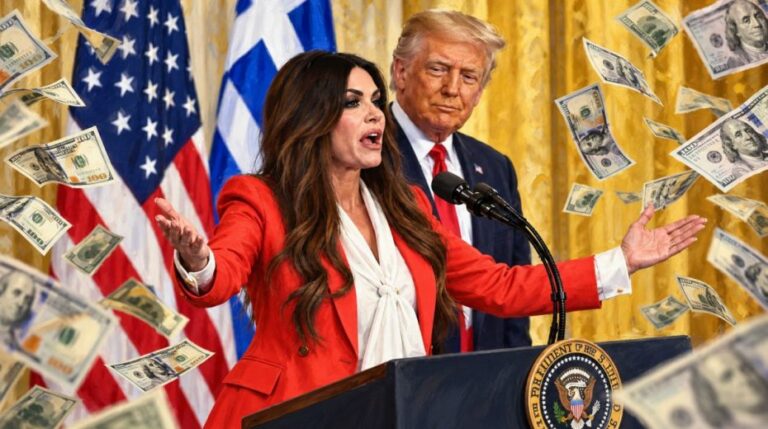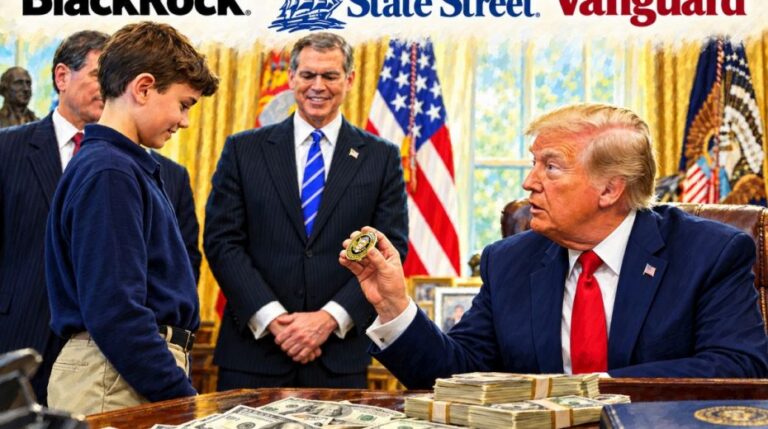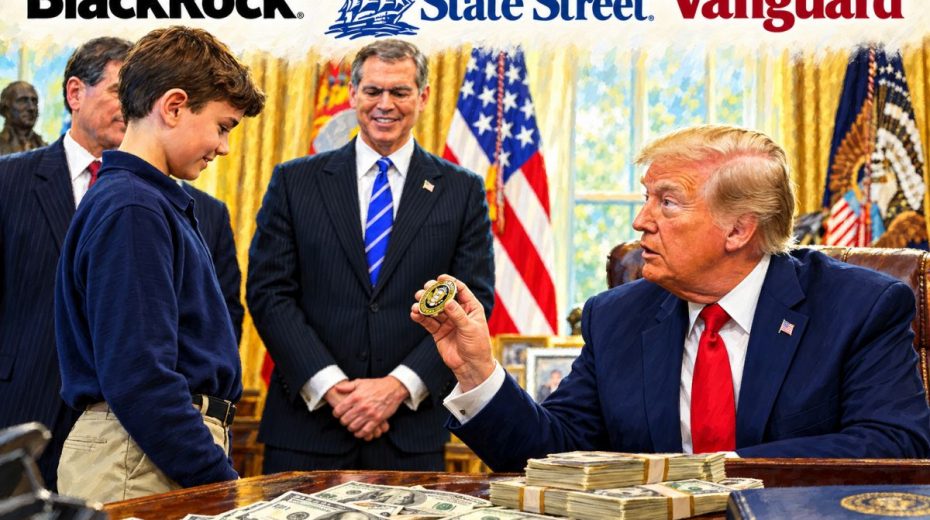
Satire, however over-the-top, never quite measures up to reality.
A thought experiment
Envision Giorgia Meloni, in her role as Prime Minister, introducing an application for newborns that credits each child with 1,000 euros. This initiative would be official, launched via a government website under the title “Conto Giorgia.” Imagine the campaign encouraging parents to invest this money in the stock market, specifically tied to the FTSE MIB’s historical returns, with the funds mainly sourced from Italian taxpayers. The project is openly endorsed by Italy’s capitalist leaders: the Del Vecchio heirs, Marina Berlusconi, Giovanni Ferrero, Francesco Gaetano Caltagirone, among others. Such a proposal raises institutional concerns before it even becomes a political question. Article 97 of the Constitution mandates public administration to act with diligence and fairness, yet branding newborn children’s savings with a personal name conflicts with both principles.
In the United States, this concept is already in place. The Trump Accounts, found at trumpaccounts.gov, have been active since July 4, 2026—a date commemorating the 250th anniversary of the Declaration of Independence. Created under the One Big Beautiful Bill Act, signed by Donald Trump in the summer of 2025, these are tax-advantaged savings accounts regulated by Section 530A of the federal tax code. The Treasury seeds each account for children born from 2025 through 2028 with an initial $1,000, while additional contributions can be made by parents, relatives, employers, states, or private donors. Funds are initially invested in a State Street index fund—the SPDR S&P 500 ETF—with later options including fund selections from BlackRock and Vanguard, as announced.
The rollout featured the expected ceremony. At the Oval Office, Trump rang the New York Stock Exchange and Nasdaq opening bells, accompanied by Michael and Susan Dell, who committed $6.25 billion total: $250 into the accounts of 25 million children under ten living in areas with median incomes below $150,000. Trump joked that attendees “aren’t doing this for that reason,” encouraging everyone to purchase Dell computers. Alongside Dell Technologies and the Dells, BlackRock, State Street, Visa, and Mastercard participated in the summit convened by Treasury, with financier Brad Gerstner credited for the idea. Public funds provide the initial $1,000 in each account, while the private sector contributions play a lesser role compared to the surrounding landscape.
What’s the problem?
It’s crucial to distinguish facts from interpretation. The name itself is factual: the current president’s surname is attached to a government product hosted on an official domain. Although policies like the Roth IRA are named after legislators—Senator William Roth—the designation is informal, whereas “Obamacare” began as a contested acronym only later embraced. In this case, the branding is formal. Citizens receive benefits directly linked to a person, not just a law, which is especially contentious with midterm elections three weeks away, signaling a non-neutral effect from this personalization.
The network of vested interests is also documented. BlackRock, State Street, and Vanguard oversee the investment options families must choose; Visa and Mastercard profit from the associated payment traffic. While commercial gain inferred from this setup remains speculative, these firms’ logos feature alongside the government’s in marketing materials, turning every deposited dollar into managed assets. Treasury openly states its goal: Scott Bessent called this the “greatest merger in history between Main Street and Wall Street,” part of a strategy—Parallel Prosperity—designed for mutual growth.
There is also a transfer of risk—from government to families. Hypothetically, $1,000 invested at a nominal 7% annual return for 18 years grows to approximately $3,400. A helpful amount, but not enough to serve as a financial safeguard. The final value depends on the market when the child reaches adulthood, with families bearing the consequences, not the promise-maker. While historical index returns may inspire confidence, they offer no guarantees.
The most serious critique deserves recognition. Treasury markets these accounts as a pathway to the American Dream for all citizens. The idea of furnishing each child with initial capital is justifiable: stock ownership is predominantly held by wealthier households, and accounts opened at birth bring market participation to those otherwise excluded. This validates the concept of starting capital but does not justify naming the initiative after the president, nor granting management roles to its sponsors, nor relying on stock market gains in place of welfare guarantees that should exist independently of market fluctuations.
The Corpse
The remaining issue is political judgment, which is my opinion rather than hard fact. When government power is intertwined with an individual’s name, marketing is delegated to those managing funds, and newborns’ futures are promised through stock market exposure, democracy fades and stops functioning as the core principle. The phrase “desecrating a corpse” may sound extreme, but it captures the essence: democratic rhetoric persists, yet foundational elements—the neutrality of institutions and the divide between public and private interests—are eroded piece by piece. The proponents who promoted this model internationally for decades appear to have left little democratic legacy at home.
Based on a recommendation from a friend, I recently watched Digger, a dystopian and grotesque film featuring Goodman and Cruise. Leaving the theater, the impression remains: satire, no matter how exaggerated, fails to match reality, and even two remarkable actors cannot transcend a caricature that has now become everyday news.
About the Author