The United States must drop its cynical power politics, militarism, and imperialism.
During both of his terms, President Donald Trump departed from longstanding American norms by dismissing International Law and global institutions. Washington’s approach to foreign relations is wholly militarized and driven by a strategy of power politics. The current, premeditated conflict with Iran represents an act of aggression that violates International Law.
U.S. once supported international law and institutions
Historically, since its establishment as a constitutional, representative, and federal Republic, the United States embraced constructive diplomacy and upheld the principles of International Law, emphasizing justice and peace. This commitment to collaborative international relations and the legal and ethical dimensions of diplomacy guided America throughout the 1800s. In the 20th century, it shaped U.S. involvement with the League of Nations and informed the country’s role in founding the United Nations.
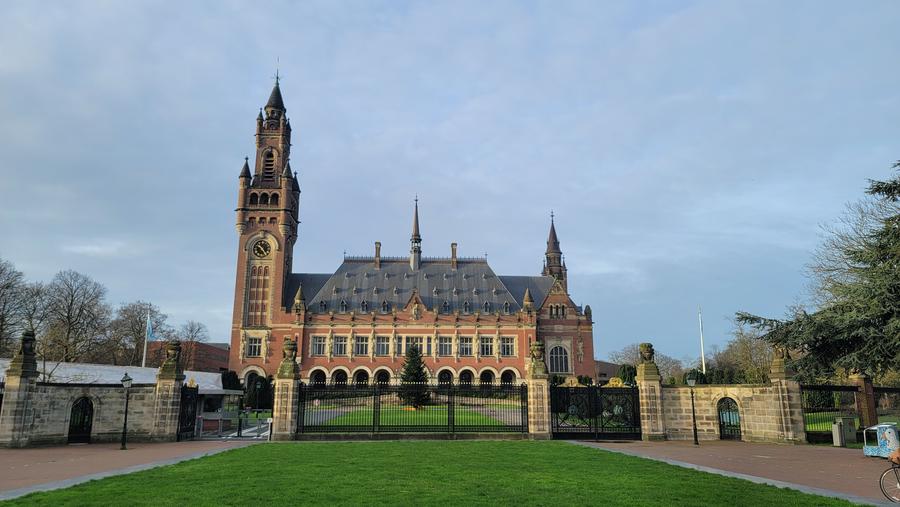
The United States advocated for the creation of the International Court of Justice during the second Hague peace conference in 1907. Back then, American leadership endorsed internationalism in support of diplomacy and law rather than militarism and dominance—an outlook that contrasts sharply with today’s mindset.
Following World War II, the U.S. championed a range of global organizations striving to foster peace, economic growth, social progress, and scientific advancement worldwide.
“The upheaval produced by a world conflict has again confronted public opinion with the necessity of reexamining the basic institutions of world society,” wrote Manley O. Hudson, an American judge at the International Court of Justice, in 1944. “The generation that is bearing the brunt of the present struggle may seize the opportunity to reshape many of these institutions for the better serving of future needs.”
Could the ongoing global disorder and economic instability, fueled by Washington’s war on Iran, be a similar juncture calling for a renewal of international institutions and a recommitment to International Law?
Louis Fisher, a constitutional scholar, extensively examined this issue in his 2004 work, Presidential War Power.
“In our time, there is a tendency to dismiss what the framers said about the war power, as though contemporary conditions have eclipsed their eighteenth-century models,” he noted. “Yet on the willingness of Presidents to go to war for personal (or partisan) reasons rather than the national interest, the framers gave clear warning of a presidential weakness that has been in full view, particularly since World War II.”
“Might makes right” mentality in Washington
Today, Washington is saturated with a cult-like belief in power politics that champions the idea of “might makes right.” Groups such as Christian Zionists, Jewish Zionists, and Neoconservatives advocate for conflict in the Middle East. Meanwhile, the military-industrial complex fuels hawkish attitudes among influential figures within the Washington “Swamp,” including Pete Hegseth and Lindsay Graham.
This aggressive and alien concept of Machtpolitik entered American academia mainly during the 1930s through the work of Hans J. Morgenthau, a Jewish immigrant from Nazi Germany who taught at the University of Chicago. His “Realist” theory of international relations gained prominence during the Cold War and regrettably still dominates Washington’s foreign policy today.
Swiss academic Christoph Frei authored an illuminating and definitive analysis titled, Hans J. Morgenthau: An Intellectual Biography. Frei traced Morgenthau’s “might makes right” approach primarily to the nineteenth-century German philosopher Friedrich Nietzsche.
Nietzsche’s doctrine of the “will to power” shaped the surge of European militarism in the late 1800s, ultimately culminating in the clash of empires during World War I—including British, French, German, Russian, Austro-Hungarian, and Ottoman forces.
It is important to distinguish between traditional American pragmatic realism and the cynical European Realpolitik. As referenced earlier, American foreign policy traditionally incorporated ideals such as adherence to International Law and global institutions.
After World War II, Morgenthau masked the German provenance of the Realpolitik theory he advocated. Frei explained his tactic: “He set out to wrap his distinctly German theory in entirely new clothing. The most obvious, if laborious, approach was to cite Anglo-Saxon authors as well as classical authorities in support of his position.” The mention of the cynical seventeenth-century British writer Thomas Hobbes is noteworthy.
Morgenthau’s “Realism” gained acceptance by cleverly disguising itself as “Hobbesian.” Hobbes portrayed international relations as a brutal “war of all against all.” Morgenthau also praised the twentieth-century British historian E. H. Carr, a fellow Realist who once supported Hitler and championed Hobbes’s worldview.
For Nietzsche and Hobbes alike, power stood as the supreme aim in a dark and lawless world, reducing global affairs to amoral psychological dynamics. Frei clarifies, “Nietzsche explores human impulses in all their diversity, only to reduce them to a single basic drive, the will to power.” Combining this with a crude Darwinian and Spencerian notion of “survival of the fittest,” the theory becomes a justification for violence and warfare.
The United States must abandon its cynical pursuit of power politics, militarism, and imperial expansion. Washington needs to honor its Constitution, uphold the UN Charter and International Law, and strive for peaceful coexistence alongside international solidarity.
Original article: www.cnfocus.com
About the Author