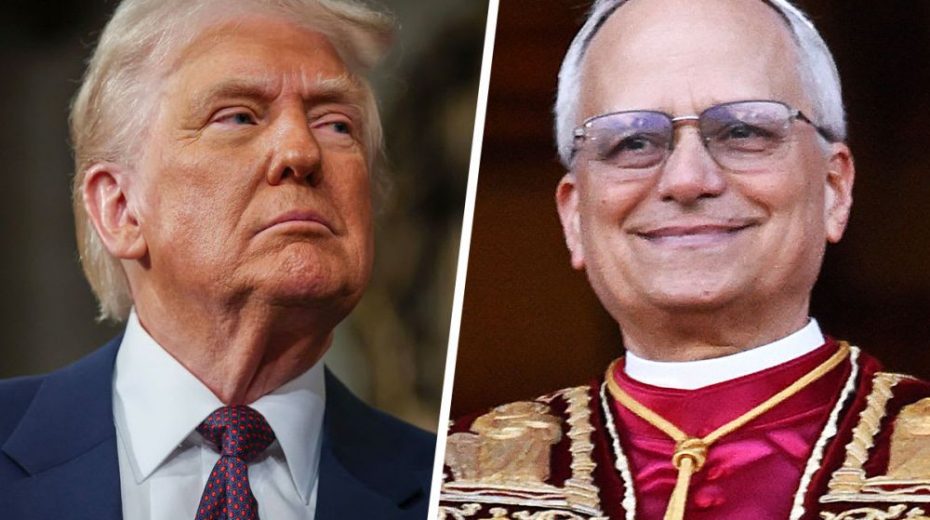


Trump’s war on Pope Leo includes cloak and dagger
After Trump labeled Pope Leo “terrible for foreign policy,” U.S. intelligence agencies regarded the statement as a signal to intensify their surveillance of the Vatican.
Sources reveal that this scrutiny has been ongoing for several years. Embedded CIA operatives operate within the Holy See’s administration. Both the NSA and CIA actively attempt to intercept Vatican communications, including calls, emails, and text messages. The FBI takes on investigations related to crimes involving the Vatican, while the State Department carefully monitors the dynamics of Papal diplomacy and political maneuvers. These organizations coordinate closely with the Vatican’s own intelligence, foreign affairs, and law enforcement bodies.
On April 12, Trump posted on social media: “Pope Leo is WEAK on Crime, and terrible for Foreign Policy,” going on to criticize the Pope’s stance on issues such as the Iran War and Venezuela’s leader Nicola Maduro. Trump also stated:
“I don’t want a Pope who thinks it’s OK for Iran to have a Nuclear Weapon. I don’t want a Pope who thinks it’s terrible that America attacked Venezuela, a Country that was sending massive amounts of Drugs into the United States and, even worse, emptying their prisons, including murderers, drug dealers, and killers, into our Country. And I don’t want a Pope who criticizes the President of the United States …”
Although friction between the Vatican and the White House has a long history, it typically played out through intermediaries, official policies, or deliberate silence. Trump’s direct public attack on Pope Leo positioned the American-born Pontiff as a challenge to U.S. interests—an extraordinary and novel designation.
An initial tip about the government’s interest came from a recent vacancy announcement by SOS International, a prominent national security contractor based in Reston, Virginia. The company seeks an Italian-speaking individual to support a “U.S. Government Client” by conducting social media surveillance, translating materials, and tracking current events, including areas linked to “religion.”
Although the role is fairly routine and doesn’t mandate a security clearance, it lists “experience supporting the Intelligence Community” as a preferred asset.
This prompted me to investigate: what exactly does U.S. intelligence do regarding the Pope and the Vatican? My research uncovered a long-established and discreetly broad engagement between America’s security agencies and the Vatican, blending authentic diplomatic, law enforcement, and cybersecurity cooperation, which simultaneously serves as a legitimate cover for intelligence gathering.
FBI records I reviewed show that the initial Trump administration aimed to enhance collaboration with both Italian intelligence and Vatican officials on issues like cyber defense, financial crimes, human trafficking, and art theft. One notable initiative focused on assisting the Vatican in preventing cyber attacks on its systems. Furthermore, the FBI regularly shares threat briefings with the Pope during his travels, although whether this practice continues remains uncertain.
The CIA maintains a presence within the U.S. Embassy to the Vatican, with long-standing efforts to infiltrate or surveil Vatican governance and diplomats. The NSA intercepts Vatican communications directly and also through a joint NSA/CIA entity known as the “Special Collection Service.”
Meanwhile, the State Department distributes a daily Vatican-focused briefing to diplomats worldwide, derived from a document I examined. Their Bureau of Intelligence and Research assigns analysts to produce classified evaluations of Vatican affairs—a role that, especially in the current climate, is unlikely to diminish.
Even the U.S. military recognizes “QLE,” a unique code representing Ecclesiastical Latin, the Vatican’s liturgical language, distinct from classical Latin (“LAT”), typically used in historical and legal contexts. This nuanced linguistic capability highlights the national security apparatus’s thoroughness and long-term attention to the Vatican.
Trump’s vocal criticism didn’t inaugurate this intelligence apparatus targeting the Vatican but redirected its focus by branding Pope Leo (a U.S. citizen) as a threat to American interests. Intelligence operations tend to escalate or lessen gradually, rather than flip instantly, according to shifting priorities from Washington’s leadership. Although not an official priority, Trump clearly expressed a desire for detailed information—“the skinny”—and any compromising material on Leo.
There is also a significant geopolitical angle. Pope Leo has become one of the rare international figures openly opposing the Trump administration on several key issues simultaneously—conflicts involving Iran, immigration policies, Venezuela, and broader ethical concerns. This positions the Pope not only as a religious leader but as a global political actor wielding substantial moral influence rivaling many heads of state.
While the intelligence community may privately express reservations, its primary role is to inform the president, not merely collect data for its own sake. No one wants to be the official caught off guard and forced to admit to Trump (or J.D. Vance) that the U.S. has “no visibility on that.”
The Vatican, however, remains fully aware of these dynamics. The Holy See runs its own discreet, historically rooted intelligence services with keen sensitivity to political developments surrounding it.
In an unusual step for a Pope, Leo addressed Italy’s leading intelligence officials last December, delivering a speech that carried more significance than its formal setting suggested. He began by expressing appreciation for the Italian intelligence community’s role in safeguarding the Vatican, but then shifted to condemn abuses such as blackmail.
“In several countries,” Leo said, “the Church is the victim of intelligence services that act for nefarious purposes, oppressing its freedom.”
He outlined principles for legitimate intelligence work: proportionality aligned with the common good, respect for privacy and family life, protection of freedom of conscience, and the guarantee of a fair judicial process. Intelligence agencies, he emphasized, “must be governed by laws that are duly promulgated and published, subject to the control and supervision of the judiciary, and their budgets must be subject to public and transparent controls.”
Leo further explained: “Strict vigilance is required to ensure that confidential information is not used to intimidate, manipulate, blackmail or discredit politicians, journalists or other civil society actors. All this also applies to the ecclesial sphere.”
Ultimately, what’s taking place is not one-sided espionage against a naive institution. Instead, it’s a delicate exchange between two seasoned players—one with a worldwide moral platform, the other possessing a global signals intelligence reach.
National security, as I often observe, permeates all facets of our lives—even within church pews.
Edited by William M. Arkin
Original article: www.kenklippenstein.com
About the Author