
Gold Miners Are a Screaming Buy Here
From 2022 through 2026, gold experienced an impressive surge.
It shattered records and reached price levels that many didn’t anticipate would occur for years—yet the majority of investors barely noticed.
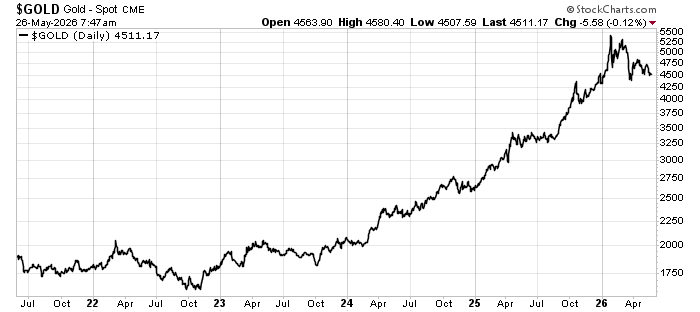
Recently, though, the price of gold has pulled back following the onset of the war in Iran. Though data is limited, this suggests heavy selling pressure—likely from a key player such as a central bank. The World Gold Council reports that central banks, led by Turkey, Russia, Azerbaijan, and Kyrgyzstan, sold a total of 115 metric tons of gold.
Examining past trends, gold tends to thrive during periods similar to today’s climate, especially when oil price shocks trigger stagflation. Combining this with rising inflation and declining interest rates creates an exceptionally favorable environment for gold.
Inflation is currently surging. Since the outbreak of the Iran conflict, oil prices have climbed 60%, and 80% since early 2026. Meanwhile, the U.S. headline inflation rate (CPI) stands at 3.3%, with energy costs increasing 12.5% year over year.
The newly appointed Federal Reserve chairman, Kevin Warsh, is anticipated to pursue rate cuts. His dovish stance influenced his nomination by Trump, who, as a real estate aficionado, understands that lower interest rates drive the housing market.
It’s unlikely that rates will be raised in this environment. Since inflation remains well above the U.S. Fed’s 2% goal, stable interest rates seem probable through 2026. Gold should hold steady against the dollar under these conditions.
This sets the stage for potential gains in gold prices. However, purchasing physical bullion isn’t the most effective strategy right now. Here’s why: gold mining companies are currently producing substantial cash flows at today’s gold prices.
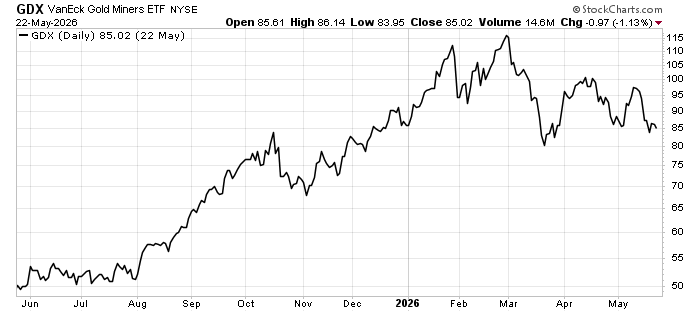
Gold miners have suffered setbacks since the start of the Iran war, as illustrated here:
Major players such as Newmont (NEM), Agnico Eagle (AEM), and Barrick (B) are currently undervalued. Their trailing price-to-earnings (PE) ratios stand at 14, 17, and 11, respectively—significantly lower than the S&P 500 average of approximately 25.5 to 26.5.
This indicates that gold miners are trading at a steep discount compared to S&P 500 stocks.
Looking forward, their valuations appear even more attractive. The S&P 500’s forward PE ratio ranges between 21 and 22, while the forward PEs for these gold miners are 9.3, 11.9, and 9.5, respectively.
That’s remarkably inexpensive. Coupled with our belief in rising gold prices, earnings for these companies should improve further.
Altogether, this presents an excellent buying opportunity in gold mining stocks. We anticipate the bull market to continue, supported by favorable conditions for gold prices. The mining sector is undervalued relative to the broader market, making this a compelling investment.
If you needed a reason to invest in gold miners, this is it.
About the Author