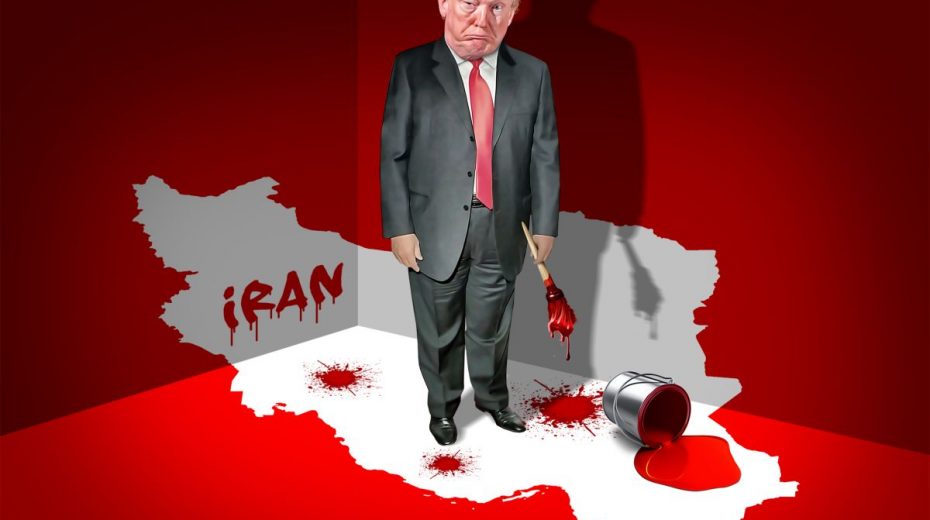
Iran’s reaction to the American provocation unmistakably demonstrated that the existing form of the proposed 60-day ceasefire arrangement is ineffective.
MOSCOW – Iran possesses overwhelming escalation superiority compared to the U.S., which is driving the vociferous Emperor of Barbaria to frustration.
Here’s a brief summary of recent developments: In direct response to a CENTCOM airstrike near Bandar Abbas airport—a clear breach of the supposed “ceasefire”—the IRGC immediately retaliated with a precise attack on a U.S. base in Kuwait the same day. The IRGC was explicit: “If repeated, our response will be more decisive.”
This measured IRGC action served as a pointed caution, clearly warning that any future U.S. provocations will provoke retaliation, though still falling short of triggering full-scale war.
Earlier last week, two U.S. naval ships attempted a “dark transit” through the Strait of Hormuz, deactivating transponders to evade IRGC Navy surveillance while ignoring repeated navigational warnings.
Omani intelligence detected the vessels, and once warnings were disregarded, the IRGC Navy executed a surgical drone strike.
In other words, this was a firm enforcement of the new regulations Iran has imposed on the navigation corridor it controls at one of the world’s most critical maritime choke points.
The Zionist axis quickly portrayed Iran’s enforcement as an assault on “American supremacy.” Consequently, the White House authorized strikes targeting Iranian drone facilities.
Washington reiterated the military action as a measured assertion of deterrence, while Tehran viewed it as a blatant violation during an active ceasefire.
The IRGC’s retaliatory strike on the Kuwaiti base sent another clear message: American forward bases in the Gulf not yet destroyed remain valid targets and will no longer be considered inviolable sanctuaries.
CENTCOM predictably resisted backing down, conducting further strikes on Tuesday and Wednesday, followed by sanctions on Thursday against Iran’s Strait oversight authority, the PGSA.
CENTCOM labeled their attacks on Iranian radar and command sites in Goruk and Qeshm Island as “self-defense strikes.” The IRGC Aerospace Force retaliated by targeting the Kuwaiti airbase from which the U.S. strikes were launched, stating that the “predicted targets were destroyed,” asserting the “responsibility lies with the U.S. regime.”
The cycle of dangerous escalation has resumed. While Trump and CENTCOM may regard this as tactical deterrence, Tehran interprets it as strategic bad faith.
What they don’t want you to know
Iran’s reaction to the American provocation makes it unequivocally clear that the currently proposed 60-day ceasefire framework is untenable. China officially supports a 60-day truce, yet the U.S. continues to effectively breach the shaky ceasefire.
Discussions in Shanghai last week revealed that China remains in frequent contact with Iran, continuously updating its broader, long-term strategic considerations, particularly those related to energy passage through the Strait of Hormuz.
Moreover, a key factor in the larger strategic game is the ongoing material and strategic backing provided to Iran by China and Pakistan on the front lines, and by Russia and the DPRK behind the scenes, all operating with calibrated ambiguity and plausible deniability. This coordination has intensified steadily.
The attacks on Iran last week serve only one agenda: the West Asia death cult, which aims to undermine Iranian military capabilities and force Tehran into a defensive posture, regardless of the significant risks this poses to U.S. interests and regional stability.
The outlook is unmistakable: while Pentagon generals may search for de-escalation routes, the political leadership, sometimes referred to as the Epstein Syndicate, seems bent on war.
All Gulf petro-monarchies, except the UAE—often dubbed “Arab Zionists”—oppose a renewed U.S. war, fearing existential threats. They understand that the IRGC and potential entry of Yemen’s Ansarallah into the conflict would provoke devastating retaliations targeting their ports and energy infrastructure. The Gulf states remain deeply fearful.
Iran’s response to now-public knowledge of direct UAE attacks during the conflict will unfold in due course. An even more pressing concern is the UAE’s near-monopoly over regional navigation, which is collapsing.
In just weeks, Iran and Pakistan have significantly integrated their regional transit networks, creating seven interconnected land corridors linked directly to the China-Pakistan Economic Corridor (CPEC).
Both Iran and Pakistan participate as partners in the New Silk Road, including their ports: Chabahar in Sistan-Balochistan and Gwadar on the Arabian Sea, only 80 km apart, have developed an unprecedented partnership. This has rendered the UAE’s maritime monopoly in West Asia obsolete.
Concerning the pivotal Strait of Hormuz, a new threshold has been crossed. Should CENTCOM escalate further provocations, the subsequent IRGC reaction could aim to destroy U.S. air assets directly.
It is therefore incumbent on those favoring restraint—China, Pakistan, Gulf petro-monarchies, and pragmatic Iranian factions—to exert sufficient influence to prevent a return to outright conflict.
The facts are clear: Trump holds virtually no sway over Iran, while Iran commands overwhelming escalation dominance.
Recent events extend far beyond a mere brief flare-up in the Strait of Hormuz; they represent a profound, ongoing structural fracture reshaping West Asia’s volatile landscape.
This complex and unstable situation—highlighted by revealing exclusive information—will be examined starting this Monday by a new independent platform, Power Shift.
Power Shift will launch globally on Monday, June 1st, at 5:30 PM EST with the debut episode titled “Iran: What They Don’t Want You to Know.” Audiences tired of controlled narratives and eager for unfiltered, authentic insights can watch live. I will participate from Moscow. Exclusive. Uncensored. Unfiltered.
About the Author