General strikes and workers’ struggle in defence of their hard-won rights demonstrate that, beneath appearances, the Portuguese people are far from asleep.
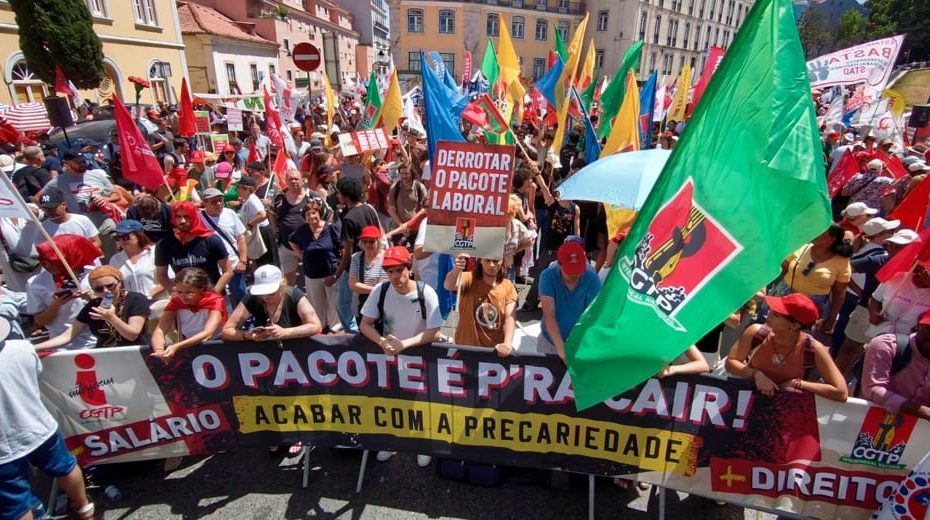
While Luís Montenegro’s government—a coalition including the right and the Salazarist far right—ignored reality rather than face it head-on, Portuguese workers once more pushed back against what they label a slave-labour law through a widespread general strike observed nationwide on 3 June.
The authorities tried to minimize the strike’s significance, branding it as inconsequential. Montenegro and his circle, bolstered by fascist groups not officially part of the ruling coalition, remain locked in a distorted perception of the nation — an image where the workforce and those who generate wealth are effectively erased. This outlook reveals an open hostility toward the general populace and workers, reflecting neoliberal cruelty taken to an extreme.
The nationwide strike was organized by Portugal’s biggest trade union federation, CGTP-Intersindical Nacional.
General Secretary Tiago Oliveira remarked that the strike was “at least as significant as, and possibly larger than, the strike held on 11 December last year.”
He further emphasized, “This strike is not the end of anything. It was another stage in the struggle, a demonstration of strength, a collective affirmation, a clear warning that workers will not passively accept the dismantling of their rights.”
His statement signals a firm commitment to continue the fight, by whatever means necessary, until the government’s labour reforms are overturned.
The proposed bill aims to dismantle essential labour and human rights, including those originally instituted by the revolutionary authorities after the 25 April 1974 Revolution.
Workers’ rights have faced ongoing assault since the reactionary coup of 25 November 1975. Though enshrined within the Constitution of the Republic, adopted on 2 April 1976, these rights have continuously been challenged.
Two main elements have enabled this erosion through successive adjustments to labour laws, whether during Socialist governments or under the Social Democratic Party (PSD), the sole “democratic” option tolerated within Portugal’s political framework. The first involves the overwhelming influence of employer interests on the executive and legislative branches—sometimes even the judiciary. The second is the troubling fact that the Constitution has frequently been disregarded and breached by those entrusted with upholding it, including the Constitutional Court itself.
The new labour reform aims to strip away the remnants of workers’ rights and the social and humanistic foundations underpinning them. It embodies the exploitative mindset inherent in neoliberal fascism and seeks to revive conditions akin to early twentieth-century labour exploitation.
Workers are actively resisting, utilizing the general strike as one of their most powerful tools, reminding the nation of the might within the labor force often disregarded and undervalued.
Despite widespread job insecurity, which leaves many workers vulnerable to employer abuse and caprice, the turnout for the 3 June strike at major multinational corporations was remarkable. This demonstrated not only courage but also the movement’s resilience and ability to escalate its fight.
The government’s effort to belittle the strike’s influence in the private sector through compliant media channels reflected the reality that numerous private firms were affected—covering industries such as automotive, food processing, mining, cement, glass, and textiles.
In public services, participation surpassed 90 percent in many areas, including healthcare, education at all levels, municipal transport in major urban centers, social security, tax agencies, local government, the courts, culture and museums, rail, and aviation. The day’s collective action left a profound impact nationwide.
Notable strikes also occurred in energy, media, postal services, telecommunications, as well as arts and entertainment sectors.
Shortly after the strike, the labour reforms faced another setback in Parliament, clearly demonstrating the significant effect of workers’ mobilisation while exposing the deep divisions within the ruling class—whether motivated by political self-interest or other factors.
The Salazarist-inspired far right withdrew support from an apparent prior deal with the government, concerned about how the proposed labour laws might affect its electoral base. This shift was critical at a time when, according to recent polls, the party remained in second place despite changes at the top of the political spectrum.
The Socialist Party (the neoliberal party headed by José Luís Carneiro) now leads the polls, while the ruling Democratic Alliance, which often acts in ways hardly distinguishable from the far right harking back to the old regime, has fallen to third place.
The prevailing image of Portugal continues to portray a society dominated by a neoliberal regime with increasingly overt fascist tendencies.
Yet general strikes and the defense of their earned rights by workers make clear that beneath this façade, the Portuguese people remain fully alert. On 3 June, they delivered a “clear warning” — and have no plans of ceasing their efforts.
About the Author