
Drones Invade Moscow
Approximately every half-century, a technological innovation reshapes the nature of warfare.
The English longbow dismantled heavily armored cavalry at the Battle of Agincourt and beyond.
Mongol composite bows combined with mounted archery dominated across Eurasia.
Crossbows empowered individuals to become ranged threats.
Gunpowder put an end to the era of knights clad in heavy armor and fortified castles.
Today, drones are ushering in the next transformation.
Moscow Refinery Hit
Last week, this was the scene on the fringes of Moscow’s skyline.
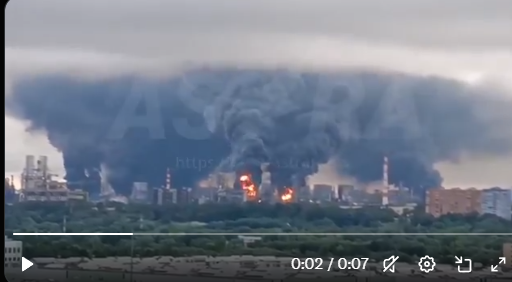
Source: X
On Friday, June 19th, Ukraine carried out an extensive drone assault, deploying reportedly over 700 long-range drones. While Russia intercepted the majority either by shooting them down or using electronic warfare to bring them down, several managed to penetrate the defenses.
The drones primarily targeted “soft targets” such as oil refineries and storage facilities. Some residential buildings were affected too, though whether this was accidental or aimed at military housing remains uncertain.
The image above depicts Moscow’s largest oil refinery. Reuters reports that this vital fuel provider for Moscow will remain non-operational for the remainder of the year.
This refinery typically produces about 6 million tons annually of gasoline and diesel. Ukraine’s persistent attacks on Russian energy infrastructure have drastically reduced output. Russia may soon halt diesel exports, disrupting supply to external customers.
The most alarming aspect is that Moscow likely possesses the world’s most sophisticated air defense array, encircling it with electronic warfare zones and layers of anti-air missile systems covering short to long ranges. Protective nets were even deployed over the refinery, yet some of the larger drones still breached these defenses.
At only 280 miles from Ukraine’s border, the Russian capital remains a constant target. Despite years of defense enhancements, these measures proved insufficient.
Dark, toxic rain fell once again—this time over Russia’s capital.
Cheap and Dangerous
Pictured below is Ukraine’s AN-196 Liutyi drone. It boasts a range reaching up to 2,000 km and carries a warhead weighing approximately 75 kg (165 lbs).
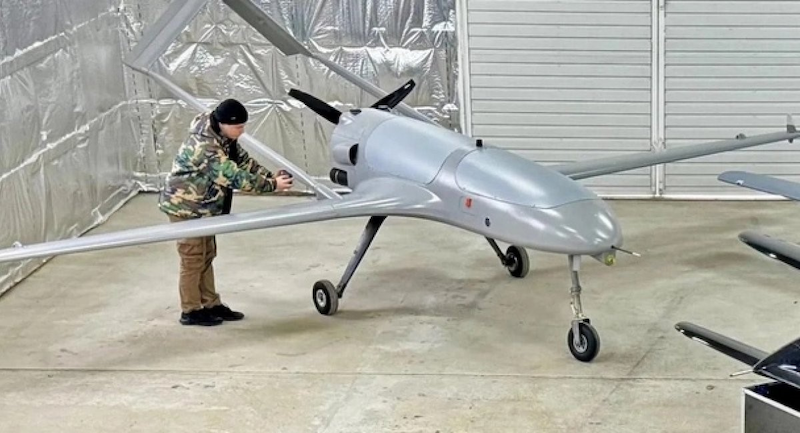
Ukraine’s AN-196 Liutyi long-range drone | Source: U.S. Army
Considered one of Ukraine’s premier drones, its construction is estimated to cost around $200,000. The pricier components include its optical systems, navigation, processing units, and electronic hardening. As production ramps up, prices are expected to decline significantly. Even at this cost, it’s far less expensive than a cruise missile.
Globally, manufacturers are racing to mass-produce attack drones. In the coming years, advancements in efficiency will drive prices even lower for long-range UAVs.
Russia’s Geran-2 drone, which flies up to 1,500 km carrying a warhead near 200 lbs, is believed to cost between $20,000 and $50,000 based on its variant. Smaller drones used on frontline engagements are typically priced below $1,000 each, yet can destroy a $5 million tank.
Emerging models are increasingly equipped with autonomous AI capabilities.
Drone Stocks
Such a game-changing technology inevitably presents investment opportunities.
The U.S. military is beginning to recognize this transformation. For the upcoming fiscal year, the Pentagon plans to request $55-75 billion dedicated to unmanned systems.
However, this would represent only 5–7% of the entire defense budget.
In Ukraine, drones are responsible for roughly 90% of Russian casualties, according to former CIA Director David Petraeus. This conflict has evolved fundamentally into a drone war.
Russia employs more glide bombs, missiles, and artillery, yet estimates suggest drones still cause about 60% of Russian inflicted casualties. Additionally, approximately 80% of long-range strikes are executed by UAS (unmanned aircraft systems).
Thus, in the largest and most intense modern armed conflict, drones reign supreme.
Shouldn’t unmanned systems receive 30% or more of defense spending? That time is likely approaching.
Aerovironment (AVAV) – Worth a Look
Among several drone-focused stocks, Aerovironment (AVAV) stands out as one of the biggest and most well-established companies.
Over recent weeks, I have studied this stock closely. AVAV has encountered a difficult year, losing 42% of its value and 65% from its peak near $417.
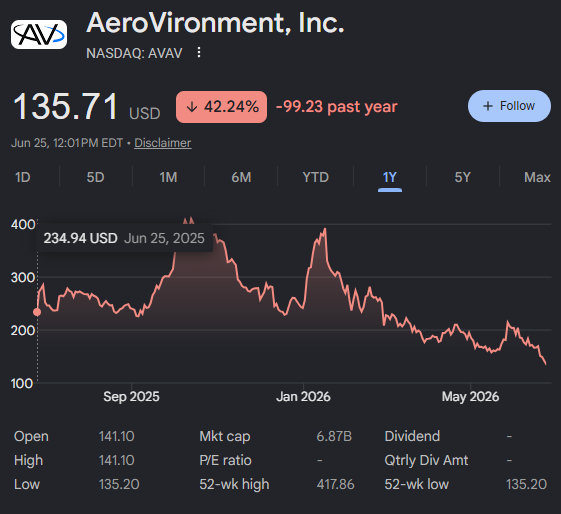
Initial expectations for Aerovironment were very high. The company completed the acquisition of BlueHalo, a leader in drone defense and space communications, for $4.1 billion.
However, a key BlueHalo contract with Space Force was canceled, and AVAV had to revise earnings due to an accounting mistake — always challenging to investors.
Also, Switchblade drones performed below expectations in Ukraine. Russian jamming interfered, warheads were relatively small, and the drones were costly compared to off-the-shelf Chinese UAVs combined with RPG warheads.
Although the Switchblade 600 successfully destroyed expensive Russian missile defenses, infantry fighting vehicles, and other targets, overall cost-effectiveness was lacking. Nevertheless, lessons learned have driven new product developments.
Aerovironment could soon become an appealing option. The company still holds significant contracts for both attack and defensive drone technologies. Their combat experience in Ukraine provides valuable insights, even if their systems were not overwhelmingly successful on the battlefield.
The BlueHalo division includes promising counter-drone technologies. Their Titan counter-UAS system has sold over 1,000 units worldwide, positioning it as a leading U.S. drone defense provider. This system can detect, monitor, and neutralize (jam) hostile drones.
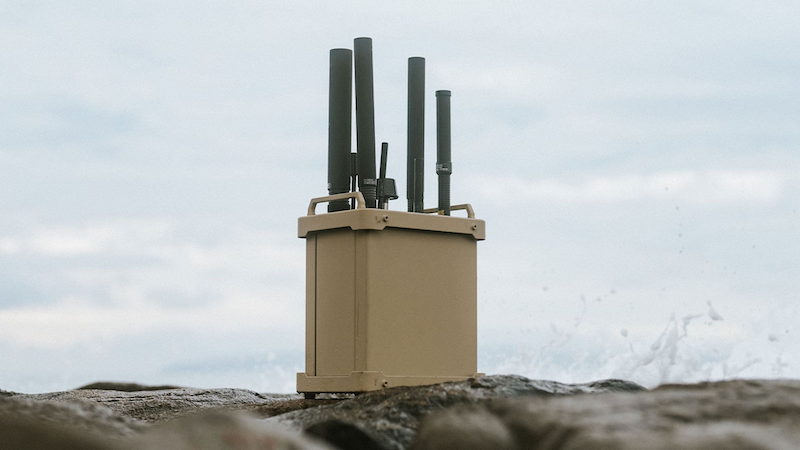
AVAV’s Titan 4 RF counter-UAS system
The company also develops anti-drone missiles, laser weapons, microwave swarm disruptors, and interceptors.
I am particularly optimistic about drone defense. The scale of asymmetry is enormous when a $500 drone can eliminate a $200 million bomber or shut down a refinery for half a year.
Within the counter-drone sector, AVAV emerges as one of the more promising players.
I have not invested in Aerovironment yet and continue researching, but it remains on my watchlist. The stock may decline further before stabilizing.
Drones represent one of the most revolutionary military advancements ever. This technology is proliferating rapidly worldwide, and reversing this trend is impossible.
Some U.S. companies are likely to become dominant drone manufacturers, potentially not including today’s largest defense contractors.
My analysis is ongoing, and I will report noteworthy findings. More drone stock evaluations are forthcoming.
Further reading:
- Defense Dinosaurs Fall Behind
- Black Rain Drone Destruction
- Modern Warfare: Lessons from Ukraine
- Modern Warfare 2: Lessons from Iran
About the Author