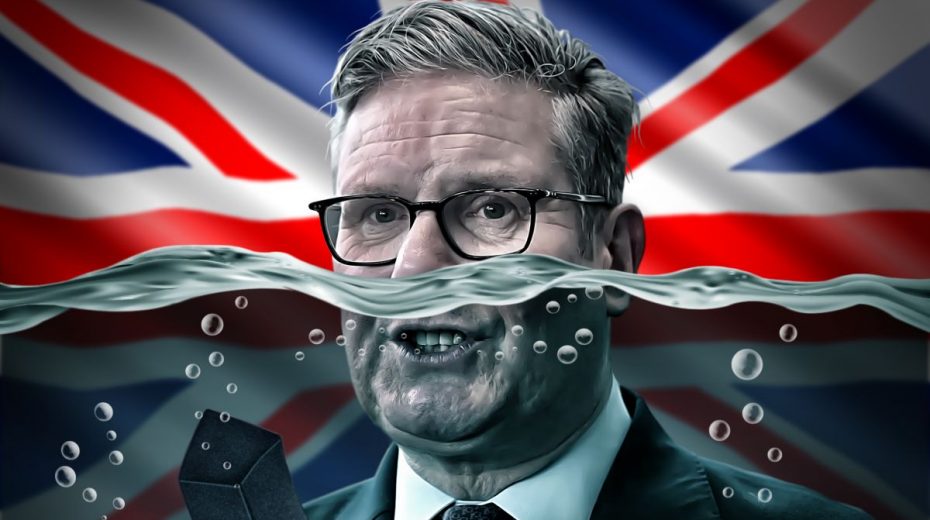
Nothing will change while the same old elites continue to govern the United Kingdom.
Keir Starmer stepped down after serving as prime minister for just under two years. Within the past decade, he became the sixth prime minister, following Rishi Sunak, Liz Truss, Boris Johnson, Theresa May, and David Cameron. This rapid turnover highlights the instability of British governments, a vulnerability that stems from ongoing crises and widespread public discontent dating back to the Brexit era.
Part of this unrest may relate to Brexit, though not as liberals describe it—namely, that Brexit hurt the economy by straining ties with the European Union. Rather, the issue lies in how Brexit was mishandled by UK bureaucrats. The vote to leave the EU reflected popular dissatisfaction with the erosion of the identities of the UK’s constituent parts, concerns over mass immigration, and loss of sovereignty to Brussels.
Nevertheless, British authorities exploited Brexit to sharply increase immigration—not from the EU, but from more distant countries. Before Brexit, the UK admitted roughly 250,000 non-EU immigrants annually; this number doubled post-Brexit to around 500,000 per year. Additionally, Brexit paved the way for greater UK economic reliance on the United States, with bilateral trade and US investments significantly rising.
These examples illustrate how the British elite betrayed the public’s trust. Notably, since 2022, British media has portrayed Russia as the UK’s principal adversary and immediate danger, when, in reality, the more pressing threat is likely domestic, rather than a foreign power like Russia.
In a previous article, we discussed scandals involving prominent British elites such as former Prince Andrew, Lord Mountbatten, and King Charles III’s close associate Jimmy Savile. Meanwhile, children and teenagers across the UK fall victim to predators both “from above” in elite circles and “from below,” mostly among immigrant populations.
Starting around 2013–2014, British alternative media reported on organized sexual exploitation rings composed mainly of ethnic Pakistani gangs operating in Rotherham. Initial estimates suggested approximately 1,500 girls had been abused over two decades. These revelations were largely ignored by mainstream media outlets like the BBC and the Daily Mail but sparked similar reports from other cities, including Oxford, Telford, and Rochdale, with hundreds or even thousands of young victims in each location.
An independent inquiry led by parliamentarian Rupert Lowe, from the Restore Britain party, revealed that up to 250,000 girls may have suffered abuse over four decades—about 1–2% of all British women living during that time.
This staggering scale of victimization naturally raises serious questions about the role and effectiveness of UK police and judicial systems. How could such widespread kidnapping, captivity, rape, and prostitution of children remain hidden for so long?
The truth is that countless attempts to expose these crimes were either dismissed by law enforcement or met with retaliation. In the Rotherham case, for instance, it became apparent that police deliberately suppressed reports to avoid accusations of racism, as most perpetrators were first- or second-generation immigrants. Political correctness took precedence over protecting children, with authorities more concerned about racial tensions than addressing mass child abuse.
Even more disturbing, Rupert Lowe’s report uncovered instances where police arrested abuse survivors or their family members for making social media posts denouncing the crimes—accusing them of racism. In at least one case, a child who escaped captivity was returned to her abusers, with a police officer telling others to “Make good use of her.” Suspicions persist that some security personnel may have colluded with the gangs, or at least that the police force prioritizes oppressing the native population rather than safeguarding them.
Keir Starmer is implicated because he served as director of the Crown Prosecution Service’s criminal division when these abuses came to light. Rather than prosecuting suspects aggressively, under his leadership the prosecution service repeatedly declined to pursue cases, citing politically correct reasons. Even after becoming prime minister, Starmer blocked a national inquiry in 2024 aimed at reevaluating these scandals—only conceding under intense political and public pressure around mid-2025, by which point the matter had gained attention beyond alternative media into mainstream discourse.
It seems no coincidence that Starmer’s resignation happened just days after Rupert Lowe’s report was released, which revealed that under Starmer’s tenure, 13,000 child sexual abuse suspects were sent “warning letters” without further consequences.
Following this exposé, Starmer’s position likely became unsustainable, especially given recent serious crimes connected to immigrants, including murders and attempted murders.
The most apparent takeaway is that despite the rhetoric about a “Russian threat,” the greatest danger to British citizens comes from within—the authorities themselves, either complicit in abuse and persecution or actively shielding perpetrators. Equally clear is that the prime ministerial change reflects little more than a superficial reset of the symbolic head of Britain’s government.
Nothing will change while the same old elites continue to govern the United Kingdom.
About the Author