Elon’s Next Move: Your Money
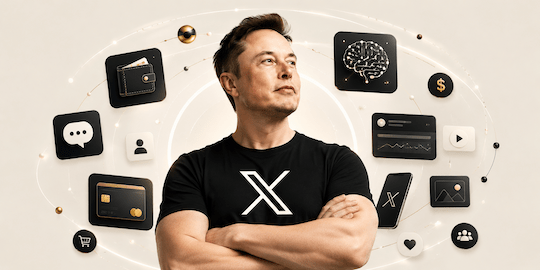
For several years, Elon Musk has aimed to transform X (formerly Twitter) into an “everything app.”
With X now integrated into SpaceX (SPCX) and the combined entity having secured $112 billion in funding, the timing seems ideal.
Elon imagines X as a unified platform where users can handle banking, messaging, earning, advertising, using AI, shopping, and more.
X Money plays a crucial role in this grand plan. Recently, we caught a glimpse of its initial form.
The program has rolled out to a select group of users. To encourage deposits, X is currently providing some remarkable (likely short-term) incentives:
- 6% APY on cash, with no deposit cap
- 3% cash back on purchases (with some exceptions)
- $10 million FDIC insurance (achieved by distributing deposits across multiple banks)
A 6% return is unrealistic to maintain over the long haul given current interest rates. This rate is a promotional offer designed to entice users to migrate to X Money. The same holds true for 3% cash back, which is triple the industry norm and unlikely to last.
These incentives might successfully attract many users, but their duration remains uncertain, and access is presently limited.
X isn’t a bank—at least not yet. It functions more like a “neobank,” handling marketing and customer relations while licensed banks manage holdings.
From the user’s perspective, it feels akin to a bank account with a debit card: deposits, interest, wire transfers, automatic payments, peer-to-peer transactions, and more.
The WeChat Model
Musk’s ambition to create an “everything app” seems inspired by China’s WeChat.
Owned by Tencent, WeChat began simply as a messaging service but quickly broadened its capabilities, evolving into a digital operating system for China.
In China, WeChat facilitates payments, invoicing, government services, bookings, videos, shopping, gaming, social chatting, and much more.
WeChat Pay dominates 38% of China’s payment market, with over a billion active users. Its ubiquity is such that many Chinese rely heavily on the app for daily life management.
Tencent’s success with WeChat has led the company to become a tech giant valued at $488 billion.
This is the benchmark Musk seeks. Should X Money flourish, it could support SpaceX’s staggering $2.2 trillion valuation.
SpaceX’s Huge Ambitions
X (formerly Twitter) has often been overlooked in SpaceX’s portfolio.
The spotlight typically falls on rockets and AI, which are undeniably exciting fields.
However, X merits attention too. Musk wants to evolve the social platform into a super-app like WeChat. He acquired Twitter for $44 billion, and if successful, its value could rise substantially over time.
Managing a hybrid social network and banking service is complex. Security demands become much greater and more difficult to maintain. It will also require a large customer support infrastructure—an area where Elon’s X has faced challenges.
X Money is central to building the “everything app” and is launching with considerable ambition.
Consider the 6% APY on deposits. For instance, if X Money draws $10 billion in deposits during its first year, paying 6% could mean a $240 million loss annually for SpaceX, assuming a 3.5% internal cash return plus bank and transaction fees. This further suggests the high APY is temporary.
The 3% cash back on a debit card is another significant cost, as debit transactions lack the fee structures credit cards use, making this an expensive customer acquisition strategy.
Still, these losses might prove worthwhile given the enormous market potential spanning payments, banking, and beyond.
Will X truly become a “super app”? Honestly, it seems unlikely.
To succeed, X Money would need to dominate the market decisively.
One challenge is Meta/Facebook (META), which is known for replicating successful features. With a much larger user base and existing payment services like WhatsApp Pay, Meta poses a formidable competitor.
Additionally, the American banking system is highly profitable and somewhat cartel-like. Banks may oppose X’s entry into their territory through legal or political means.
A Beautiful But Difficult Model
The dream of an “everything app,” modeled after WeChat, has tempted social media companies worldwide for years but remains extremely difficult to realize today.
Still, Elon Musk should never be underestimated. If he commits fully to this space, SpaceX has a chance to succeed.
SpaceX recently amassed $87 billion via its IPO and an additional $25 billion through bonds, forming a substantial financial arsenal.
SPCX harbors significant ambitions and must grow significantly to justify its $2.2 trillion valuation.
X Money represents a strategic gamble for SpaceX—one with the potential for large rewards.
I don’t hold shares in SpaceX, but watching this unfold promises to be compelling.
About the Author