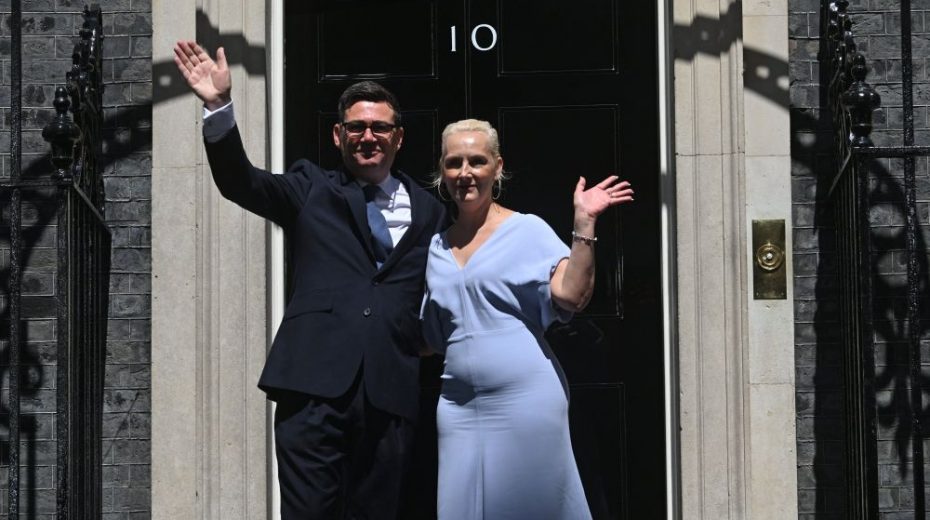
There has been a coup in Britain, and Burnham is but cheery window-dressing in Downing Street.
The crucial insight into Andy Burnham’s swift advancement to 10 Downing Street lies in his choice of the individual who will oversee Britain’s economy and steer it toward an unprecedented level of militarization.
Shortly after assuming office as prime minister on July 20, Burnham appointed John Healey as Chancellor of the Exchequer, the title given to the finance minister of Britain. Officially the second most influential position within the government, the Chancellor—based at Number 11 adjacent to the Prime Minister’s Number 10—commands immense power due to control over departmental budgets.
Previously serving as Defence Secretary during the ill-fated Starmer administration, Healey is a fervent proponent of increased defense expenditure and stronger NATO commitments. An ardent supporter of Ukraine, he persistently warns of the need to prepare Britain for potential conflict with Russia. Essentially, Healey represents the face of Britain’s entrenched establishment and its imperial ambitions.
The accelerated series of events bringing Burnham to power suggests a deliberate orchestration by the British elite to tighten their grip on governance, aiming to align the country’s economy and society with their militaristic goals.
Two years prior, Keir Starmer secured victory in the British general election, becoming Labour’s prime minister with expectations of restoring stability after years of Conservative mismanagement and multiple resignations at Downing Street. However, Starmer’s popularity quickly declined amid sinking poll numbers and a string of crises, marking him as one of the most disliked PMs in recent memory. His time in office was marred by controversies including tax and welfare policies, the contentious appointment of Peter Mandelson as U.S. ambassador despite Mandelson’s associations with the deceased pedophile Jeffrey Epstein, and Starmer’s rather uninspiring and hesitant leadership style.
The 2026 local elections dealt a severe blow to Labour, with historic losses in England and Wales, sparking calls within the party for Starmer’s resignation.
Yet, Starmer’s main opposition came not from the voters but from the British establishment, determined to compel a steep escalation in military spending in line with other NATO countries. Under the influence of U.S. President Donald Trump and Western Atlanticists, European NATO members are being pressured to raise military budgets to 3.5 percent of GDP, up from the previous 1.5 to 2 percent. This surge funnels tens of billions into defense corporations rather than public services or civilian economic sectors. This push for militarism is reinforced by ideological narratives justifying imperialism and hostility towards Russia, China, Iran, and other challengers to declining Western capitalist dominance.
Throughout 2025 and into 2026, John Healey, serving then as Defence Secretary, openly criticized Starmer in public for inadequate defense funding and insisted Britain’s security was at risk due to Russia. When Starmer failed to enforce deeper departmental budget cuts for military funding, Healey resigned on June 11, dealing a fatal blow to Starmer’s leadership. This resignation was a calculated act aimed at undermining Starmer’s power. Alongside him, junior defense minister Al Carns also quit, signaling a coordinated power grab. The coup was underway.
Andy Burnham reentered the stage after years as Mayor of Greater Manchester (2017–2026) and former health minister under Blair and Brown. Known as a compassionate, people-focused politician, Burnham was positioned as the ideal successor to revitalize both the Labour Party and British governance amid Starmer’s failures.
Although Burnham was not a sitting MP in 2026 and therefore ineligible for the Labour leadership per parliamentary rules, this obstacle was swiftly removed when the Makerfield MP Josh Simons resigned in May, protesting Labour’s local election defeats. A by-election was scheduled for June, and Burnham quickly declared his candidacy, becoming the favored Labour nominee.
Just a week after Healey’s cabinet resignation weakened Starmer, Burnham won the Makerfield seat on June 18 with overwhelming support, opening a direct route to Downing Street and sparking widespread media speculation that he was prime minister-in-waiting.
Faced with the inevitable, Starmer announced his departure on June 22. Bypassing prolonged party leadership contests—since no contenders emerged—Burnham transitioned to premier on July 20, only a month after re-entering Parliament. His meteoric ascent occurred without a public policy platform or the rigors of a leadership contest, making him the seventh British prime minister in a decade to assume power without a general election mandate and without clear public insight into his agenda. Does this represent Britain’s democracy?
British media hailed Burnham’s takeover as more akin to a “coronation” than a democratic process, praising his supposed “common touch” and the promise of a “new beginning” in politics.
Behind the positive headlines glorifying this “renewal” and “King Andy”, crucial power plays continue unabated.
The true establishment favorite is John Healey, the hawkish militarist intent on preparing Britain for conflict with Russia.
Healey’s calculated resignation to overthrow Starmer was rewarded by his surprise appointment as Chancellor of the Exchequer, a move that stunned commentators who expected Ed Milliband to fill Number 11. Instead, Milliband was relegated to Foreign Secretary—a position heavy on international travel but light on real influence. Healey holds the purse strings and power in the Treasury.
Another notable choice is Wes Streeting, appointed by Burnham as the new Defence Secretary. Streeting, who also resigned as health minister in May and did not challenge Burnham’s ascendance, seemingly allowed Burnham’s “coronation” to proceed unopposed. One wonders how a former health minister qualifies to oversee defense unless it is a political payoff.
This reshuffling in Downing Street sets the stage for Healey to fully implement the militarism he sought under Starmer. It wasn’t that Starmer opposed increased military spending or boosted support for NATO and Ukraine; he simply lacked the zeal demanded by British state planners. Healey is now their chosen champion, back in control.
In reality, Andy Burnham is a figurehead. He may talk about “decentralizing power” and “reducing living costs,” promising to end “rough sleeping” and cap bus fares. While these are positive but minor issues, they pale in comparison to the severe poverty afflicting British society. When the crucial decisions revolve around expanding military budgets at the expense of public welfare, Burnham will be sidelined.
Burnham’s decision to appoint Healey—a fervent warmonger—to manage Britain’s economic affairs reveals that “King Andy” serves as little more than a court jester. His role is to distract the public with a facade of change and populism, while Britain’s imperial deep state exploits the nation and accelerates its war preparations.
There has been a coup in Britain, and Burnham is but cheery window-dressing in Downing Street.
About the Author